
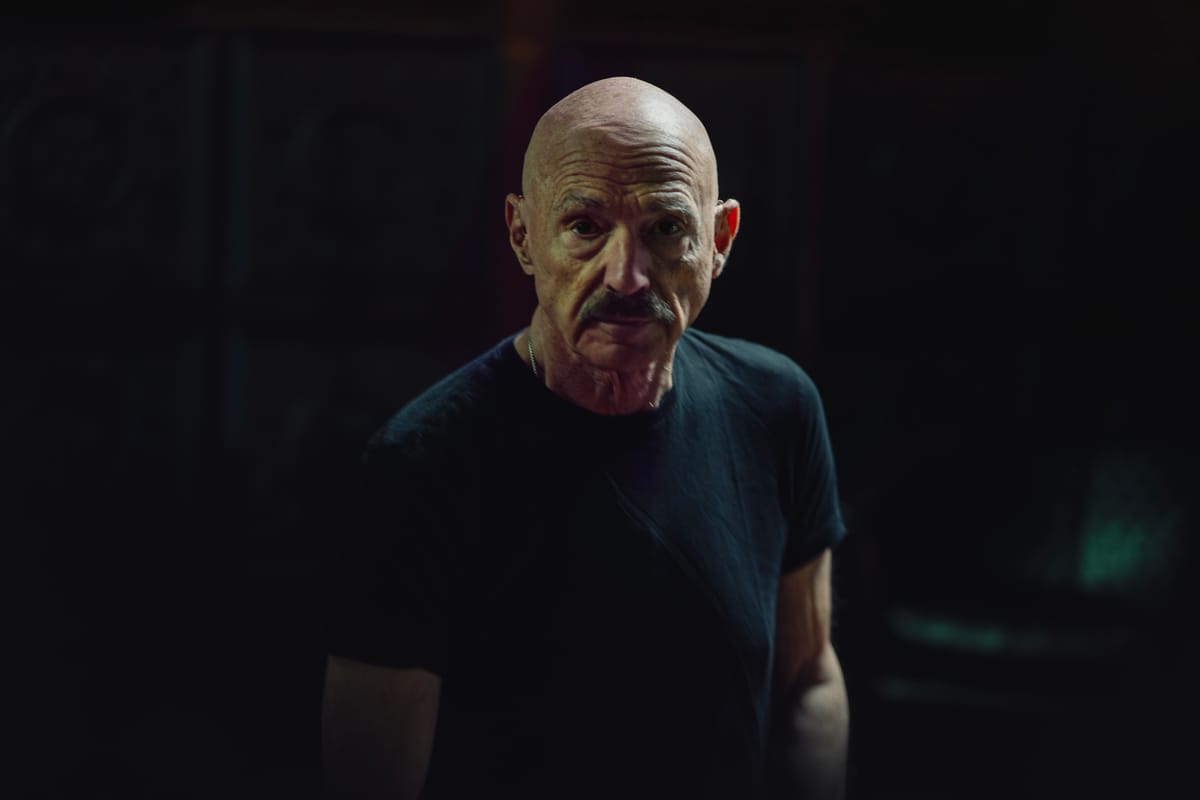
You have heard the bass playing of Tony Levin. To King Crimson and Peter Gabriel fans, Levin needs no introduction. To the uninitiated, there's not enough space here to print his discography. The music of Alice Cooper, Dire Straits, John Lennon, Tom Waits, Pink Floyd's A Momentary Lapse of Reason, the Liquid Tension Experiment supergroup, and countless others has been partially or fully embellished by Levin's bass.
Levin is one of the sticks – Chapman Stick, that is, an unusual stringed instrument that can handle bass and melodic parts – in Stick Men, a trio rounded out by drummer Pat Mastelotto (also of King Crimson, as well as Mr. Mister) and touch guitarist Markus Reuter. Stick Men's new album, Let’s THRAK Again, is out now, and it's their first LP in a decade.
TND's Tyler Roland spoke to Levin on his two big goings-on this year – Stick Men and stellar Crimson offshoot BEAT – plus a handful of other topics.
This interview has been edited for length and clarity.
Tyler @ TND: The new album Let's THRAK Again comes ten years after Stick Men's last [2016's Prog Noir], and the title references King Crimson's 1995 album THRAK, which was that outfit's first in eleven years. King Crimson moved from four to six players in that evolution; what’s the biggest change in Stick Men from album to album here?
Tony Levin: That's a very good question. It feels like we're always evolving slowly. I think we have our voice, our way of writing, and we have our unusual sound from Pat Mastelotto, me, and Markus. Our sounds are changing some, but we have our defining way we are. I love that that's different than other bands. The way we really evolve the most is in finding ways to compose our new material. Used to be we'd get together in a room, back before COVID; partly, because Markus is based in Germany, we had to find other ways to do it. Trading files, everybody does that, that's fine. But we have... they're files, but they're not files. They leave a lot of room for the other players to recompose the piece and to add their own voice. Half of [the compositions] are contributions from all three of us, though done remotely and surprising the other players,. So in that sense, I think we are evolving. I do feel this album is a little more powerful than albums we've done before, but it is still our voice. It still sounds like Stick Men.
This "Thrakery" arrives in close proximity to the last BEAT run, which will have a bit of '90s material [THRAK being KC's only '90s album] worked into the set. Are those two decisions related? Why has that been given a new look-over by both ensembles?
First of all, I heard that too. I say that jokingly, because I'm not sure what we're going to do. The day after the Stick Men tour ends, we begin rehearsing in L.A. That's when I'll find out for sure what Adrian's ideas are, and what we can work out amongst us. But yes, the plan is we're going to do some music from the THRAK era.
Is that related to this?
No, far from it. Would be a good story. I should lie and say "yeah, it's all tied together."
The piece "Let's THRAK Again" – I wrote the title, and then I wrote the beginning. In the [original] "THRAK," there is a counter-rhythm, seven against five. "THRAK" has a melody, but some of us referred to that counter-rhythm as "Thraking."
"Thraking" has other definitions; I've found that it means something different to every King Crimson member. Anyway, to me, "Thraking" meant playing this seven against five. I had the thought for Stick Men: "what if we began with that? A touch guitar can play two parts at once. What if I play the seven/five, and what if we wrote, for Markus, a 'Counter-thrak?'" So we did that. The piece seemed so new for us, even in harkening back, that we decided to name the album that.
My name for the track was actually "Let's THRAK Again Like We Did Last Summer." That refers to a [Chubby Checker] song called "Let's Twist Again Like We Did Last Summer," which couldn't be more different; it's simple stuff. That was the title we used for a while, until it came time to design the album cover, and all those words wouldn't fit! We shortened it to "Let's THRAK Again" and renamed the second song on the album "Like We Did Last Summer."
Pat and I, and Markus, are involved in a summer camp, a musical camp every year that celebrates King Crimson music and brings people together who are progressive rock lovers. [Note from Tyler: I've attended several times. It’s a blast!] "Let's THRAK Again Like We Did Last Summer" was a reference to the camp: Let’s get together and go wild, the way we did last summer.
The record has "Reel One" and "Reel Two" variants, with different running orders, mixes, and so on. Who had that idea?
Markus. In any band, different people handle different aspects. Like, I book the hotels, and I plan some things. Markus takes the album when we're done and chooses how to mix it, and how to approach the release. He's realized that in this day and age, you can do a lot more, as Peter Gabriel does [on 2023's I/O and his upcoming record O\I] – having two mixers do very different versions of the piece. I think I picked a running order, and he picked a running order. Really, it's two albums that have something in common, but they are quite different.
I can't speak more to the details – I'm just a guy who listened to it and said "yes, that's a great idea."
What's the story behind "Haggin Triptych," a suite that owes itself to three pieces of artwork on a museum's walls?
We played many times at that wonderful museum [Haggin in Stockton, CA]. They did an exhibition of my photos a few years ago. We're really familiar with that place.
It's not set up as a venue, but they began having shows with Stick Men. It's not the best acoustics, because it's a museum room with this fantastic, gigantic painting behind you. Backstage is another room with a whole bunch of paintings. The last time I was there, I thought "well, we're all familiar with 'Pictures at an Exhibition.' What if I began a version of that? Pick three of their paintings – some famous, some not so famous – and did some Stick Men music on that?" They're not progressive style, they're much quieter and more classical than what we usually do. Pretty much what I composed stayed.
They're much shorter than the songs we do live. On one version of the album, they're together as a triptych, as they were designed to be. On the other one, they're separate, which makes it completely different experience. Anyway, they don't suit our live show – to do a two-minute, quiet little thing. We could do it, and we might do it in the future, but this tour we decided not to.
One thing we're consistent about is stepping outside the usual, but still keeping the essence of what we are.
It’s kind of funny that I'm interviewing you now, because my last interview for this website was Melissa Auf der Maur. She, like you, is a bass player with a decades-long affinity for photography. I'm going to flip a question I asked her for you, which is: I feel like playing bass and taking pictures are art forms that benefit from blending in in just the right way. Is there anything from photography you took over to bass or vice-versa?
Very good question. Very intelligent idea. One that I haven't thought about before. And I'm always like, what? An interview question I haven't had before?
They're different in more ways than they're similar. I love making music up and doing it my whole life; it is what I was born to do. Music is wonderful and then it's gone, maybe that's part of the magic. Yeah, you can record it, but it's not the same. Anyone who's been to a concert that was great knows listening to the music is different than being at that concert experience, that two hours. It's wonderful and then it's gone. The photographer, it's the opposite – you have the moment. It's not a couple of hours. You planned it (or you didn't plan it) and then it lives forever. You can hold a picture up.
I've been shooting [since] when it was film. As it changed to digital, I made the only mistake [of] my photographic career: I changed to digital too early when it was low-res. There's about five years of my pictures that are just too small. Anyway, as I got more into digital, I embraced it.
I came from that era when bass sounds were completely analog – the bass would go into a DI, and then it would go through a board of analog equipment, and then it would go into tape. As it got more digital, I accepted it, but I started hearing the differences and appreciating that [we] need to be very careful. If you jump on digital technology too early, it could end up sounding dated a few years later. I went through that adventure and [got] a digital signal path on bass.
With my photography, I embrace some of the same techniques, like compression. The bass I compress a little more than half the time; compression I do on a lot of my photos, not all. Then there's distortion. I somewhat learned from my bass technique the ability, or the desire, to tinker with the photo, and make it look the way I want, instead of the way it happens to look, using compression and distortion.
There's a value to analog. I still have the old analog bass, that signal path, and I still have the film camera. I don't use it much lately, but I can. Having the old film exactly the way it was, like the old signal path to tape, is very valuable, and special in itself.
BEAT has got Terry Bozzio taking the place of Danny Carey. You've done a lot of studio stuff with Pat Mastelotto in Stick Men and Crimson, and you've done studio work with Bozzio as well. But with Danny, as far as I know, you haven't played any in-studio stuff with him until you appeared on a couple of Puscifer tracks, one of which was "Seven One," which has Danny on it. [Check out the TND interview with Puscifer's Carina Round from that release cycle here.] How did that come about?
Personally not great. They sent me the files. I played bass in my home studio, and only later I found out that Danny's on it. I played on a few tracks, but I really enjoyed the track you mentioned. Sometimes you just react to something musically and don't worry about whose it is, where it's going, and what's going to happen in the future. That's kind of what music is for.
Frankly, I think I was busy when I got a bunch of tracks from Maynard, and I didn't even play on them all [at first]. It took me a while, but then I sent them back, and I didn't follow up and ask "what's going to happen with this?" until I heard they're going on the road and the album's out. That's the only studio work that I've done with Danny.
That surprises me.
Well, we're both pretty experienced at the less-than-ideal situation of being in the studio alone, not with the other guy you would like to be there – would've been great to be together, but it just didn't work out that way.
Well, thanks for clearing that up. I was curious about that.
And let me mention: it's going to be wild being back with Terry. I've done a lot of live playing with him, and a lot of studio albums, but very different material than what we're going to be doing this time, and we're all waiting for that first rehearsal. I know it's going to be great – probably not easy to sort out the kinks of how it will go, but we're all excited about that, and we're all very pleased. It'll be wild when we actually get in front of people and do it.
I've been surprised more than once by hearing about your appearance on some song I've known for years, like that Alice Cooper track "Welcome to My Nightmare," or a Tom Waits song. You've been in a lot of recording sessions, and I want to know: what's one recording session from history you wish you were a part of?
Wow! Good question. I'm just going to say... Hendrix.
You can't go wrong with Hendrix.
Yeah, well, you could go deaf!
The more complete answer, maybe less concise, is that whenever I hear really good music – maybe any bass player is this way – I'm appreciating the bass playing and the bass part; a part of me wishes I had been there and doing that.
Stick Men's Let's THRAK Again is out now. Grab it here and catch them on the road at the following dates:
09/14 Seattle, WA @ Hidden Hall
09/15 Portland, OR @ Starlight Patio & Lounge at the Star Theater
09/16 Eugene, OR @ Wow Hall
09/17 Corvallis, OR @ Whiteside Theatre
09/19 Stockton, CA @ Haggin Museum
09/20 Santa Cruz, CA @ UCSC Music Center
09/21 Petaluma, CA @ Mystic Theatre
09/22 Pacifica, CA @ Winters Tavern
09/24 Los Angeles, CA @ The Baked Potato
09/25 Los Angeles, CA @ The Baked Potato
09/27 Escondido, CA @ California Center for the Arts
09/29 Phoenix, AZ @ Walter Studios
09/30 Tucson, AZ @ La Rosa
And check out two bonus questions that wrapped up the conversation below, which were suggested by Tony's bandmates Adrian Belew and Pat Mastelotto.