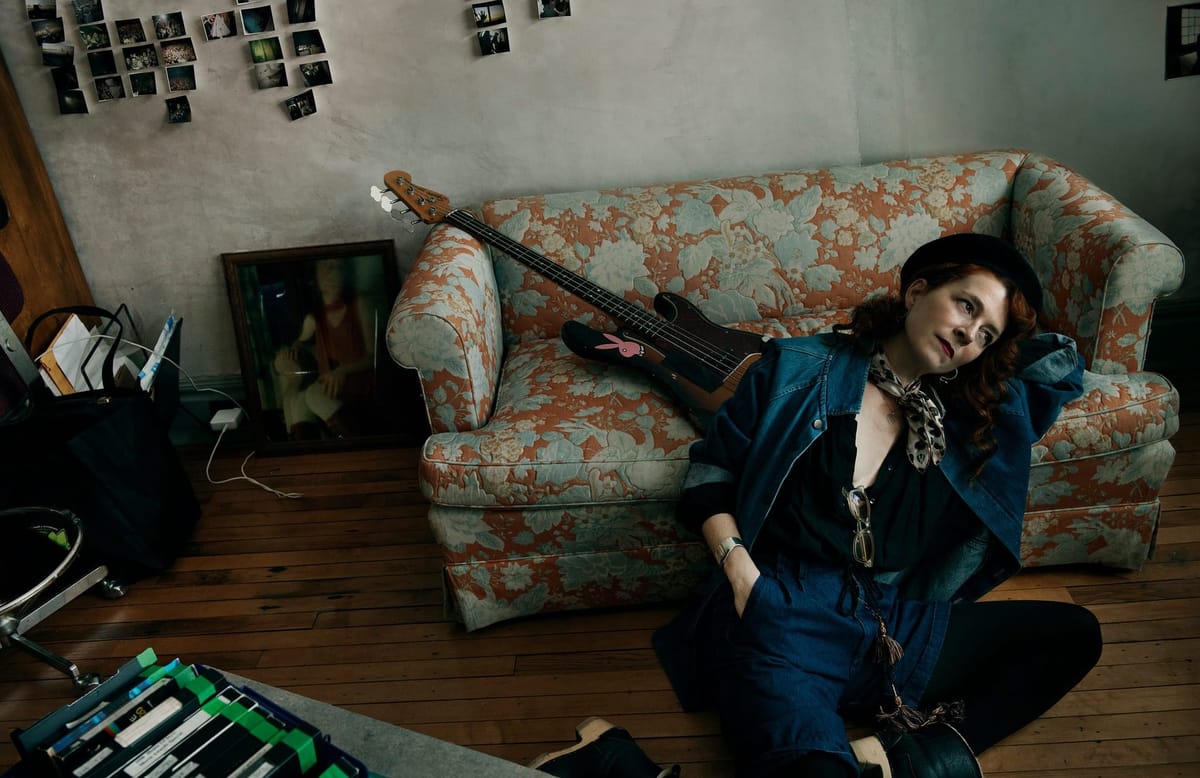
Melissa Auf der Maur is one of the defining women of '90s rock music. She put aside her blooming photography career in order to play bass in two major bands, Hole and Smashing Pumpkins. She also released two solo albums in 2004 and 2010, but has dedicated her time to Basilica Hudson, her art center in New York, since then. Earlier this year, Auf der Maur released a memoir, Even the Good Girls Will Cry.
She never dropped her love of picture-taking, and Auf der Maur now has a photography exhibition set to open at the Art Gallery of Ontario, My '90s Rock Photographs, on September 2. A photo book will accompany the exhibit and will release on September 8, but perhaps the bigger story is her first new music in 15 years, coming out on September 4. BASS WOMB ROOM: My '90s 4-Track Demos x Field Recordings blends period self-recorded audio experiments with new interludes.
TND's Tyler Roland talked to Auf der Maur about the exhibit, her episode of Geddy Lee's miniseries "Are Bass Players Human Too?," and her obscure side project Constant Comment – which Roland learned about through her recent chat with Nardwuar.
This interview has been edited for length and clarity.
Tyler @ TND: This is a follow-up to the memoir you did, Even the Good Girls Will Cry. Something tells me it's not coincidental to have those two very confessional, reflective projects back to back. Do you think that the energy that went into your memoir inspired this project?
Melissa Auf der Maur: It all happened simultaneously. Four or five years ago, on the eve of turning 50 and my daughter turning ten, I had a lightning bolt of "oh shit, I've got to unpack the 90s." My daughter was raised by a mother who had devoted herself to music, who she never saw play music. I didn't want to be on the road as a mother, so I quit music and founded an art center, Basilica Hudson. I realized ten years into that new journey that I had gone running from the '90s and never really looked at it.
Even the Good Girls Will Cry is more than a '90s rock memoir. It's about coming into womanhood during the last analog decade. My father died of cancer at the peak of my success with Hole – I joined in the wake of Kurt's death and Kristen [Pfaff, original bass player]’s death. Then, when I joined the Pumpkins, D'Arcy (the original member) had gone M.I.A., due to what seemed like mental illness. My journey in the '90s was bathed in pain and power. I'm like, "What did we fucking witness?" The memoir I set out to do as the mission statement of what I saw.
Photography is my first love. I was in the dark room taking photos way before I was playing bass. I went to university with a serious plan to be a fine art photographer. When I was invited to join Hole, my initial response was "No, I'm going to do my master's in photography at RISD."
During the last decade of the 20th century, I accumulated 15,000 photographs. When I joined these rock bands, I became determined to be the one to capture our story – the woman in the band, not the girlfriend of the guy in the band, not a guy outside the band. I photographed every audience I ever played to while also documenting everything backstage, hotel rooms, existential moments of "what the fuck am I doing?" – also the exciting parts. I was a tourist, a documentarian, and a self-reflective photographer. Those 15,000 photographs were burning a hole in my psyche.
I heard that, yeah, the number of photos totals around 15,000, and this exhibit you have coming up is 200 or so.
The photo book has about 220. I went from being a fine art photographer to joining a band and having to rely on snapshots and one-hour photo services on the road. In the exhibit, we have blown-up, big versions of my photos, and glass cabinets running along the wall, where I have dozens and dozens of my snapshot photos.
Did it take a lot of agony to shave off…?
Oh my God, impossible. I mean, writing my memoir was no problem. I downloaded it from pure memory, and I'm completely convinced I was able to because I photographed and kept a diary every day. My memoir was written so quickly and easily, and I never even referred to my diaries or my photos. When we dove into the photos, I started scanning and getting photo students to come in and scan. Then, I got a proper archivist who set up the whole system.
The curators and editors of the book have looked at more of the archive than me, because I fucking hate looking at screens, so the only thing I can do is move physical pictures around and make sequences. The archivists and the curators have had to comb through these thousands of photos in a computer program called Lightroom.
I knew what my reoccurring angles were – the audience from the stage, Courtney from the back facing the audience, backstage, me and the band, me alone in hotel rooms, me in mirrors, interstitial — like, Mount Fuji from a train window. I had the archivist tag the images, so the curators are able to go in and seek, like, "Self-Portrait" or "Melissa With Person." I have this section of the book called "Fellow Travelers," which is every time I'd meet someone exciting, like Beck, Danny DeVito, Christina Ricci, Claire Danes, or Gabby Hoffman.
My dream is to make the archive more of a living, breathing thing, like library archives, for other people to create stuff out of. By the end of 2026, I'm going to be so done looking at my life through the '90s.
For the eight new interludes you put together for the new music collection, were you inspired by the '90s road life or your more current ties to the idyllic, picturesque Hudson New York?
In my memoir, I tell the dream I had about three-dimensional sound, which I think was a message from another realm, spirits or aliens. It told me I had to make music to connect with the human race in this lifetime. So I founded Basilica Hudson, a giant, reclaimed 1880s industrial factory, with the dream of it being a temple of sound inspired by my dream. For ten years, I immersed myself in drone music.
When I went back into the studio last year to envision a sound for my exhibit, I wanted to bring this more ethereal, esoteric soundtrack. It is a strange hybrid of my 21st-century self, honoring music as a sonic frequency of connectivity, as well as my '90s demos, which were like myself in the 21st century. I was just experimenting with tape sounds and keyboards and stream-of-consciousness.
I wasn't planning on using my four-track demos until, all of a sudden, it was like "wait a second, those are the audio archives of my time in the '90s." I connected them with these interstitial ambient tracks. I wanted to make the last room an ode to my bass and an ode to the audience – an immersive sound and video installation. Bass is the heartbeat that brought me to the people, the audience.
As I was archiving all my crazy '90s stuff, I came across endless handicam videos; I would put the video on my bass amp. The crowd sound alone, just the roar of the Pumpkins show in Seoul on July 4, felt like ambient, weird sonic art. I started using these field recordings as an audio tapestry to connect the main tracks. My demos, at the time, were like garbage in my mind – "oh, I'm learning how to use a four-track. I'm just going to pick up a guitar. I'm going to use my dictaphone and sample something, and I'm going to try to build a tapestry." The soundtrack is a weird hybrid of all of it.
You're talking about the four-track aspect of the music. I was rewatching that interview you did with Nardwuar a little while ago and you mentioned, at one point, a side hustle you had. I think it was called Constant Comment.
Yes. It was so fucking...wait, did he mention it? Yes, he did. The bass, drums, and cassette.
What are the chances that material sees the light of day, would you ever look into that?
Sympathy for the Record Industry put ["Fire Crasher," their only released track] out as a 7." I wanted to include it on the soundtrack, but guess what? I fucking sampled shit. That was a lot of what I was doing, sampling. I have a huge collection of vinyl from the '50s through '80s of strange radio bloopers, moon landings, of course. The Constant Comment project was me, [Hole drummer] Patty [Schemel], and our third member of the band was a DAT cassette tape that we called… what the fuck was his name? It was, like, Radioshack, I don't know. I feel so stupid. Nardwuar remembers, of course. [Note from Tyler: I rewatched that part of the interview and yes, the tape was named "Radioshack."]
It was only one song?
No, we had a whole set. It was me on bass and samples, and Patty on drums. We took it on the road, we played a lesbian festival in Seattle and we played the Commodore Club in Vancouver. We recorded only one track because Sympathy for the Record Industry was doing a split 7" with another girl rock band called Red Aunts and asked whether we'd want to contribute with our side project. That 7" is going to be in my exhibit. I wanted to include the song, but it was polluted with samples I took from a radio blooper. There's a copyright issue, but you can hear it on YouTube. I guess we can't release that. Patty and I only have a few photos of our shows and that one song.
Nothing would stop me and Patty from playing a weird drum-bass noise project again. It is of that era. A lot of the tracks in the Bass Womb Room are of that moment when I was experimenting in the studio.
Speaking of experimentation, I watched your episode on the Geddy Lee miniseries, "Are Bass Players Human Too?" There was this one sequence – I think it's the defining part of the whole episode – where you're guiding your bass around to make feedback with the amp.
What's so cool about that bass episode – other than I got to become friends with Geddy Lee – is he visited three different men [Primus ringleader Les Claypool, Nirvana's Krist Novoselic, and Metallica's Rob Trujillo; Auf der Maur was the only woman]. He spent a week with me. It ends with the bass jam, and I was very clear with the producers: "I have not played my bass in ten years. I am not a virtuoso bass player, but of course I'm not going to say no to Geddy Lee on a private jam in my art space." I told Geddy that whole week, "I'm very vulnerable. Like, I don't know what I'm going to play."
For my 50th birthday, I asked my family to give me this semi-hollow bass because I had a drone music event I brought to Scandinavia, to Denmark, to Holland. I performed with other drone artists, and I borrowed a friend's semi-hollow bass – I discovered it made incredible feedback, really fucking cool drones, so I asked for it for my 50th birthday. When Geddy came, I said "how about this? You use my P Bass when I'm going to use my weird new bass."
At the end of the jam – Geddy said it off camera because he didn't want to insult the other bass players he had just jammed with – he said, "You claim that you're not a bass player, but this is the only jam I've had where you just played. The other guys showed me licks, talked about technique... you played, and you were in the sound." He said "you're a musician, and you should just be a musician."
All I've ever wanted to do is just be an artist, but I got hijacked for a long time in a giant machine, even for my solo records, which I'm very proud of...
...oh yeah, the first one [2004's Auf der Maur] no one seems to talk about. I dig it!
You know who talks about it? Everyone in Europe and the U.K. It's sold a lot in Germany and Italy. When I went on my memoir tour in Europe, there were as many solo music fans as there were Hole and Pumpkins fans.
Bass playing and photography: both art forms benefit from blending in in just the right way.
Thank you. I see a similarity.
Do you think that certain skills you picked up in one medium, in one art form, made their way into the other?
Definitely. Bass, I always say, is the mother of all instruments – she's observing the whole thing. The bass is the glue between the drums, the singer, the audience, the dynamics, the guitar playing, the riff. If there was a photographer in the band, it would be the bass player, because they are observing, they are receiving the outside world. So, yes, I think that it's not a coincidence that my two tools that I've used my whole life are a camera and a bass.
You refer to the '90s as "the last analog decade."
Yes.
What do you think the 2020s is the last decade of?
Humanity.
I plan on writing another book because I worship writing, and my next book is going to be [on my life from] 2010 to 2020. We are trans-human now, a hybrid of machines and humans. We're all hoping that the Roaring '20s would come back, but the Roaring '20s were an explosion of decadence into deep depression, as well as the Second World War. I think that the decade I became a mother and started an art center, which is what my second book will be, was the transition into the trans-human moment.
The last decade [saw] the final generation who were raised without completely being online, and now we are all tapped into the algorithms. I have faith in the human soul as a transcendental existence beyond the body, beyond the machine, and beyond the planet. In the '90s, I always thought I was out of step, out of time. I was not a bass player or a photographer; I was just a creative soul. As much as I have to complain about in the 21st century, I feel like the world is ready for the way that I saw things, which is: it's one creative expression, and it's not limited to this life, this body, and this medium. I wonder if I was three decades early and 300 years late – I think there is a renaissance coming.
I have always faith in the beauty of humanity, and I think that the more fucked up our planet and our society gets, the more beautiful certain souls can become.
Visit the Art Gallery of Ontario to see the exhibit, and look out for Melissa's soundtrack album, BASS WOMB ROOM: My '90s 4-Track Demos x Field Recordings, and photo book, both coming out in September. Find a Bandcamp preorder link for the music here.
What do you think?
Show comments / Leave a comment