

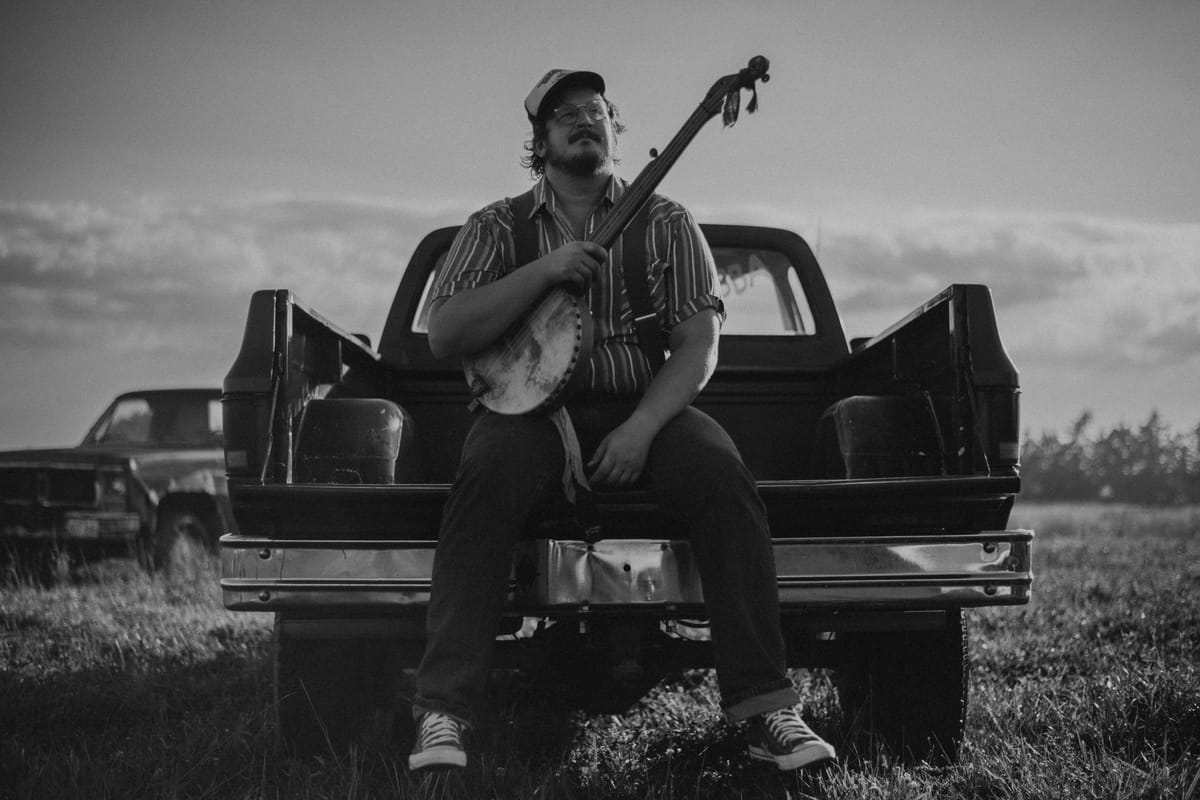
The excellent Arkansas-by-way-of-Kansas folksinger Willi Carlisle thrives on contradiction. His Tyler Childers-produced new album The Universal Bubba makes that more explicit than ever, drawing up characters that Americana music has never met before, even if plenty of actual middle Americans have. In two parts of the title track alone there’s a tenderqueer who likes target practice and a guitarist who favors anime and EyeHateGod.
But even before then, the gregarious giant sang of his unrequited lust for the nonbinary “Big Butt Billy” on last year’s Winged Victory, and the shockingly low-priced tour (tickets in Philly came out to $29 including tax! In 2025!) came complete with papier-mache props for his bandmates to dress the part. He also covered Richard Thompson’s “Beeswing” and Lavender Country’s waltz “Cryin’ These Cocksucking Tears” unearthed from before its time. He’s probably the most buzzed-about artist in some decades to have a polka in the repertoire.
On the new album, he mixes up his romantic tribulations in a hibachi metaphor on “Golden Dragon Buffet” and laments the big-guy blues on “Sadly Enormous.” The fictional tales are richer and the personal ones get more autobiographical. There’s just more of everything; it’s a double on vinyl.
Needless to say, he’s exactly the person I wanted to talk to following an Election Day that for once wasn’t deeply depressing. And he was game to explain some of his more evocative turns of phrase, such as the elusive “blues lawyer.”
This interview has been edited for length and clarity.
Daniel Aaron @ TND: Hey, Willi, how are you?
Willi Carlisle: I’m pretty good. Just picking up from Portland, Maine.
How are you feeling after Tuesday?
[Laughs.] Pretty, pretty good.
Yeah! Your native Kansas even came through, and it looks like you might even get a blue governor.
We’ve always known it in Kansas. There’s always been… y’know, the Catholics have always been more liberal than we thought. More than I think the rest of the nation thought out there. I heard the rumblings all the time when I was a kid. I had journalist grandparents. Thanks for caring; anytime somebody notices something about Kansas, all of us are like, ‘oh, thank you.’
What publications did your grandparents write for?
My grandfather wrote for the Wichita Eagle, and I guess my grandmother just, like, read his drafts and threw things at it. [Laughs.]
There’s no way an Election Day release week was accidental. Were you worried at all about how the outcome might have affected you when you were about to present this epic work?
Oh, you know. One, I’m a folksinger. What the fuck do I know about the algorithm? And two, this is the last week anybody can release a record in terms of [year-end stuff]. It’s about to be too late. I think we were just eager to do it and did it the moment that we could, and we were tightening things up until the last minute. So I don’t know, I’m happy to present more good news to the American public. [Laughs.]
It’s certainly making a song like “The Master’s Hammer” hit harder: “The world’s on fire and I’m here for it.”
I hope it doesn't all get buried. But then again, it's just not a game I know. It could be foolishness.
Do you know a few tenderqueers with semiautomatics?
Of course. Who doesn’t? I’m living my life right. I am lucky to know some subcultures that are on that weird line between anarchists and other kinds of far-left. And I find that those sorts of folks kind of complete the political circles. Where one side goes so far one direction, they come out the other a little bit.
There’s a meme that reads something like, “if you go far left enough, you get your guns back.”
I’ve always been fascinated by that. Places where the old kind of weird America is still alive.
Can you tell me what a “blues lawyer” is?
[Laughs.] Well, it’s a guy with a nice guitar who plays covers. It was a joke that we used to always tell when we were out on these long tours just playing background music in random bars, but we were always playing original songs. Me and the boys could always pull out a long set of covers if we had to. But for the most part, we were out there hustling our own work, burning CDs on our laptops and then selling them for five bucks, things like that. And frequently, we would be supplanted by blues lawyers, middle-aged guys with other careers who would come and rip pentatonic blues scales.
And usually, I found it unsexy and uninspiring and also really not risky. Even if our music cost a lot less to make and in some cases was a lot harder to listen to, I didn’t find much booty shake inside of those pentatonic scales. So I’ve been mad at them forever. And I’ve always wanted to yell that phrase into a microphone. I think my least favorite song in the world is “Sitting on Top of the World” because of those guys. Because every version sounds the same.
Blues is one of three very different genres you mention in that song [“The Universal Bubba Pt. 1”], along with reggaeton and grindcore. Not to mention anime and crypto. It feels very important to your music to show your reach and knowledge of different scenes and walks of life.
Well, so I’m a folksinger, and I think that there are some genres that are still folk even though they don't seem like it. A grindcore scene is literally held together by several people who are obsessed with something that is objectively hard to listen to. Right? Finding love and fellowship and exchanging kindness in a way that is still pretty radical. And I know that they don’t think of themselves as radical, but I do, because getting to travel the country all the time, you see less and less of that kind of individual strong taste and group solidarity amongst people.
So I think that genres that are still highly tied to the immigrant experience or to communities that share specific tastes can open up little pockets of real mental freedom inside the kind of homogenized hellscape that I’m currently gazing upon through my hotel window wherein I see a Chick-Fil-A, a Taco Bell, and a big box store.
I’ve never heard of grindcore being linked to the immigration experience before.
Oh, I meant to... the distinction there is that I said “or,” not “and.” Or specific communities.
Ah, that’s easier for me to grasp.
You don't know about the Brazilian grindcore scene, Dan? [Laughs.]
Is the purpose to pair these atypical lyrics and subjects with traditional music?
Yes, I intend it. Because I don’t want to just use the same old seeds if we’re gonna fertilize a new garden in this kind of music. I’m interested in all kinds of music, I just happen to be trained first as a folk singer. This album is as close to that word “Americana” as I’ve ever been, borrowing sounds from the last maybe 30 years of Americana music, maybe longer. It has a lot of traditional music aspects to it, and I guess American old-time music aspects to it. And I feel like I would be remiss to not include people from a lot of other traditions in that.
The Universal Bubba is out now on Signature Sounds.
What do you think?
Show comments / Leave a comment