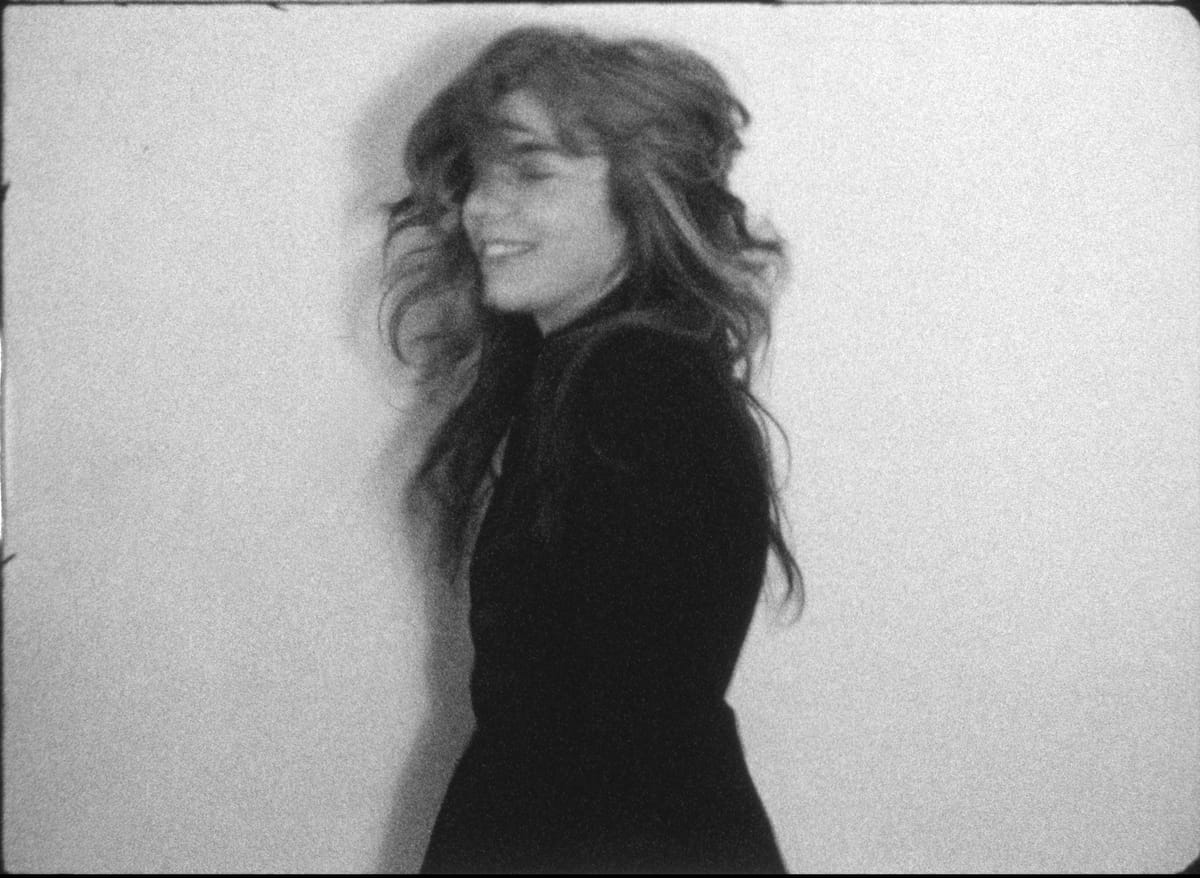
It's tempting to revere Julia Holter as a scholar or an academic, perched upon a mountain of books in the top floor of a library, or at the conductor's podium in a grand concert hall. With a background in musical composition and an MFA to boot, asking Holter anything feels like asking a college dean for help with your homework; she probably has more intellectual things to do.
But Holter is an artist's artist, grounded in her craft and engaged with art at eye-level. Although her creative projects are lofty and complex, such as live-scoring the 1928 silent film, The Passion of Joan of Arc, her approach is intuitive and improvisational. Despite dipping into textures, harmonies, and thematic materials that are grounds for scholarly discussion, the way she speaks about them are born from creative curiosity and genuine affection; there is no affectation or posturing when she talks about music, only a deep-seeded love for the art form.
On the heels of her 2024 album, Something in the Room She Moves, Holter returns in 2026 with Materia, a companion album inspired by the concepts, sentiments, and demos of Something in the Room She Moves. In it she explores the joy of improvisation, her love for her fellow musicians, and freedom of exploring uncharted musical landscapes.
In our conversation, Holter shares the instruments and inspirations that have propelled her new record, the education and ingenuity that inform her craft, and the habits and lessons that have influenced her artistry and technique across her creative career.
This interview has been edited for length and clarity.
Tony Le Calvez @ TND: I saw that you're a pretty big reader. Is that right?
Julia Holter: Actually, I wish I was more of a reader, but I do read sometimes, I guess I'd say. I need to read more for, like, my mental health, but I'm reading a few things. I'm reading this somewhat recent biography of Simone Forti, she's a dancer and movement artist. I'm reading her new biography. And I’ve been very curious about this for a while now, but finally looking at this, Eileen Myles edited this collection of texts on pathetic-ness: it's called Pathetic Literature. It’s just like a collection of different literature, from poems to prose, from all kinds of people, including a friend of mine (Mark So) and all kinds of famous people, young people, old people who are no longer alive, and it's just, like, a huge collection. So those two things are on my desk right now.
Do you do a lot of writing, at least like prose writing, outside of music?
No. I have in the past; I do not think I'm good at it, but I have enjoyed it in the past. I became interested in the act of writing poetry. I wouldn't say I was good at it, but, while I was in music school, and like, overwhelmed by music school, and like, the ‘music schoolness’ of it. So it was helpful to just turn to another medium, I guess I would say. But obviously there's a lot of overlap in terms of sound and rhythm and all that kind of stuff.
I feel like I got that conversation a lot with classmates in poetry workshops. They would talk about how all songwriting is poetry, and I was like, “eh, they're kind of two different beasts.”
No, they're totally different. It's weird how different they are. They are connected, but they're really different.
When it comes to writing music, what instrument do you go to first? What's the first tool you reach for when you want to write music?
I only play keyboard, and I sing, obviously. So I always write at the keyboard, although sometimes it depends on what I'm writing. I've also written for other instruments in more of a classical music mindset, so if I'm writing for violin, I can't write at the piano in quite the same way, obviously. I have to think about the anatomy of the violin and how to write for that. But generally, I write my songs at the keyboard. I'll sometimes turn on the recorder and just play keyboard and sing, and that's how I come up with ideas and improvise. I record myself a lot to capture the things that happen, and it can sometimes lead to the kind of wandering characteristic that some of my songs have.
How much do you balance between writing down on sheet music as opposed to recording the idea first?
It depends on what I'm writing. Sometimes I use notation to remember voicings I'm doing on the keyboard, or a specific order of notes, and stuff that's hard to capture. Other times I just record myself playing it and then I transcribe it later when I need to, mainly because I'm arranging it for other instruments and I'm trying to communicate it to a player or something.
How much do you think about texture in the composition process? Or is that something that comes later in the recording and mixing?
It depends on the song, but I think about it a lot and often. When I'm coming up with the song, I set up those layers just with MIDI, or just really basic synth sounds. It often is part of the writing process for me. It depends on the song, but the arrangement and production is very close to the writing process for me. I sometimes have trouble really conceiving of the song until I know how it's being arranged and produced. It's probably true of a lot of people who produce all their own music.
What kind of keyboard instrument are you using?
I have a few different keyboards, but I have my main one that I've used live ever since I started touring in 2012. It's the Nord Stage – mine is a Nord Stage 2. And that's really flexible and easy and it's light. I have the lighter one, not the heavy weighted one, which feels amazing to play, but it's very heavy. So I can play shows with this, and I can write on it. It has a decent piano sound.
I can use it as a MIDI controller, so sometimes I use it just as a MIDI controller in Logic. And MIDI is fun to improvise with because you can keep the performance and change it in different ways and capture things in the performance in an easy way. Whether I use it for the final product or not, it's a nice, easy way to know exactly what you played and capture it.
I was curious if you've worked with any analog synths, where you've got to patch in and plug in with all the cables and stuff.
Yeah, I do not know about modular synthesizers, really. My approach to synthesizers has always been: if I'm in a studio that has one, I record with it and I play it a few times, but I don't really know deeply about what I'm doing right. I like to play with that. And my favorite has always been, like, CS… Yamaha CS…80? Or Yamaha CS60, which is like this really special old synth Vangelis used in the Blade Runner soundtrack. And I love that synth so much, but it's very hard to find. I mean, it's very expensive and very elusive, but they've made Deckard's Dream, so I recently, finally, after years of wondering if I should get it, finally got it. A sweet used one, and it's really lovely. It's my first analog synth. It's pretty cool.
I get the impression that it's harder to find time to practice when you're a touring, working musician. Do you find that disciplined practice is still a part of your routine as a musician?
It's something I need to work on. I think that I am not very disciplined about certain things, and one of them is my piano skills. I haven't taken a piano lesson since I was like 20, maybe, or younger. And I am interested in building up my skills, but I certainly am not focused on that at all, I have to say. But I'm curious about it. I think I'm more concerned about, you know, having time to exercise or having time for some more fundamental things. I do practice with the band, but I feel that I've become much more of a rhythm keyboardist. I should work on my skills with a keyboard and work on it more so that I'm doing more polyphonic kind of textures on the keyboard. I also feel I could work on taking a voice lesson, which I haven't really done. I have done it a few times in my life, but I think it's important to take care of your voice and I just don't keep up. I've never warmed up my voice. I never do anything for my voice. I didn't come from a vocal training background, so I feel like I need to be more thoughtful. So maybe I need to work on that.
There's only so many hours in the day. It's hard to find time for everything.
I'm a musician, so, I mean, obviously I should prioritize that, but I think of myself more behind the scenes. I do perform, but I feel to be more of a writer behind the scenes or something like that, so I should work on my skills as a player. I haven't had a lot of jazz [lessons]. I did take jazz piano very briefly when I was younger, but that's also something I should do. That would be amazing. I always felt like, “oh, I'm not good at this.” But that doesn't matter. I enjoyed it a lot. I mean, I'm not good at classical piano either.
I was wondering how much music history you learned in school and just for fun, and then, how much that translates to what you're thinking about when you're composing music. Do you ever think about the wider context of music when composing, or are you just in your own lane, trying to explore the sounds in your head?
I did spend a certain amount of time as a student in music. And I also teach music. And at the same time when I study music theory to some extent and music history, yes. But when I'm writing, it's like I don't know anything. I mean, it's not true, though, but it feels that way. Obviously, we know the things we know and we have the good and the bad that comes with learning of certain traditions or whatever. And so that is part of me. And I think a lot of what comes out in my fingers is like, certain hand positions that I learned, and learning certain pieces, like a Debussy piece or a Beethoven Sonata, you know, like fundamental things that become fundamental in your learning that leave your hands to play in certain ways. So that comes through probably– certain habits. The certain habits that come through and you're like, almost not thinking, but my hands do. But in terms of thinking, I'm not thinking at all when I improvise to write.
I don't know if improvising is even the right word for it, but that's the easy way of calling it. If I'm just sitting and playing the keyboard there might be certain habits that come through from the past, but in terms of harmony, it's like anarchy. I'm just playing stuff that comes to mind, and patterns probably are emerging that I'm not thinking about. Tradition is helpful when it comes to developing the song, then I might start to think a little more. So I'll look at what came out kind of intuitively, and then say, “what could work here?” Even then, I don't think I'm thinking that much. I'm definitely not analyzing it in terms of what I learned in music theory. If you take beginning, like, early music theory, it's very basic, and it's kind of presented in this simplistic way that when you're a beginning student starting out, like, you think you're supposed to write that way. And it's not true.
So there can be a confusing thing when you first start taking music theory or whatever that you're supposed to write without parallel fifths, for example, or people have these things. But this is not true. It's a very specific context in which these rules were constructed, and they are within a specific realm, but it's not factored into my music. I don't think. But I mean... I have thought about the certain elements of, I would say, orchestration is really helpful or things like that have been helpful. And music theory was helpful in certain ways. Counterpoint: it can be really helpful, but not in a way that's easy to pinpoint. Like when I'm writing music, the notation comes in handy when it's time to transcribe something and communicate it to someone else, and that's also when the thinking comes in, and I have to analyze what kind of chord it is.
I watched your Joan of Arc project from a couple of years ago, where you scored the film [The Passion of Joan of Arc, Carl Theodor Dreyer, 1928] live. That's another spot where I was wondering how much the historical context was informing your decisions on where to go with the music.
I've been working more on that project, actually, so it's fresh in my mind. I took music from Joan of Arc's time period, which is early 15th century. She died in 1431, so she was like early-ish, first half of 15th century, I guess. I took relevant music from that time period, the chant from that time period, to use as material to make parts of the score. One of them actually, supposedly, was sung after one of Joan of Arc's triumphs in a town where she won a battle with soldiers that she was with, so like taking these relevant chants and building. I harmonize them. And then that became the material for the music. There's other material that I wrote that's like, not that. But a good amount of it is based in historical context. And then one of the others, I did this canon that's in the style of another canon from that time period. So that is definitely a situation where music history was helpful.
Can you talk me through what that research process looks like?
I mean, I'm not interpreting it like a scholar at all. There are people who do that, but I'm not a scholar. So I just found chants on the internet that were from her time period. I was not, like, reading medieval neumes or anything. I was just looking at chants. So it's Te Deum Laudamus, which is a well-known chant. And then, Ave Maris Stella is the other one. And Te Deum, I think, is the one that supposedly they were singing when [Joan] was riding in. But yeah, I wasn't going into the library, looking up medieval neumes and transcribing them into modern notation. I'm really not doing anything very scholarly.
This new project, Materia, is labeled as a “companion piece” to Something in the Room She Moves. iWhat made you want to explore those sounds and that project more?
There’s a lot of different reasons, but I just found myself making this song, “The Laugh Is in the Eyes,” at one point. One of the reasons is I was making this new song, in the middle of tours, and I thought it would be nice to make something new with the band that recorded Something in the Room She Moves with me, and also went on tour with me, and it would be a new song we could play live. So I had this new song, and I wanted it to be connected with everything we had been working on, so I pulled out a file from the demo making period of Something in the Room She Moves. And I just made a new song within it. I wasn't really using any material from Something in the Room She Moves, but I was trying to, and kind of playing with stuff, and then finally came up with something which I think was just using one of the MIDI drums I had used to write and record the demos for the songs on Something in the Room She Moves.
I came up with this beat for “The Laugh Is in the Eyes” that became the foundation for that song. So that was the starting point, was making that song, and recording it, which we did. Making that song was so fun, I kind of felt like, “oh, I'd like to do another song.” I also made the song “Fantasy,” which is like a song that kind of came out of this. It wasn't a very clear beginning to this project, but I would say making “The Laugh Is in the Eyes” was the starting point. And there was also an impetus on my part to extend “Materia” [which appeared on Something] and do something different with it, because there's a lot of stuff in it that I just wanted to try new things with.
Your last album had some intense themes; you were talking about grief and becoming a parent. Do you feel like a lot of those themes have also carried over into this project as well?
Yeah, I feel like poetically it's connected with that record.
Do you feel that way through musical cues, through themes, or through lyrics?
I think just the overall approach, which is very sensual, very emotional. I mean, a lot of my music is very emotion-focused, or sentiment-focused, rather than narrative, but I would say, especially Something in the Room She Moves, and I think this is as well. There's a little bit of narrative, I guess, but it feels sensual in the same realm, and it really has a lot of the same instrumental material, and, to me, the color palette is somewhat similar in certain ways.
Is there anything about this upcoming project that you were most excited for people to hear, but is there also something you're very excited about just personally? Like, a particular part of the process of making the record that was just fulfilling for you?
I don't know if I processed it yet. It really feels like with other records of mine I've made, they're starting their whole own world, and this one does feel connected to that last record, but it is definitely its own thing. I don't know if I know yet what it is, but I think it is different for me to talk about than my previous records, where I've started from a whole new focus. I feel really happy about it, and I think I like it. I don't know, sometimes I have a weird relationship with things I've finished, where I feel really intense about them or I can't stand them anymore, because that's a very natural thing artists have. It doesn't mean the work is bad. It just is a feeling one gets with the completion of a project, and I, for some reason, don't have that with this, so it's kind of a funny, calm, happy feeling I have about this record.
I'm still kind of getting to know it, though, and curious about it still, and I'm not sure if I really have an intention for others or like what I want them to experience. I think it definitely is a reflection of how much I love these musicians I work with. And it's another example of what great players they are and musicians and creative people. I love showcasing, like, Devra Hoff’s playing, her fretless bass melodies. I guess it's a mix of the band, and then there's actually quite a few solo improvisations that are straight from the original demos, like both “My Twin” and “Clepsydra” are improvisations, and most of the material that you hear is from, like a moment in time around 2020. I'm not a great improviser or anything, but I think there's something nice about those moments.
So it's kind of a mix of band, and then solo me in one record. I don't know if I've done something quite so hybrid like that, which maybe is interesting. I don't know if that's interesting or not. It also, in that way, reminds me a little of Ekstasis, which is a record of mine from 2012. I don't think it is related in an obvious way, but it has a similar feeling to me, but I don't know if that is going to be a thing other people feel.
Julia Holter's new album, Materia, is out August 21st, via Domino Records.
Preorder the album here.

What do you think?
Show comments / Leave a comment