
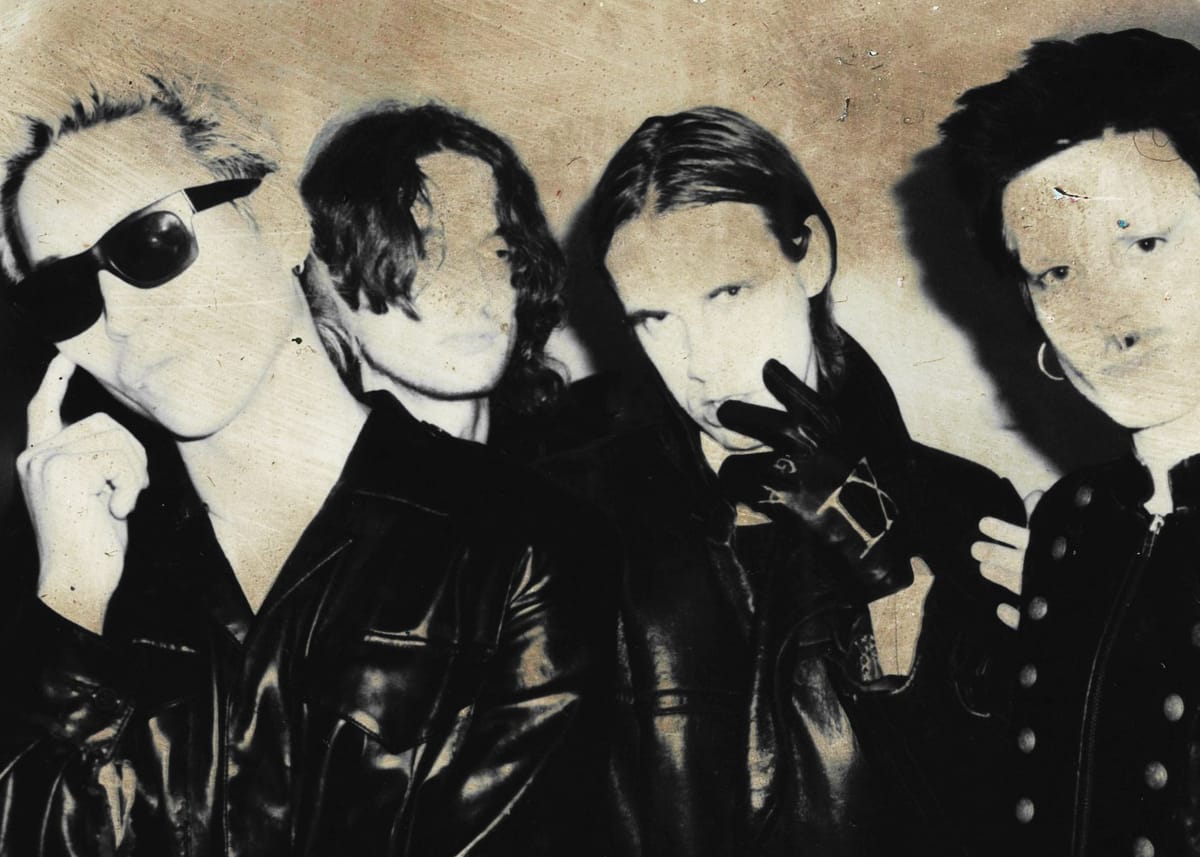
A band like HMLTD purposefully walks a step out of sync, sometimes to a location not even pinned on the map.
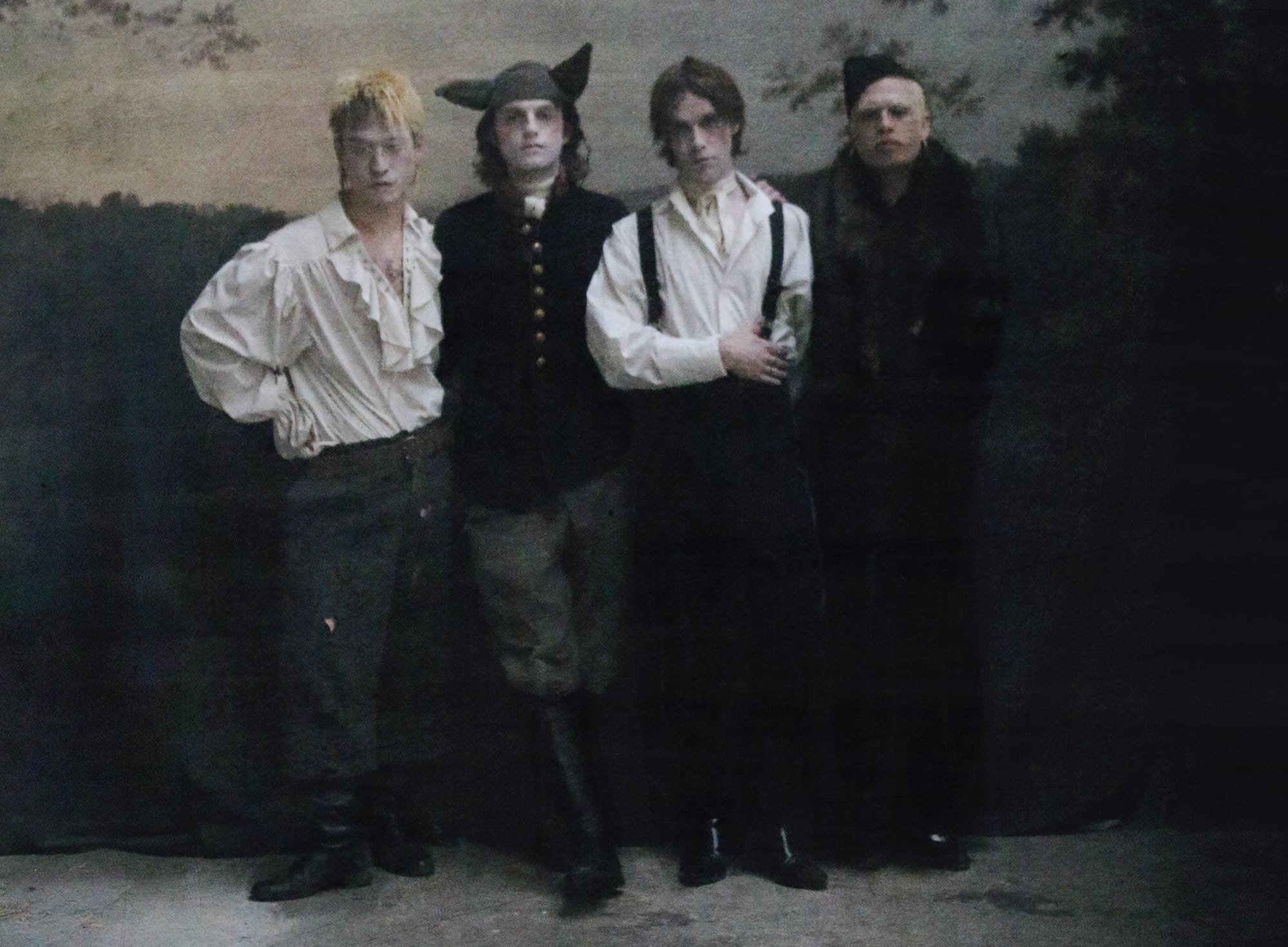
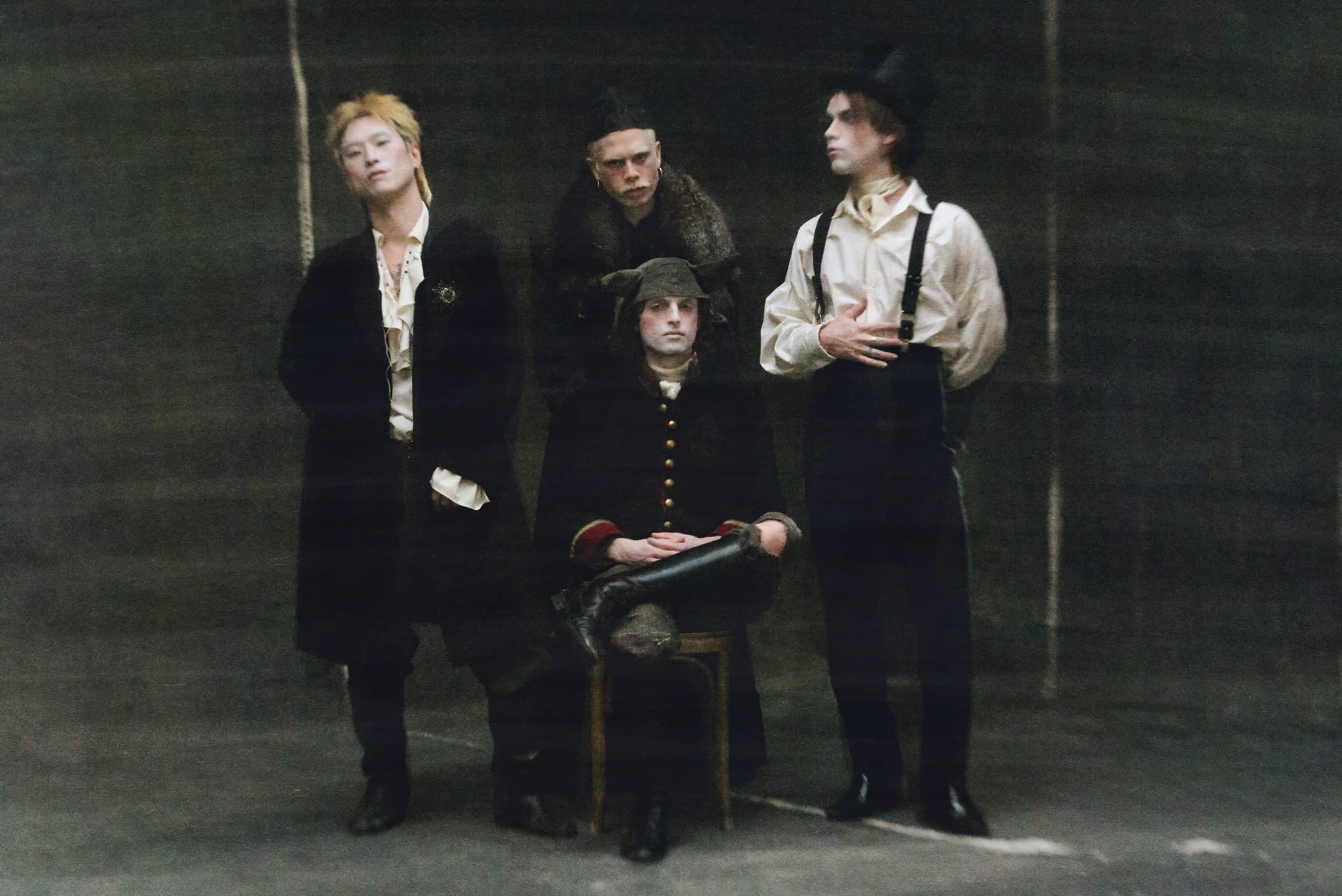
The London art punk collective, founded by Henry Spychalski and Duc Peterman and which now includes Andrei Martynchyk and Theo Spark, were, at some points in their career, art school freaks crafting the ultimate "pop band." The band's 2018 EP Hate Music Last Time Delete, a cool, new romantic-inspired synth punk raver, had the glamorous love songs and iconic stage presentation that could easily trap a Soft Cell and Depeche Mode fan, even if the lyrics sung of perverted romances with doll parts and photographs.
Both sides of HMLTD — the adventurous, tongue-in-cheek lyricism of Spychalski, which sometimes swung into the comical, as well as the glossy electronic pop production — exploded in their debut album West Of Eden in 2020. The first of many manifestos on the collapse of Western Civilization, the group riff on the pop tropes of cowboy western folk balladry ("The Ballad of Calamity James"), starry-eyed love songs ("Mikey's Song"), and vaudevillian showtunes ("Joanna" / "Where's Joanna?") to pronounce total decay.
HMLTD's unpredictability at the switch of each track kept them fun and enticing, even if their next project found edginess outside their cult fanbases' expectations. Their second album The Worm is, to me, a beautiful, absurd thing, windswept in the fantasy of a giant worm colonizing and eating London brick by brick as its residents scream in terror, get ripped from their lovers, and give into the madness. The prog rock leanings, the abandonment of hard-hitting industrial dance, and the structure of a rock opera exposed the theatrical side of the group's DNA festered (and thrived) in polarization.
But three years later, the band have emerged from the shadows with the new, vampire-themed, club-ready album FANGS, HMLTD's third record out today via Lucky Number.
They turn their focus back to revolutionary music — that which lights up one's eyes, makes a room go cold, and holds a mirror to an unrecognizable world.
In a conversation with The Needle Drop earlier this fall, Spychalski confidently declares that the Western world has once again lost its bearings to hyper-capitalism, consumerism, and humanity-erasing technology. As a response, he's bringing back the magic of the ancient dead. He's demanding gothic insurrection.
This interview has been edited for clarity and length.
Victoria @ TND: First, what’s been going on since The Worm? I know that the band has gone through a lineup change, as well as a return its synth punk roots from the Hate Music Last Time Delete EP, only more expanded. Did shuffling around evolve your understanding of the band as a collective rather than a traditional four-piece configuration?
Henry Spychalski (HMLTD): After The Worm we took a quick break from writing, and then at the start of 2024, we started working on a new album. We spent a whole year working on it; it was going to be called Where Is The Tunnel? This Must Be The Light. It was essentially a breakup album, and the whole thing was recorded live as a band, with just guitar, bass, vocals, drums. A stripped-back indie record to the max, basically.
We got to the end of the process, and we realized that we hated it. Although the songs were very good, I think, it was the kind of album that any band could have made in theory… in the sense that it didn't have any of the avant-garde experimentation, interesting production, or fusion of genres that make HMLTD unique. On top of that, the scrapped album was about a very traumatic period in my life; instead of feeling catharsis from the songs on that record, I was just reliving it every time I had to open my mouth and sing it. The idea of then going through a whole campaign of performing those songs live felt so terrifying and a bit of a death sentence.
Overall, we felt as though we strayed from our roots, so we wanted to return to that, and with those changes came to changes in personnel. We're now joined by Theo [Spark] and Andrei [Martynchyk], who had been playing live with us for a few years. They really helped to develop the new sound, which I think was trying to recapture what was originally interesting about HMLTD but updating it for the present moment.
I know that Theo came from the band Skinship, and Andrei from Silkarmour. What about their experiences from their other bands was attractive to you? What kind of dynamics and tastes did they bring to the collective?
Andrei is a few years younger than the rest of us; he has a lot of energy. I think the rest of us have become somewhat jaded in certain respects, whereas Andrei brings a youthful naïveté and playfulness. Equally important, he's an extremely talented producer. You hear that in Silkarmour: their songs have a novel and experimental approach to sound design and production, and Andrei really imbibes that in an incredible way. We all produced the album together, but Andrei has taken the lead for most of it. He’s also largely responsible for the move towards a more dance music-oriented direction.
I love Theo. He’s incredible at bringing energy and positivity. He is very charismatic and a true showman. He’s really brought a lot of that showmanship and flamboyancy, which is such an integral part of the HMLTD DNA.
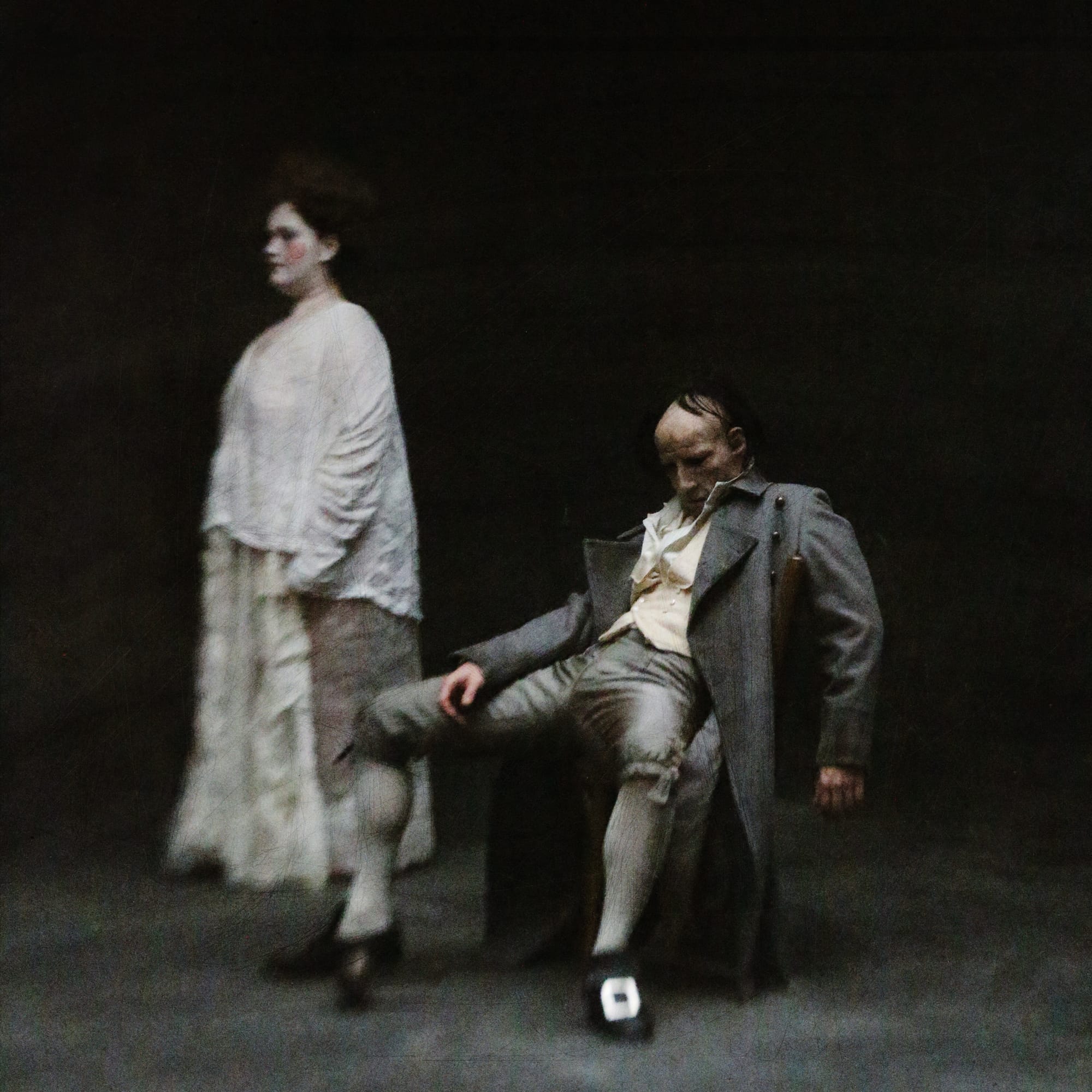
Speaking about flamboyancy and theatrics, the centerpiece of the album and a song I really wanted to talk about is “Château Vamp Freestyle.” It’s fantastic; the way that the vocal deliveries and vaudevillian piano drive the performance feels very much like The Worm in the sense of its creative wit. When so much of the record is dance, bloghouse, goth, and new romantic, how’d you come to center it on this very theatrical number?
The freestyle operates as an interlude moment. It starts with the sound of curtains opening, it ends with the sound of curtains closing, and it's meant to be an intermission in a vaudeville theatre piece or cabaret. I think it's such an integral part of our DNA. That’s influenced from Weimar-era Germany and the works of Bertolt Brecht and Kurt Weill. I think HMLTD always had a very humorous and tongue-in-cheek side, and we wanted to write something that was funny. At least to break up all the violence and anger.
It’s an interesting thing, in terms of what I listen to nowadays, where my musical influences tend to fall. They’re either stuff that's been made in the last five years or stuff that was made in the 1930s and before. For some reason, there's very little in between.
I sometimes hate it when artists take themselves too seriously. Like, at the end of the day, music should be fun, and some of my favorite music is music that makes me laugh. Especially when I was going through the traumatic breakup that I mentioned earlier, I found that music in general was so emotionally manipulative: you could listen to something really beautiful, and it would trigger you so deeply. For a good six months to a year, I must have stopped listening to music almost completely. The only way that I was able to start listening to music again was through artists that toed the line between music and comedy. Some of the Scott Walker adaptations of Jacques Brel songs, for example; the songs of Bertolt Brecht. More contemporary acts would include CHRIST DILLINGER, RXKNephew, and Jim E. Brown. Those were the artists that practically allowed me to listen to music again. So, for me it was important to have a track on the album that paid homage to that kind of art.
The part of the world building that roped me into FANGS immediately was the fact that you sent me a comprehensive influence list of literature, music, and film. It brought together a lot of vampire stories, but also a lot about death and the occult explored in 19th and early 20th Century sources. In order to create a futuristic sound and (in your own words) say, “The future is goth,” how did these old texts literary figures inform your vision of what you want the future to be?
Gothic horror emerged in the 19th Century as a direct response to the Enlightenment and this notion, belief, or confidence, even, that man had finally achieved mastery over the world. And the power of Gothic horror was to challenge that idea by reviving the ghosts of a buried past, reviving the occult magic and horror of the unknown that man believed he had banished. And I think in the 21st century, especially at this current moment, both with capitalism and the obvious presence of generative AI, I think we're once again moving into a dark age where confidence in the mastery that we once felt over the world has faded, and people once again feel as if they don't really understand how the world works.
Therefore, I think that it's high time to try and have a Gothic revival where we use these old concepts and resurrect these ideas of demons, witches, and vampires to try and understand the world around us. Because I think that's the power of mythology: when you can no longer understand reality or in a literal sense (which I don't think we can anymore), you then can turn to symbolism and occult magic as the only way of being able to explain and understand things. And so that's what we mean when we say that the future is goth.
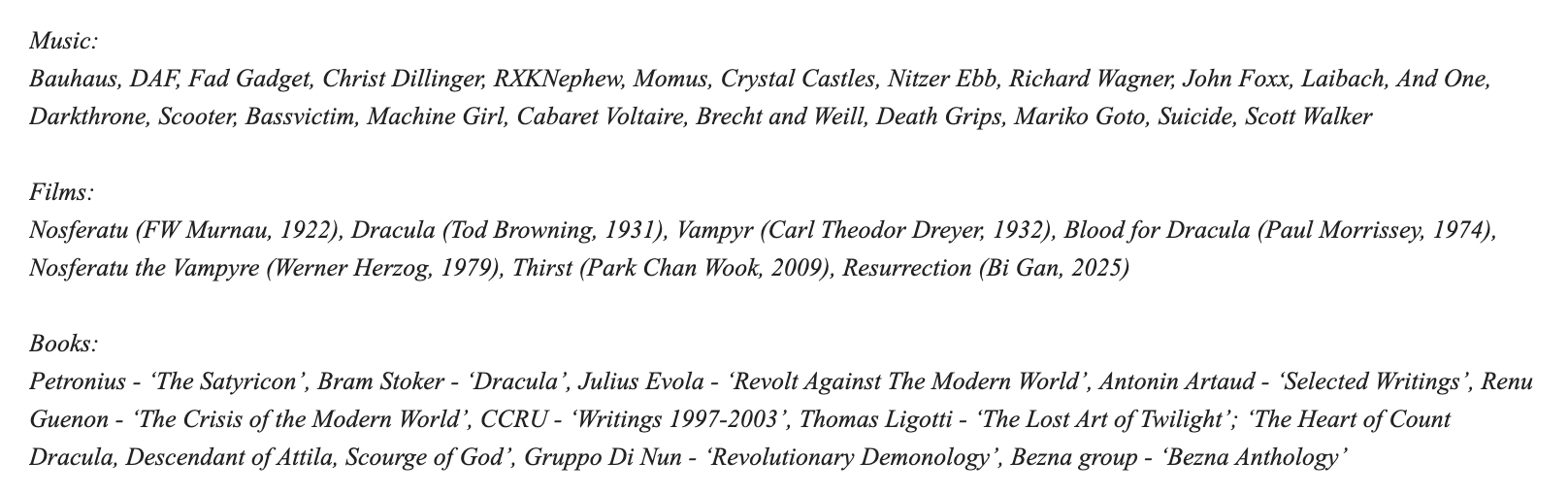
Do you see these cultural shifts coming in cycles? I saw Antonin Artaud and other essays and books from the 1920s and 30s were on the list, and I couldn’t help but notice they were published about 100 years ago — also reacting to global technology advancements, World War I, and all these massive changes that dramatically changed the makeup of Europe and the Western world. And that came about 100 years after the gothic movement. Do you find any significance in the timing of your call for a revival?
In the sense of it being a hundred years?
Yeah, I mean, I find a lot of parallels between the timing of things like Artaud’s Theatre of Cruelty and what you’re saying now. That was also a text about looking to ancient magic and ritual written during exponential technological development and unbelievable violence.
I think Antonin Artaud, later on the Viennese Actionists, and I suppose to lesser extent, the situationists, have always been a really massive influence on what we've done. If you look at our whole career trajectory, they've been major influences in how we've thought about performance, audience, and confrontation. In a way, we see ourselves a part of that lineage.
A lot of what's called “punk” now — or a lot of what has been called “punk” for a long time — is no longer transgressive. One of the major challenges of an artist now is to do something that's truly transgressive when transgression itself has been totally subsumed by the mainstream and turned into something packageable and marketable. I’m going to sound crazy here, but I think it’s what Ye (Kanye West) was trying to do when he declared himself a Nazi: he was trying to find the last possible frontier of transgression, maybe without even realizing it, and then decided the only options open to him were Nazism or pedophilia because all other routes of defiance have been subsumed into the mainstream. To be clear, HMLTD don’t endorse either of those choices, and we will never support anyone who does; we’re not about those things at all. But, unless you want to devolve into that, it's very difficult now to truly be transgressive.
It’s helpful to turn to people like Artaud, to try and understand transgression and how it relates to the mainstream, and to try and find a new way to be transgressive and navigate the world by creating ruptures within it. I think Artaud and the Viennese actionists were all trying to create some form of rupture in reality, and that's very different to simple “shock tactics,” which are performative and what often passes for “transgression” in modern culture.
A lot of the album mirrors that abrasive, transgressive electropunk style. But I wanted to learn more about the standout slow song, “A Thousand White Horses.” To me, it sounds like a classic Yung Lean pop ballad because it's got a jerkiness to it, maybe in the way both you and he deliver words in a syncopated, against-the-beat manner. Could you talk more about that track and how you wanted to use quietude and slowness in a record that goes full force for the rest of it?
I'd say the major influence on “A Thousand White Horses” was Arthur Russell, who Andrei had been listening to a lot when he wrote the song. (That one is largely Andrei's song, by the way.) But it was also definitely sonically inspired in terms of its overall vibe by Yung Lean and Drain Gang. I think, to an extent, we're all living in post-Drain Gang world right now; all culture is kind of downstream from those artists and Crystal Castles. If you look at most of what people call “the underground” — whether it's fakemink or Worldpeace DMT — it's all derivative of Crystal Castles or Drain Gang. So, it's kind of inevitable that we'll imbibe some of that, too, I guess.
But, yeah, in terms of an energetic level, the Gothic is dark and violent as a genre and as a subculture, but it's also very beautiful, elegant, and romantic. It would have been remiss of us to have only focused on the violence and the horror of the Gothic without focusing on the fundamentally romantic sensibility that lies at the heart of it. So, “A Thousand White Horses” is also our attempt at a “beautiful” song within the Gothic landscape.
What does that early-2010s internet scene of electronic and underground production mean to you? What do you find attractive about it?
I think Crystal Castles was probably the most important underground act of the 21st Century, and we're only now fully realizing just how important they are when you look at subgenres like witch house and cloud rap. Just the size of their influence is insane.
A lot of that music — the 2010s-era alternative dance music — generally comes from an era of internet optimism. When the internet was really fresh, and it still felt like it promised freedom and community. We're now dealing with the reality that the internet’s a lot darker than what anybody had anticipated, so I think that there's something interesting in looking back to early internet-era sound. Even in something dark like Crystal Castles, their songs still feel like they represent an era where there was genuine hope for the internet. At the same time, I think what we have now is increasingly… Well, we have the expression “indie landfill” already, and I think we're now living in an era of “sleaze pop landfill.”
Yeah, every time I open the music news pages, there are somehow 50 new electronic producer/singer duos trying to be The Hellp for some reason.
It's insane! I know you know how it's become easier than ever to release music to a wide audience. And in some sense, I think that's been a really positive force in terms of democratizing music-making and putting an end to industry gatekeeping. At the same time, I think that the distinction between fans and artists is becoming ever more blurred, and I think that less people now are willing to just be fans — which I think is a very noble thing to be.
As a result, I think there’s going to be a complete collapse of fan culture because fans are not content to be fans anymore. They want to be the artist; the gap between fans and artists feels smaller than ever. I believe that people in the West generally have too much pride to want to put themselves in the position of being fans because there's no sense of mutual recognition in that exchange. In the decade or so that I've been making music, one of the things I noticed the most, is that, because of the increase in the number of people making music and trying to make it as an artist, there’s been a massive increase in the amount of music that’s just economic content. As the supply increases, the value decreases massively, and I think people are going to start caring less about music because it's so fun to make and so accessible. And I think that you're really seeing that loss of value at the moment.
I'm not sure what you mean by that. From a cultural critic’s perspective, I’ve thought that the dynamics were blurred by fans expressing their enthusiasm for an artist by wanting to be their best friend, not direct competition. They’d rather get invited to the parties and do free advertising than pick up the guitar and write another stock sleaze pop album or whatever.
That's true as well, I think. I don't think those two things are exclusive. Maybe it's just because it's now so much easier for people to market themselves. But it seems to me that there are more artists than ever before, and certainly more people making music and trying to put it out there than ever before.
Again, I think that’s a great thing in many ways, because I think that music should be something that everybody can make. I'm uncomfortable with the whole idea of music as a commodity to sell anyway. What I see is less an explosion of people making music in an innocent way that's about the creative act and more of a kind of mass spread of people hustling and grinding to try to be the next 2hollis or whatever. To me, that's just not a good path, but it's a path that I'm sometimes on or have chosen before.
One of the hardest things for me in my career (and as a human being) has been to try to understand my own relationship to success, what it means to me, and what I define as “success” and what its value is. I think that a lot of people are getting caught into this trap and this cycle of trying to “make it” and profit off art, and it just feels to me as though creativity is the new rat race, in that sense. Sometimes it makes me want to quit music and go and get a desk job, because I feel almost guilty about feeding the machine and being another person creating content when we already have so much of it. For me, it’s a morally confusing time to be an artist because I feel like everybody just needs to stop making things for a bit, including me. I'm not special here.
Any final remarks?
Make England goth again! Now is the time for Gothic insurrection.
'FANGS' by HMLTD is out today via Lucky Number Recordings. Stream here. The band have a number of live performances across The UK and Europe scheduled for the rest of the year; tickets are available now.
The Needle Drop may earn an affiliate commission via purchases on ticket links through this article.

What do you think?
Show comments / Leave a comment