
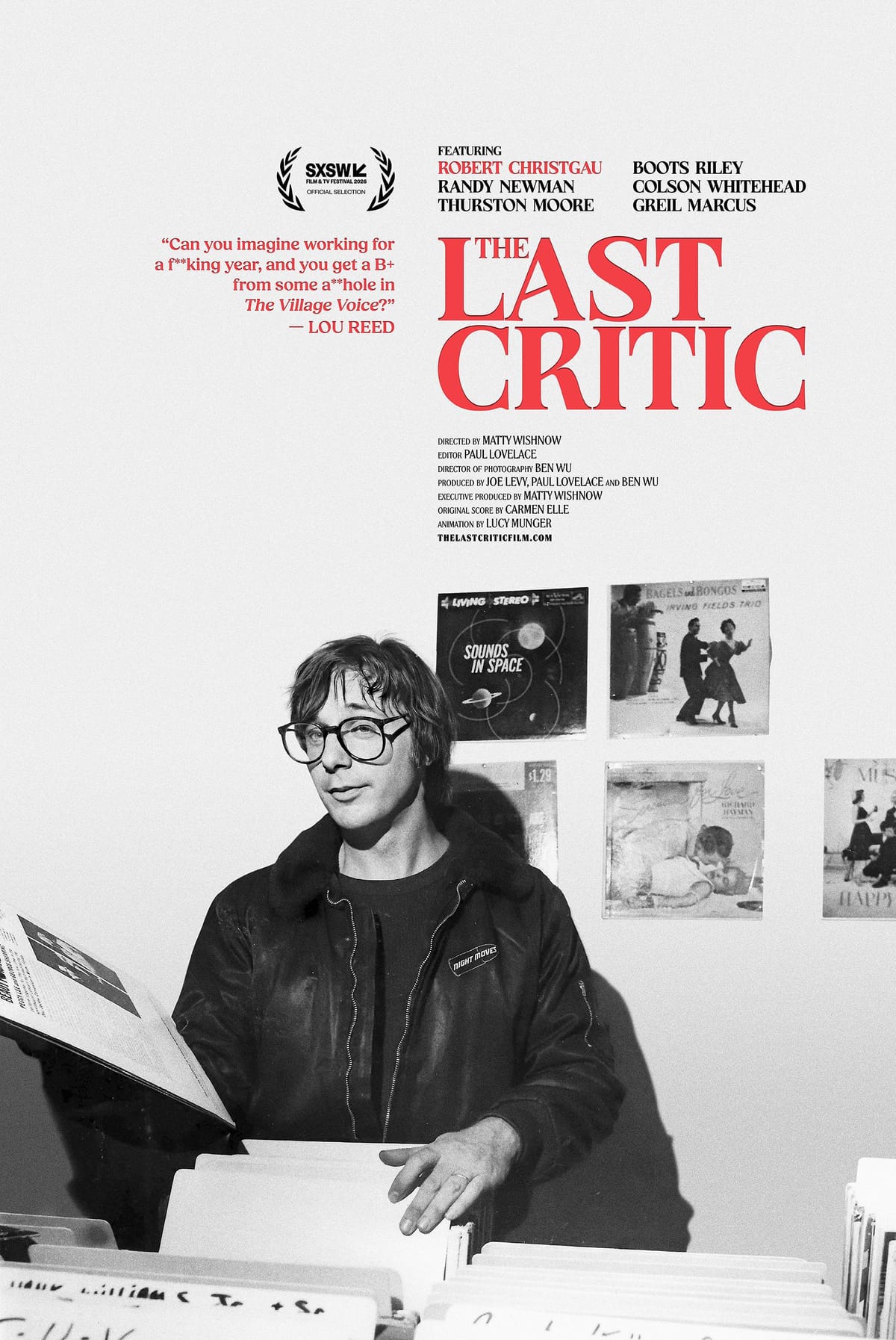
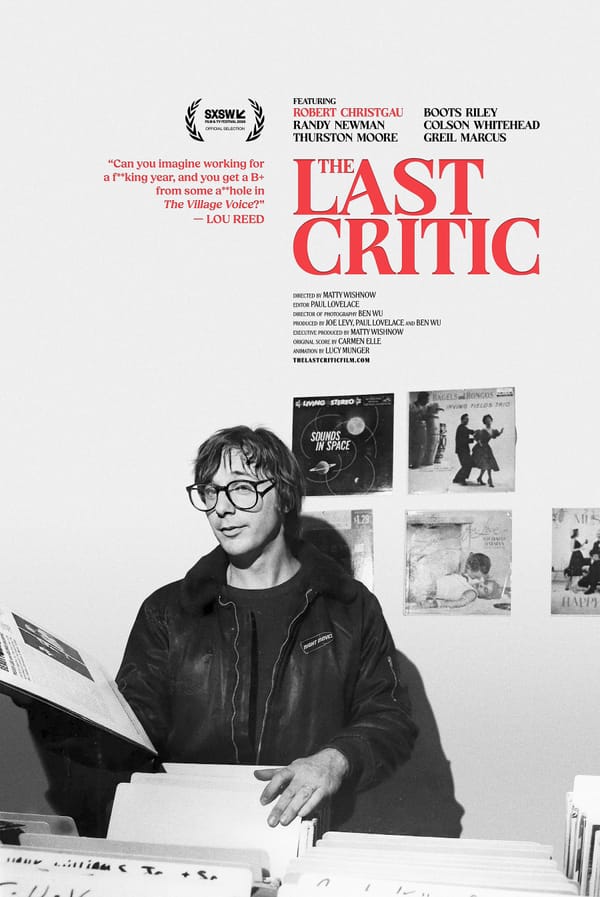
When I met Robert Christgau at PopCon in 2024 – often the only music critic people can think of by name before and/or besides this site's founder, Anthony Fantano – there was a sizable camera following him. "That's either a world-class creep, or a documentary maker," I thought to myself. Turns out it was the latter, lugging the lens around for a new feature entitled The Last Critic. On November 17, I attended a screening of the film in New York City, a stone's throw away from Christgau's apartment sagging with the weight of thousands of LPs and CDs.
[Full disclosure: I tried everything to get an interview with Christgau for the site, including emailing him, calling him directly more than once, and asking his manager before writing this piece. Alas, it was not to be... But here we are!]
The Last Critic is the directorial debut of its maker, Matty Wishnow. A breezy watch, it follows a typical format: scenes of its still-living subject interspersed with montages, archival footage, and talking heads who talk up the eighty-something Christgau, including Thurston Moore from Sonic Youth. Another one of these heads is that manager I mentioned in the disclosure above: Joe Levy, a longtime Village Voice and Rolling Stone heavyweight as well as the editor of Christgau's Substack, the stubbornly-named "And It Don't Stop" (indirectly referencing his nearly six decades of music criticism).
"I was definitely skeptical that a documentary about a music critic was a good idea – plenty of docs about musicians aren't," Levy told me in an email. But he needn't have worried. He singles out animation by Lucy Munger illustrating Christgau's writing, "astounding" in its economy. Her "simple but incredibly detailed and accurate" work is a parallel of Christgau's reviews. In some respects, so is the doc itself – "blunt as fuck," to quote late Village Voice veteran Greg Tate, who appears in the film. I won't spoil the film's biggest surprise, one that came to Wishnow, Levy, and Christgau himself.
It's possible have a negative opinion of the ever-divisive Christgau, so you'll savor these excerpts from the doc: one, an opening presentation of a quote from the man, referencing the "opinions are like assholes" aphorism ("not everybody's got ten thousand of them"); and two, Carola Dibbell (his wife of decades) explaining how they bonded through having an argument.
It's not all looking back, though. We glimpse the man playing rap usually savored by folks less than one-quarter his age, keeping an ear out for anything worth noting in a pithy write-up.
Christgau, who estimates he's heard 250,000 hours of music in his lifetime, has a stuck-in-his-ways approach in keeping with his self-appointed, emeritus-like "Dean of American Rock Critics" title. His website is described in the doc as prompting "the dial-up modem noise" in one's head. Unlike Fantano, who uses a numeric system resembling a smoothed-out version of the decimals Pitchfork favors, Christgau – like a stodgy professor – uses letter grades. One of my favorite sequences in the doc ran through his explanations behind grades, and examples of records in receipt of each. E, the second-lowest, suggests "proof that there is no God." Only two albums have been given a lower score, the very lowest, E-: Aorta's self-titled, and Kim Fowley's I'm Bad.
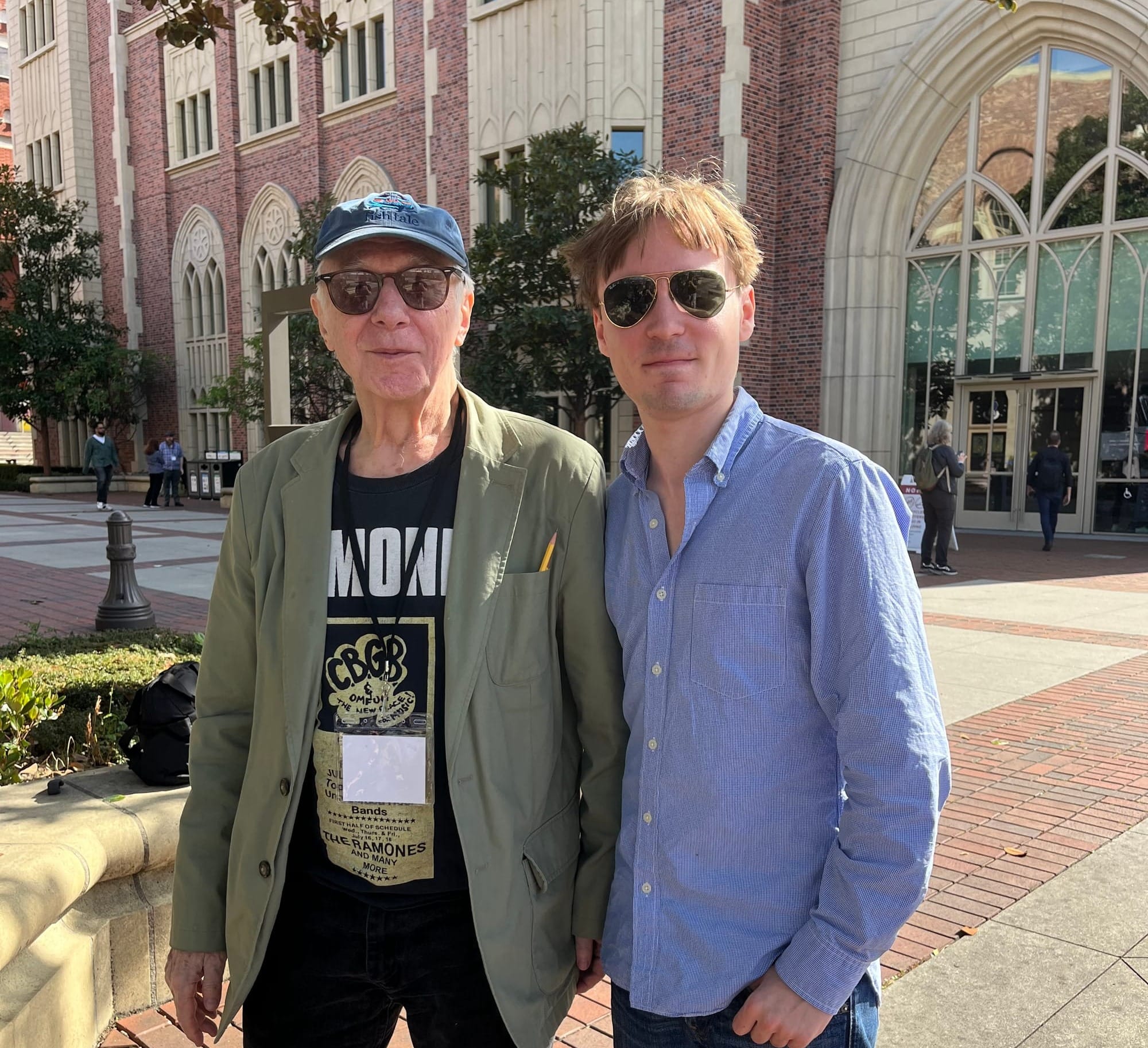
Near the film's end, Christgau takes the stage at PopCon, and you can see this writer in the blurry background, wearing the blue button-down I did in the picture below:
The Last Critic does not engage in a heady confrontation or re-working of the documentary format. There's no obnoxious or pretentious filmmaking ideas that Wishnow forces, those that Christgau might have written against the way he has in takedowns of elaborate prog records. Nor are there many risks taken. It's a straightforward, to-the-point presentation of one of the old heads who happens to still be with us.
The chuckle-heavy crowd surrounding me during the screening provided a soft mattress for the movie to land on. Wishnow, in the audience, had to have been psyched. I have to say that it produced a more wholesome enjoyment than the quiet admiration I bestow on Christgau's body of work.
I say watch it, four decades before someone decides to make another film called The Last Critic about Fantano and his critiquing.
What do you think?
Show comments / Leave a comment