
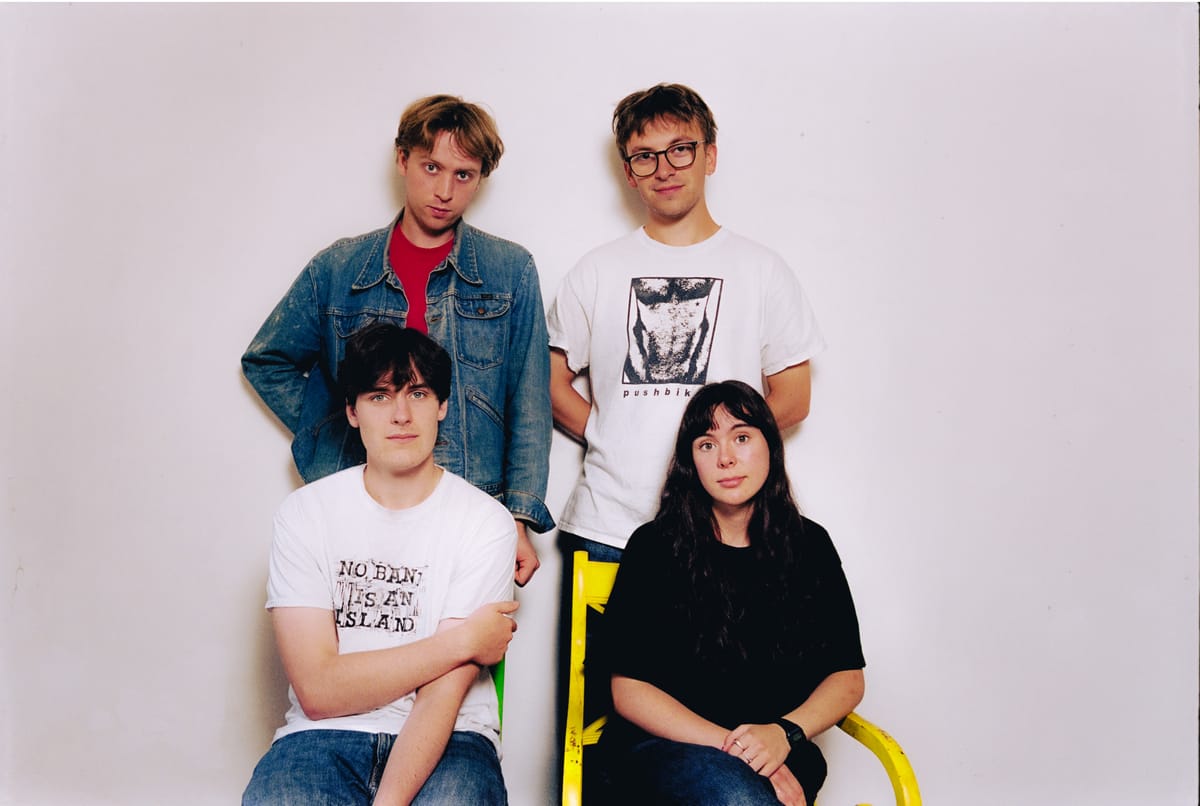
To the outside observer, Westside Cowboy just appeared one day, fully formed and ready to tour.
The Manchester four-piece often repeat in interviews that they came together through the simple question, “Do you want to start a band?” Then, two years after their 2023 formation, they won Glastonbury’s Emerging Talent competition, released two EPs, signed onto Island Records, and embarked on tours supporting both Black Country, New Road and Geese — the indie rock it-bands of today.
Plus, their collaboration seems as intuitive and natural as their four-part vocal harmonies, which inject a bright, folksy charm to each one of their ten total recorded rock tracks.
When I sat down with vocalist/guitarist Rueben Haycocks and drummer Paddy Murphy earlier this week to chat about the band's formation, I noticed almost every explanation behind a certain production trick began with “We.” I’m sure they disagree on things regularly — every group of people does —but when discussing their music, they barely even interrupt each other.
Partly because of the band’s talents, partly because of all the quick endorsements from big names in the indie scene, Westside Cowboy had, perhaps, the smoothest transition from nothing to something, a rare feat that makes me wonder if we might have a new big rock band in our midst.
Realistically, the band’s story isn’t so clean-cut. Westside Cowboy were a total overhaul of identity — the final product after years of the members trying to make it in an experimental, post-rock band. (DieKaiDai, for the curious.) They’re still trying to figure out the whole live band thing, even though that's what originally earned all the recent acclaim. "50% of doing music is like incredible. It's the best feeling ever," Haycocks said after recounting a particularly bad show. "But then about 20% is total disappointment in yourself. The other 30% is blindly trying to convince yourself that making music is still a good thing to do.” If you wanted more math, he added that the band's bad-to-good performance ratio is "one out of every four shows."
Most importantly, Westside Cowboy are beginning to stand out against their British peers with their strong love for power pop, alt rock, classic punk, and folk. (The added embrace of Americana — or Britain-icana, as they dubbed it — turns the most heads, Murphy and Haycocks say, because no one around them expects a rural British band to want to be American. Based on the music alone, it's clear that's not what they're doing.) At a time where instrumental-heavy, noise-heavy maximalism is championing the underground, the Cowboys are writing shorter, humbler, punchier tracks meant to be sung in a crowd.
Westside Cowboy's sophomore EP, So Much Country 'Till We Get There, is out today via Island/Imprint Adventure Recordings. Let's catch up with the band.
This interview has been edited for clarity and length.
Victoria @ TND: You now have two EPs under your belt. You recorded the first one, This Better Be Something Great, out in England with Lewis Whiting from English Teacher as the producer, and then you did the second one, So Much Country ‘Till We Get There, in New York City with Loren Humphrey. How do you guys see these two EPs as a document of the progression of your band’s sound?
Paddy Murphy: The first EP we did we did a place called Greenmount Studios in Leeds. It’s just just a great little studio, and we were recommended it because of its tape set-up and stuff. The whole theme of the first EP was that we literally just wanted to plug in and play. We wanted [This Better Be Something Great] to capture what we were like live because we gigged pretty heavily all over England — that’s how we’re known pretty much. But then we got there, and we realized it was our first time as a band ever being in the studio environment. I think with some exceptions, it's nearly impossible to capture the energy of a live show on a studio recording. We kind of came to that conclusion after the first EP.
When we went in with Loren, we didn't throw that goal out the window as such, but we basically allowed ourselves to think about recording differently. Loren was really great for that; he really got us when we met him. But, he’s also not from our world at all, so with certain things, whilst he really understands us musically, he's not beholden to any of the preconceived ideas that we had talked ourselves into. So, I guess the new one sounds like us fucking around more, trying on new things, and seeing what works and what we learned.
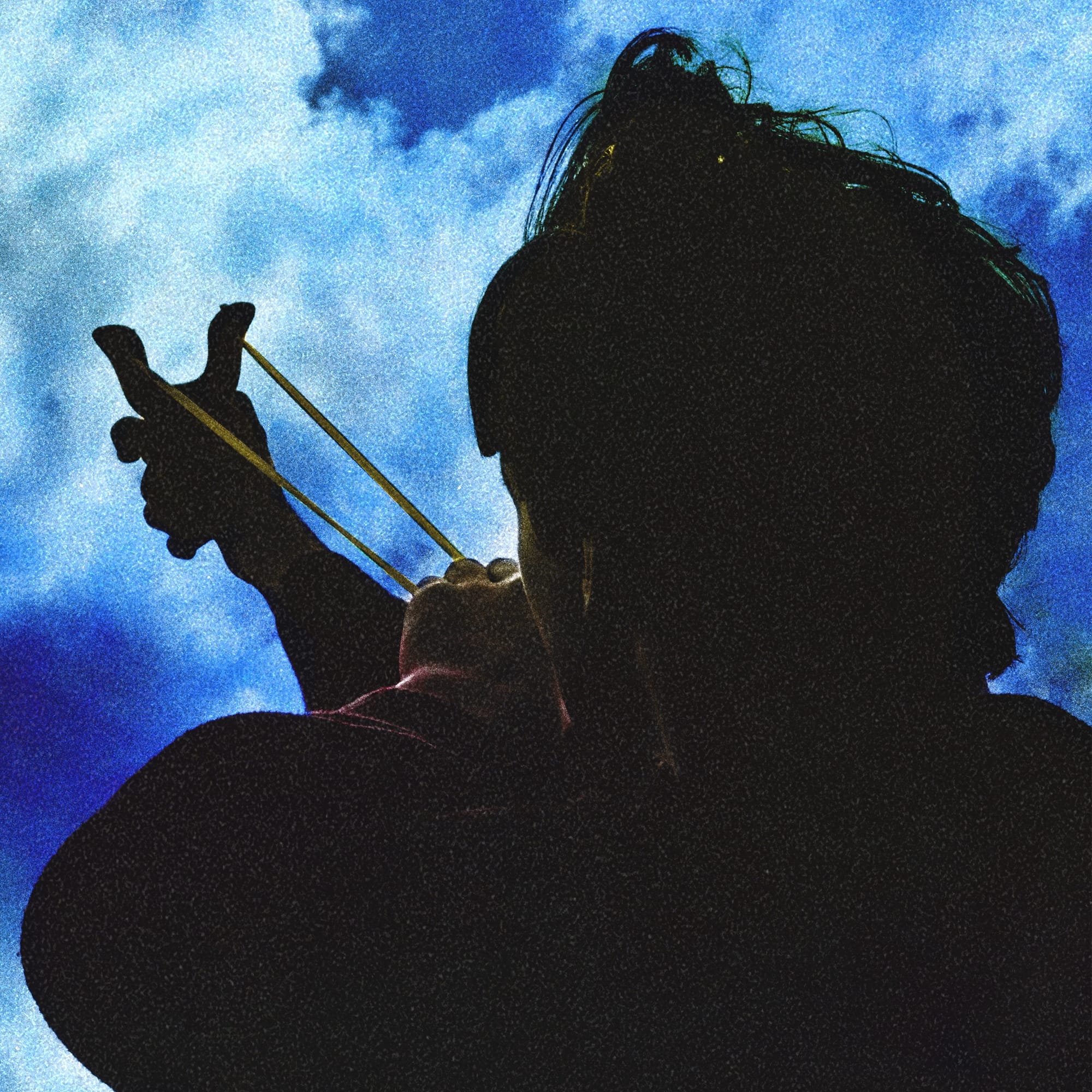
Reuben Haycocks: This is kind of what Paddy said, but we learned that a good recording shouldn't necessarily be what it sounds like live. Like, if you were playing a set, you have to shove the songs down people's throats...Or down people's ears, let's say. Especially as an opener, which is what we have been up until now, you have half an hour to prove yourself to these people. I’ve learned that doesn't translate to a recording because you have to give the listener more credit, that they can perceive notes and sounds when the song’s not just an instantaneous live thing. Subtle changes are much more effective than like — and Jimmy [Bradbury, guitar] hates me saying this — when we cartoon-ify our songs for live. It was the first time we ever felt like we weren't like rushing to hold people's attention on us.
PM: Yeah, like Reuben said, just up until that point, we were just being like, “Ah, we got 20 minutes; we’ve just got to play everything!” And then we just would play everything…at double the speed, as well.
What did you mean by “preconceived ideas”?
PM: We were under the impression that the EP was going to be a big, rattling, distorted live show. Loren does this thing where he will sit you down and show you the stems of classic albums and be like, “Look how shit this is. Look how bad each part is. Now look how clean it all sounds.” He showed us a different way of thinking about record-making: how older records would have actually been made versus what we've just inferred from the music that was probably intended but not necessarily actually on the recording.
RH: A problem with a lot of modern production is that everything has to sound massive. Like, a drum has to sound like a fucking skyscraper, and we’ve got to have loads of bass because everyone loves bass. But, when you go back and listen to a Rolling Stones album — like you listen to Exile on Main Street or just loads of amazing records from the 70s…the snare drum sounds like it's made of paper, and the bass is just through a guitar. We didn't end up using any pedals. We thought none of that mattered; just go and play in a room. We had done live vocals for a lot of it as well. There’s this whole idea that recording has to be this sanitized thing, and every sound's got to be amazing. Loren was just like, “Yeah, who cares? What matters is like the sum of it all.”
Loren did some extra instrumentation in "Strange Taxidermy", which we at first were like, “No, no, no, no, no!” But then he'd gradually introduce ways of using piano and bits of percussion that didn’t feel corny or cliché to us. That's always such a failsafe with the Cowboys: we're literally the most stock rock band you can get. All we got to do is write an okay song for two and a half minutes. And because we just use three chords, it's kind of hard to go wrong sometimes.
RH: They say it's hard to go wrong, but watch people give us one star.
The live vocals are especially interesting, mainly because they’re the whole band singing together. How do you approach the songwriting process and building that vocally-driven sound?
RH: Quite often, the song will be brought to the band as an acoustic guitar and vocal thing. Then we'll just end up playing with it for a little bit, and to be honest, we very rarely actually speak much about the vocals in the writing stage of the song. Usually, we'll be playing as a band, and you'll just notice that someone has started singing something. And you'll be like, “Oh, that sounds alright! That’s quite good actually.” After the initial writing phase, we’ll maybe get into it and ask, “What’s the purpose of that backing vocal? Why were you drawn to do it in the first place? How can we expand on it?” Hopefully it sounds organic.
A song like “The Wahs”, which probably [is] the most vocal harmony-heavy. Yeah, that one was just a joke at the start, and then and then we were like, “Ah wait, this is actually quite great!” I'm not sure whether you've ever experienced this, but you know that feeling when you go home after a long day of recording and be like, “That was the best thing I've ever done in my entire life!” And then you go in the next day and you're like, "Oh, my God, are we seriously putting ‘baaaahs’ in a song?”
PM: It's always kind of a bit of a dare. Sometimes it's like, “Eh, let's just do a ‘baaaah’ song!” Like, loads of bands got a ‘baaaah’ song — or at least classically, I guess. But also, coming from me, who came up when post-punk was everywhere in England and there were very few bands that were straight up singing, the idea to try and make singing a real part of everything and not have it feel like an afterthought just carried through.
RH: Plus, it's the biggest hack that you can do! I think as humans we're conditioned to love people singing together. There's nothing better than a really great choir. Obviously, we don't sound like a choir…
PM: Look at old Arcade Fire and “Wake Up” on Funeral. Nowadays, it's so weird listening to that song because I think I saw a video where someone said that was that song was responsible for ‘stomp clap hey’ in some ways. But in reality, it's just them having a sing together!
RH: Yeah! That's the reason why a band like Mumford and Sons is so popular, even though it's realistically a weird thing to be at the forefront of music for a while. The music’s totally singable, and in that way, it's great. I think people really love being able to sing along to things. I guess you end up making the music that you want to hear, and we just wanted to hear people singing.
How do you see yourselves as a simpler four-piece band in the scene? A lot of the bands cropping up around you are very much not that. It's like, everyone's in a seven-person band, and they're all somehow classically trained. What do you think about the recent shift where a lot of people are becoming more interested in “the traditional rock show”?
RH: Everything goes in cycles, doesn't it? There's been so much amazing, more experimental forms of guitar music in recent years — the seven-piece bands or whatever. But it can get pretty tiresome, especially when it's not done by the best bands in the genre. When you watch some random arts school kids attempt it, it can be a bit of a dirge.
PM: And by the way, we have done it as well. It just didn't feel satisfying to us. We find it sometimes with recording Cowboy songs that the idea where you “put stuff on” almost feels like a cop out. Making stuff more experimental doesn't click with us. Like, noise sections: to some people, that would be their bread and butter, but that is not the thing that that makes me tick, and I don't think that's the thing that makes any of us tick at all. So, when we were doing it, it was just not very authentic. If it's not the thing that you inherently do yourself, there is going to be someone out there who does do it more naturally, and they are always going to be a million times better than you are.
RH: And they deserve the attention for it. Like, we’re not trying to hate the style at all.
PM: Yeah. So, we started this band not necessarily as a stance on music, but as something genuinely for us. We just wanted to feel satisfied in music again. Then we started playing about a bit, and we saw these bands coming up who are like us, like pushbike. They're good friends of ours from Exeter, and they invited us to play a gig with them at this place called Exeter Cavern. We watched them play, and it was just like, “Oh my God, music like this needs to come back!”
RH: It really inspired us to continue the loudest guitar pop ever. And then there's an off-shoot of that band called Bramwell that have some of the best written songs I've heard from people our age in forever. It's starting to happen now where a lot of people were coming to similar conclusions as us at the same time. You see it in America. You look at, for instance, Sharp Pins, Good Flying Birds, or even Horsegirl: it's all coming back to bare-boned, three-minute songs. AND! We had the fortune of being able to go on tour with Black Country, New Road, who are, in our generation, the OG seven-piece band. They love, love, love pop music, too. And it's amazing to me! Because Lewis [Evans] and Charlie [Wayne] — the sax player and drummer — were the first two people outside of Manchester to get in touch with us and say that they liked the music... And they make great music.
That love for pop comes across, especially in their last record. I guess lot of experimental bands — especially in the shoegaze resurgence, which, in all honesty and with very few exceptions, has become an excuse to play guitar badly…
RH: Oh, we know. We were a part of that in our band before Cowboys.
Yeah, but to your point, a lot of people gravitate toward noise for the sake of labeling themselves as “experimental.” It’s better than not experimenting at all, I guess, but it’s still not really adding anything new to the genre, if that makes sense.
PM: I mean, as people who were in shoegaze and shoegaze-adjacent bands, we've realized that it's kind of a hack to making quite good music fairly fast — that’s what we did. All you do is make a vibe and sound. But also, we love a lot of shoegaze music; we used to have fucking pedals coming out of everywhere. We left because we found it to be lacking a lot of substance all the time.
RH: There are a few genres that can be done really well and can be faked really easily. Shoegaze is one of them; the seven-piece, Swans and Godspeed You! Black Emperor rip-off band also is one of them. Alt country is another one, which we sometimes get. You play a mid-tempo song and put a pedal steel guitar on it, and it's quite easy to get good songs quite quickly. But, I think doing that does a disservice to all the incredible country bands that exist.
PM: And shoegaze bands. And post-punk bands.
But with alt country, it’s clear from your music that you guys are working within that vocabulary. What do you mean that it's easy to make a decent song out of it?
RH: There are gimmicks that you can just use. Like, again, going back to shoegaze, it's like: have a load of pedals and an open tuner. With post-rock: have a violin and record it with loads of reverb. Alt country: pedal steel, mid-tempo, something vaguely Neil Young-ish with the guitar. Maybe it's different in England because it's not the music that typically prevails in the underground scene. I think people saw it as a sidestep from a lot of the post-punk and thought it was instantly so refreshing because it was maybe a bit of an out.
PM: It's kind of like the joke when that Bob Dylan biopic came out, and you'd walk down the street and fucking everyone was wearing the Freewheelin' jacket and had a fucking harmonica around their neck. It just feels opportunistic, maybe.
RH: This is the thing. In the earliest Westside Cowboy songs, it's so unbelievably alt country, and because we were having loads of fun, I don't want to drag people who just want to have fun and write songs, because that's literally what it's about. We sort of end up talking ourselves in circles because we go, “Ah, these people are fucking fakers!” and then I'm like, “Well, actually we are also fakers. We are the biggest fakers.”
PM: Okay, but we are and we aren’t…
RH: But that’s what I mean! Like, this is what Britain-icana is. We got into so much Americana and traditional music, but we felt silly doing it as English people because it's obviously not where we're from. To be clear, we don't want to make American music at all. We want English bands who like country to try not to emulate it, and instead try and get it wrong in an English way, because, at least to us, it’s interesting to funnel it through yourself and end up with a mangled alt country.
PM: It came together because we put it with everything else that like makes our music tastes, I guess; that became the band.
RH: And if people want to write music, please write music! Westside Cowboy will fully back you, and we will not be angry if you do alt country! Just do it for the right reasons, please!
PM: I guess what we're trying to say is, whilst we may have sounded like that for a bit, we don't really see ourselves in that lane anymore.
To close, I’d like to talk about your No Band Is An Island collective, which you’ve set up with some local bands. It’s celebrating its year anniversary next month. What’s it been like working with other indie bands to raise money for charity and build a scene?
RH: We were just really interested in the community of a scene, and we started off doing stuff mainly so we could feel like we were impactful in some way. Half of the reason we started it was so that we get to really appreciate all the bands that we were coming up with, putting on these nights of gigs. The other half was that we were able to use the scene as a vehicle to hopefully do some charitable acts.
PM: It was weird because it was around the time when the band was starting to do a little bit better, and we had a little bit of more business-y interests, I guess. We were realizing, alongside many people, that you feel so powerless to so much of the awful things that are happening in the world — and that people in charge are allowing to happen or even fully encouraging. It's ballooned since then.
Aoife [A. O’Connell], who plays bass and sings, is the engine room. Everyone has their own stamp on it, but she was the first one to put flyers out and be like, “I want us to do something.” It started with Manchester bands, but now loads of out-of-town bands play as well.
RH: Collective accountability, I think, is our goal. We hope in the future that No Band Is An Island will be a club where we all try to do music as ethically as possible. We'd like for all these bands to individually put a charity donation link on their merch table, or try to play as much as possible at accessible venues and places where there are gender neutral toilets — stuff like this. With all these things that seem, on their own, to be a drop in the ocean, we just want to be part of a collective of bands and creatives that all have a common goal. If all these other bands are doing it, then it feels…good.
PM: Being in a band is a political thing. Even though you can write music about whatever you like, the fact that you are able to be in a band is a result of certain freedoms. So, you owe it to the privilege that you have to make it the most tolerant, forward-thinking, progressive, and inclusive space as possible. It's not enough to sort of be like, “Oh, we're just a band…We don't want to do any of that.” Like, I feel like there's always more that everyone can be doing, not to be too preachy. It's literally just putting on a charity gig. It's selling a charity t-shirt. It's organizing discussions of events and stuff. There's so much that you can do — and easily!
It also encourages a lot of fans and people who go to these concerts to also look out for and support the local grassroots venues instead of the Live Nation stadiums. Or it shows people what supporting smaller bands can look like, knowing where your money's going when you buy a CD or stream a song.
RH: We really want to make a youth club for bands in Manchester. Like, you listen to all these like stories of the scenes back in the day — the 90s in Britain or the 2000s in New York — and how all these bands knew each other and were friends. The Manchester that we came up in was a little bit like that, but it felt like there was separation between people.
PM: It was a little cliquey.
RH: Yeah, I really like the idea of a metaphorical clubhouse for British bands.
PM: And it’s one that’s open to all, you know? It doesn't matter if you've been playing for 10 years, or you just started a band last week, like we’ve all got to start somewhere.
On that note, if there's anything else to add about your music, about So Much Country ‘Till We Get There, now's your chance. I know that you guys are probably tired, as you’re preparing for both a headline tour and the Geese tour.
PM: We like our releases to capture where we are at the time of recording. With our EP, we're really happy with it, but there's still loads that, if we were to do it now, we'd change. But that's like, a really healthy way to go about things, I think. As a result, everything we make will always be changing, and we’ll be growing a lot.
RH: Or until we become tired and old.
PM: Yeah, until we just let ourselves become a parody.
RH: Cash in, you know? Just take the money.
PM: Until then, we hope everyone listens to our music and likes it.
RH: Yeah, and if not, it's just music. It’s 15 minutes of your time.
So Much Country 'Till We Get There is out now via Island/Imprint Adventure Recordings. Stream it here. If you're reading in Europe or the UK, you can also catch Westside Cowboy either on their headline tour at the end of the month, or as supporters for Geese in March.
The Needle Drop may earn an affiliate commission via purchases on ticket links through this article.

What do you think?
Show comments / Leave a comment