
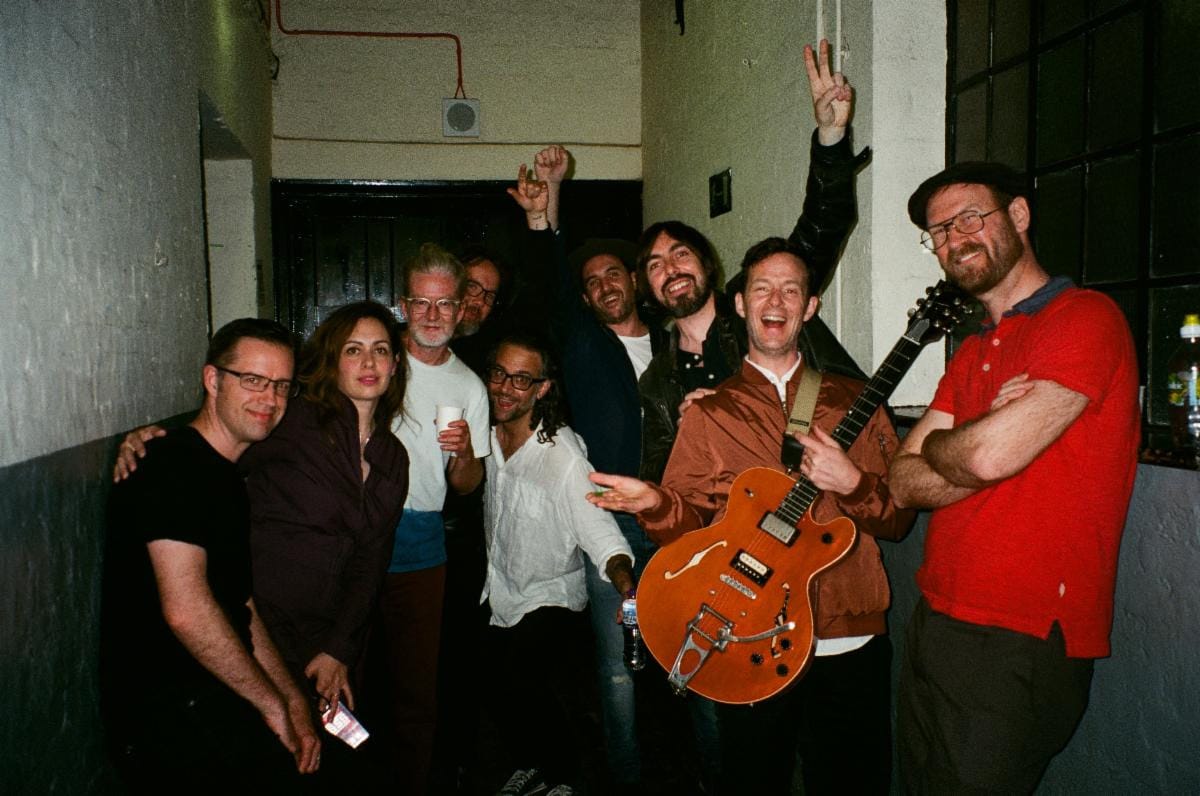
When I logged onto my Zoom call with Broken Social Scene songwriter Kevin Drew, I was met with an unexpected second face. At 10:30am on a Thursday morning, Drew was huddled up in multi-instrumentalist (and fellow Scenester) Charles Spearin's garage-turned-studio. The pair gave me a tour of the space before I got a chance to introduce myself, showing me individual pieces of gear that were near and dear to their hearts.
They showed me the 8-track tape machine that recorded the group's 2001 debut Feel Good Lost. A quarter-century later, the two dance in conversation akin to a tennis match. I served as merely a ball-boy to hand them topics. This kind of camaraderie is what's made Broken Social Scene the seminal project's its been all this time, working on a model where members come and go as they please.
While talking to Drew and Spearin about Remember The Humans, Broken Social Scene's first record in nearly a decade, their answers circled philosophy as much as they did music (if not more). Given my ~30-year age difference from the pair, they spoke to me in a candor that felt nurturing, but never belittling. That same spirit inhabits the music; it's a celebration of the humanity that remains among forces that try to strip it from us.
This interview has been edited for length and clarity
Kevin Drew: Real middle-aged men coming to you live from Toronto. That's Charles. He's a pretty important part of the band. Charlie just was at a seven-week silent retreat.
Leah Bess @ TND: Where at?
Charles Spearin: There's a little Buddhist Monastery in Cape Breton, a northern tip of Cape Breton, Nova Scotia. And I went there a bunch when I was in my 20s and then I had kids and a career and everything like that. So I went back for the first time. I just got back on Saturday and it was very nice. I love it there.
KD: Leah, you know what he said yesterday?
What?
KD: People like to talk a lot.
Despite it being a silent retreat?
CS: No, after coming home, I got into the rehearsal. I couldn't believe how much people flap their gums about stuff.
I see. So were you able to interact with the other people in the retreat?
CS: Yeah, it was basically... it was seven weeks and every other week was silent. And then every other week was talking, but it was really only about three hours of talking a day. Like lunchtime, you could talk to people; dinnertime, you could talk to people. The rest of the time, you're either working or meditating or whatever. So it's mostly silent. It's a mindfulness retreat. Language is intentionally kind of put to the side for a while.
Very interesting.
KD: I wear sunglasses. You didn't prepare for this. That's what I do. I wear sunglasses.
Indoors?
KD: Yes.
So, why was now the right time to have Broken Social Scene release music again?
CS: Want me to start? The questions are for you and then I'm here to like help you when you get stuck. Are you stuck already?
KD: She got me. First question.
You don't know. And if you don't question it, it happens when it happens. No one sits down to think, "okay, this is the moment." But when you're in the middle of it and you realize you are going to get asked that question because it's been nine years since we made a record, right? So it's a very important question to start an interview with, because we are still alive.
We are friends. Friendship right now is probably one of the most honest ways of protesting. We, as you've heard in this record, have been doing this for a long time together and we wanted to get back to the people. We wanted to play shows and that is where we feel our true honest selves can be a part of other people's lives.
And when you have new music, you remind yourself why you do this in the first place. And I think we just went into it to discover what we were thinking, what we were feeling, what our subconscious was saying to us, and how we wanted to continue this version of our story about community and how community matters.
CS: It's also a good time to release the record because we're finished.
KD: You know, I could have just gone with that.
Was the the itch to tour there before you guys started working on the music?
KD: I think so. We did a wonderful tour with You Forgot it in People's 20-year anniversary. We thought how (1) we really enjoyed playing together still after all these years, and (2) the audience who are coming out to the shows, there felt like there was an urgency to the room and people wanting to be together and have it be based around that.
We were all just in this room performing – the audience as well – to try to bring some joy to that moment. So we also made a decision. I've said this a bunch and I'm glad Charlie's here. We do reluctantly show up sometimes. To the studio, sometimes to rehearsals... it's a lot and there's a lot of PTSD around control and compromise and everybody wanting to push this boulder up the hill at this point in our lives and at our age and our health and all that. You have to sit down and make that decision to continue.
We are a middle-class band. We didn't go certain routes and signing with major labels or selling our publishing just chasing radio and things. We just did what we did and what our impulses told us. So upon this return, I think when you look at things like we get asked, "oh, you're going out and you're doing a Live Nation tour. Oh, I see you're still on Spotify," all these questions that don't matter around the work that we made, but we have to then answer them because people are trying to see what our thoughts are. It really just comes down to making a choice as a band and making a decision. And in these modern times, this is how we're going to do it and we're going to go out and we're going to be a part of the jukeboxes that were built, the stages and the venues that were built, and we're thinking of the people, not of the systems.
CS: Yeah, and also when we get together to write music, we really want to make music that makes us feel good and then share that so that other people feel good. And it maybe sounds a little bit selfish to put it like this, but the attention is what we want and it's not because we're attention-seekers but because music only exists if you pay attention to it. It doesn't really work as a background.
So we make music because because we sort of feed off the audience. They give us their attention, which is a gift, and then we give them our ideas and our music which is our gift. So it's this kind of an exchange and if you go for too long without doing that you start to feel a little bit empty, especially for long-time-applause-addicts like ourselves.
KD: I was just going to give him applause for that answer. We love the applause.
CS: We have an altruistic side to us when we make music, but we also love to be loved and we love a little validation for our efforts. So there's always this little kid in the back of our mind saying "are people gonna like this?" Our narcissism is a sweater. It's not a jumpsuit, you know? We don't have a full hazmat narcissistic suit.
KD: A vest, even.
CS: Sometimes it's a vest and sometimes it's a pair of socks.
KD: Yeah, I have some narcissism socks
CS: You need narcissism to just stick up for yourself. and that's about it. After that, you become a sociopath. So be careful.
It comes with the territory. I feel like people that are professional musicians have to have at least a little bit. The people that truly don't want the attention aren't doing it in the first place.
KD: Yeah, the whole kill the ego thing, that's such a ridiculous concept that came from men who failed and want to try to redeem themselves. You need your ego. Kill the arrogance is what you really should be saying.
Besides some of the things you already talked about, what are you excited about touring with Metric and Stars in particular? It's kind of the Canadian Super Bowl.
KD: I'm excited to see if it can get pulled off. This is on Metric's shoulders. They're going to set the tone. I'm a passenger in this car ride and we're a family. So when you put family together for that amount of time, it's a "who knows how this is going to go" kinda situation. But the music – that's what I'm excited for.
If this works, then we come out on top as friends and family members. If it doesn't work, then we come out on top and we move on from each other and we go our different ways and that's just the reality of it all. But everyone seems to want this to work within all our bands and everyone seems to understand the mission at hand that we're going out there to play for the people.
CS: And also we've been friends for so long. At this point in our lives there's a feeling of accomplishment and pride and it's just like "hey, look at us, we're still doing this. This feels good."
We were we were doing this together 30 years ago and we were just getting started. Now, we've all had our successes and failures, but we're still going. We still love what we do. So there is a celebration of this kind of retrospective or nostalgia – not even nostalgia – but it's more like, "hey, look, we kind of did it." We're still friends so there's something to that behind this tour.
KD: And we're talking about death! We haven't experienced that amongst our membership and that needs to be celebrated because it's very rare that this amount of people – the ratio in this business with all the stereotypes that come with it – we've prevailed to fortunately still be here, still standing. I've lost friends and we've lost family members: Charlie's dad, my mom, and so many in this band have lost friends and parents. So you use that as the strength to keep your perspective at all times. You really do. Whether it's eating your morning breakfast, having the coffee, playing shows, going out with your buds. You treat it as an award show because you're still here and able to do it.
Is there a different weight with going on tour and leaving your life for however long at your age when you kind of have more of that foundation of your life built?
KD: That's a great question. No one's asked me that. There is, and it's usually just health now and drinking and making sure your knees and your back are ok. But I can tell you that's all I think about, is just "I have to stay healthy. I have to watch the partying and watch the celebrating – just stay healthy."
In terms of the road, we don't tour a lot because we can't afford to tour. So it's interesting looking at this year and seeing the schedule. I don't see it as something big, but I do worry about my health and certain members in all these bands. I'm on the phone with them and we're trying to figure out how to do it with our health.
Charlie can speak to that; Charlie has two daughters – one your age.
CS: I mean from my side of things now is a great time to tour because my kids are grown now. My kids are 20 and 22, so it's easier. My wife could even come out on tour for a little bit from time to time with us, which is awesome. So for me, there's an opening.
There's a sense of "now is a good time to tour" because I don't have a lot of responsibilities at home. Whereas in the past I was constantly on the road and then I come home straight into very active parenting. So now it's a way easier time, but I know that other members of the band feel like it takes a lot of mental preparation. Each person is different and within the band there is quite a spectrum of willingness and ability and excitement about tour.
KD: I think the wonderful thing that you will see eventually is that when you're at this stage in your life, you've got your roots. Your feet are on the ground. You have wonderful partners. You've built this life through chaos and being the age we are, there's always complications and things to figure out, but it is based around the piece of understanding we've been doing this for a very long time. It's your job, and once it really sets into place, there's not a lot of fires that need to get put out. How's that for an answer?
It's great.
KD: Okay, good.
The yeule cover of "Anthems For a 17 Year-Old Girl" was an introduction to your music for a lot of people closer to my age and younger. How do you feel about a new generation that wasn't around during your run in the early 2000s finding and connecting to that music now?
KD: It's awesome.
CS: It's the best.
KD: It's the best award you can get. That film, I Saw the TV Glow, it gave us so much life, and just the trans community alone taking "Anthem's For A 17 Year-Old Girl" and seeing it sort of go viral through the word "identity" was the best award we've been given so far in our career.
CS: It felt good. It felt like we're relevant again and there was a sense of contributing to the world and in a positive way.
KD: There's nothing false about our idea of safety. And I say that because there's peers of ours who sold people that shit and they weren't [genuine]. But the protection that we actually speak about and talk about is the truth. So it's just nice to have people understand that it is a safe place to be within the melodies that we've made. And when it is a bad night, it's not about one person, it's about a community. One of the reasons why I wanted to play music was because music helped me figure out who I was. It helped me find people that thought, saw, and felt what I did.
I met Charlie when I was 19 years old and I met him because I walked up to him and said "I hear you're a fan of this band Tortoise. I'm a big fan too." So look at this relationship now 31 years later connected through music. That's the reason why I think we're still doing it. That yeule cover, and even the covers album that came out with Sylvan Esso and Maggie Rogers covering, and there's all these bands that covered You Forgot It In People – that is just a gift. It's just very heartwarming. To have younger generation say "we approve," it's the best feeling.
In the bio for this record. there are a lot of allusions to nostalgia. How much of that do you think comes from aging vs just the world getting worse?
KD: Another great question. Go, Charlie. He's the Nostalgia Guy.
CS: I mean, it's interesting because we grew up – as Generation X – we grew up during the Cold War, and I remember as a kid feeling that the world is going to end at any time because the nuclear bomb was going to fall on our heads. And then when the Berlin Wall came down in '89, I was kind of like, "What? You mean we might actually have a future?"
So I don't really have this sense of nostalgia for a safer, more peaceful time. The tension of today still feels familiar to me. We've gone through a lot as society in our lifetimes and there's been lots of tension and release. I'm not one to say that the olden days were fantastic and now things are terrible. I feel like society has gotten better in a quite a few number of ways, especially when you look globally in terms of women's education, in terms of child mortality. It depends where you put your metric, but the world really is improving in a lot of important ways.
But also the stakes are high right now. Things can get very bad very quickly, but at the same time, I'm not one to say things used to be better. So the nostalgia, I think, referenced in the bio and in the song "Not Around Anymore" and Remember The Humans [overall], for me, it's a matter of recognizing time passing and the disappearance of things. There's this sense of like, all these things that have happened in your life that have been so beautiful or so painful – they're just gone. They're gone and there's nostalgia for watching your life disappear behind you.
It's a bit of a bird's-eye view of life and it adds a kind of perspective.
KD: Charlie has a much better outlook. I was so filled with love and now as I come into this record cycle, I can see that I have given up on being an empath. You just get the shit kicked out of you. I've always tried to purposely help people and there comes a point sometimes where you truly realize you can't help some people.
And with the information and the platforms of influencers and this world of where everyone now has a microphone and they're telling you how to cook, how to eat, how to drink, how to feel, how to love – I see it as damage. I went and studied social media this last year. I wanted to see what TikTok was and I wanted to see what influencers were and I wanted to see my friends and how they handle themselves or carry themselves online. My conclusion was not one of positivity.
This loop has to break. It's speaking to what Charlie would say is "the shedding of the skin" and giving up so that you can start again and move forward. I think there's a sort of social suicide that needs to happen at some point and we're all just sitting in the waiting room looking at our phones.
And our generation compared to yours – we're neurologically programmed that what we read and what we see is the truth because we were taught that growing up. My brain's pathways are at war every day now because I don't know what is what. That's why you're starting to hear more and more from our generation "I'm not on social media anymore." But it's not about some protest towards content; it's more just that your brain can't take the information.
I'm going to flip to something Charlie said to me today when we were sitting outside on his patio. He was explaining about how we compress language.
CS: I was talking about my meditation retreat and how great portions of my retreat were in silence. And even when we weren't in silence, I was doing seven hours of meditation a day. The meditation is not to try and transcend your experience but just to notice what's going on in your mind. You're noticing thoughts, you're noticing feelings. But a big part of the experience for me was de-prioritizing language, which I came to see as a sort of data compression system. Like, every chair is a chair for convenience's sake. You can't have a different word for every single chair in the world. Otherwise, you wouldn't be able to communicate. So if you think of language as just a way of compressing data so you can fit more and more into your brain, then you start rearranging the the data with your thoughts. So you're working entirely, exclusively within language. It takes up a lot of your mental processing.
And to remove language for a little while – or at least de-prioritize language – what ends up happening is you start to increase the resolution of your other experiences. Food tastes better or clearer. You see things more clearly and you feel things, and emotions become stronger, which is good and bad. But there's also this sense of when you take away this constant compression of experience, then what happened to me was I started to feel joy, which was really interesting.
I'm just like "wow, why do I feel so good all the time?" It's not because my ego is being fed. It's not because I'm experiencing luxuries or anything like that. It's just like "oh, there's some spaciousness in my mind." And I think that – going back to social media – that's like further compressing language experience into visual content and sound content. All I can say is that it seems healthy to take a break from that kind of thing and, you know, go for a walk. Come to your senses, that's what I say.
KD: I love that because "come to your senses" is such a signature line, but you don't hear it anymore.
Can you talk about reconnecting with David Newfeld and that creative relationship?
KD: We came up together. We created a sound together: his production, our playing. We went off, we made great records without him. He went off, he made great records with us. But the comeback was sweet and it was truthful and it was honest. Being in his world is a passionate place to be because you're constantly in his brain, which works on a just a completely different basis than how you as an individual would approach music, and he was so great to work with again. He was so open. He put his fingers in every song he wrote with us. But we knew going in that this was what it was going to be like because we knew him.
One of the things about being older is you accept. Great line from Nada Surf, a great song called "Gold Sounds": "Please accept, I think you'll like it." And so much of the struggle that you have with people is when you don't accept who they are. We went in and Newf was prepared, and he worked so hard for us – so, so, so, so hard for us to make what we felt was the best thing we could make together with him. And I loved all the results. The process was right. He's such an extremely wonderful, innocent lover of music that he wants things to be as adventurous as possible, and to be able to get back to that feeling of nostalgia, to be that part of where we kind of were, it was wonderful.
CS: Yeah, working with Dave, he's so childlike in his excitement for music, and that was what we wanted. I mean, I think if we were going to recommend that other bands work with him, we would have to give them lessons first. There's certain rules you need to follow. But we went back to Dave because those first two records, they have a kind of character which helped define us. So we just wanted to see what would happen.
What do you hope people get out of or take away from this record?
KD: I hope you feel protected by the sounds and the melodies and the lyrics, and I hope you find some identity in it, and I hope it takes you away from whatever's hurting you, and that's the reason why I make records.
CS: We want people to have the experience that we have when we listen to our favorite music. You know, when we listen to our albums that we love or discover new music, you get this feeling of fascination and joy and admiration and delight. We want people to to to get that from us. We want people to feel things. We want people to feel better.
KD: Again, that word identity. We're all we're at a war with identity right now. And to be invited into someone's home, into someone's car, into someone's headphones, into someone's bedroom – it's an honor, and we we definitely think about that when we make records, because that is our goal. That is our objective – to just have people listen to help them through that day. I'm an avid music listener, and I use soundtracks to get me through. I'm constantly making mix tapes and I'm listening to new bands. I don't ever want that to go away.
Remember The Humans is out May 8th via Arts & Crafts.

What do you think?
Show comments / Leave a comment