
Welcome to Sleeper Hit Support Group, a column diving into the song currently occupying the bottom spot of the Billboard Hot 100.
In a pop landscape that asks more questions that it answers, I'm setting out to answer three questions about each of these songs: how it got here, if the song is good, and where it's going. In this 100th spot we'll find unlikely ascents, falls from grace, and resurgences of hits from bygone eras.
Today, we're taking a look at "Quik Stop" by J. Cole.
How did it get here?
I'm cheating a bit here. "Quik Stop" was actually the #100 song last week, which I skipped to focus on my bachelor's thesis. I will be skipping coverage of this week's #100, which is "Droga Letal" by Junior H featuring Gael Valenzuela & Peso Pluma, as I simply currently do not have the time for intense research on regional Mexican music, a genre I have no background knowledge in. "Quik Stop" has since left the chart completely, but there is certainly a story to tell here – potentially the most interesting story that can be gleaned from the behemoth double LP it's on.
The Fall-Off, released earlier this month, was supposed to act as a capstone artistic statement for J. Cole as he enters his legacy act years. Cole says it's "intended to be" his final album, but rappers lie about that kind of stuff all the time. The double album, split into "Disc 29" and "Disc 39," chronicles two trips to his hometown of Fayetteville, North Carolina at ages 29 and 39. The concept allegedly follows those two different points in Cole's career as snapshots of his pursuit in becoming one of the greats. The release crosses the 100 minute mark and spans 24 tracks.
This brand of hubris is nothing particularly new for Cole, the man who always seems to find himself on some vague pursuit for greatness, however that may manifest in a given point of his career. But The Fall-Off in particular comes on the heels of the biggest misstep of Cole's career, something he had no way to anticipate when the first disc's tracks were written up to eight years ago. He may not have known it at the time, but he became a part of the defining moment in hip-hop this century.
In J. Cole's verse on Drake's "First Person Shooter" – the only #1 hit Cole's been involved in – he delivers the following:
"I'm namin' the album The Fall Off, it's pretty ironic 'cause it ain't no fall off for me
Still in this bitch gettin' bigger, they waitin' on the kid to come drop like a father to be
Love when they argue the hardest MC
Is it K-Dot? Is it Aubrey? Or me?
We the big three like we started a league, but right now, I feel like Muhammad Ali"
J. Cole is now remembered as an oft-forgotten third player in the events that followed. He fumbled his window to prove himself to be one of the greats because he was simply too scared. But what he did ultimately contribute has become the biggest blight on his career.
"7 Minute Drill" (which is deceptively only 3.5 minutes long) was released two weeks after Kendrick's verse on "Like That" was the shot heard 'round the world. In it, J. Cole most notably says To Pimp a Butterfly, one of the most acclaimed albums of all time, put people to sleep. He then immediately turns around and says he doesn't really want to have to diss Kendrick because he likes the guy, rendering the entire diss null and void.
"7 Minute Drill" debuted at #6 on the Hot 100 and left the chart the following week – not because of a lack of interest, but because it was no longer eligible after it was removed from streaming.
Less than two days after the track's release, Cole publicly said the following:
"I moved in a way that I spiritually feel bad on. I tried to jab my n***a back and keep it friendly, but at the end of the day, when I listen to it and when I see the talk, that shit don’t sit right with me with my spirit. That shit disrupts my fucking peace. So what I want to say right here tonight, is that in the midst of me doing that – trying to find a little angle and downplay this n** * a’s catalog and greatness – how many people here think Kendrick Lamar is one of the greatest motherfuckers to ever touch the fucking microphone? […] I ain’t gonna lie to y'all, [the] past two days felt terrible, like, it let me know how good I been sleeping these past ten years […] We taking that song off of fucking streaming services."
"7 Minute Drill" was promptly removed from streaming by the end of that week, and with it, Cole invented a new way to lose a rap beef: being too nice. In his review of The Fall-Off for Pitchfork, critic Benny Sun called the fallout of the track's removal the quickest evaporation of a rapper's cultural goodwill since Chance The Rapper's The Big Day.
It'd be superfluous for me to explain what happened next: the Drake v. Kendrick beef is one of the best documented musical events in recent memory. It's a culmination of the half-century of hip-hop history that preceded it, both as a musical genre and as an arm of black culture. The stakes, as we now know in hindsight, could not have been higher.
Cole does not talk about the beef on this whole record, but "Quik Stop" is the closest we get to candid insight on how he views his prospective legacy.
So with all that said...
Is the song any good?
There are three ways to look at "Quik Stop", and they all largely depend on whatever view one holds of J. Cole to begin with. Before writing this week's column, I was largely ambivalent and relatively ill-informed on J. Cole. He's a rapper that was at his most ubiquitous while I was in middle school and paid no attention to hip-hop. I had two conversations with people close to me about this track to gauge their insight, something that I knew I lacked. My partner, who's a seasoned hip-hop head, found himself frustrated with the empty promises The Fall-Off embodies. The promise of a career-defining artistic opus is attempted, but its success in that pursuit widely varies.
"Quik Stop" has shown to be an early fan-favorite, which seems fitting for its subject matter. The track tells the story of J. Cole being approached by a fan at a gas station, which incites a bout of introspection about his career and larger place in the world. He explains that he usually wears a hoodie when he goes out regardless of weather to obfuscate his signature head of dreadlocks. The one day he ditches the hoodie, a guy approaches him trying to peddle weed. When the man realizes who he's talking to, he lets Cole know how much his music has impacted his life.
"Bro, I was just thirteen years old when I got hold of your tape
I tried to put n***as on, but they was slow to go play
Bro, you the GOAT, they didn't know then, but bet they know it today
I need a flick right quick, 'cause dog, I don't even know what to say
To make a dollar bill right now, I'm out here throwin' bouquets
Slangin' flowers, but I played your albums and know it's a way
I played your shit when bro got hit, it helped me cope with the pain
I played your shit when momma tripped, and I had nowhere to stay
I swear I feel like you was with me in my loneliest phase"
Did this actually happen? I'm not really sure. He could very well be exaggerating some aspects of this person's circumstances; the weed dealer aspect was a convenient plot device – but this is overshadowed by Cole sharing how he felt about that interaction in hindsight:
"The love he showed me was so strong, it damn near blowed me away
See, even I be needin' reminders on my loneliest days
That I should live in my purpose if I deliver my verses
And get the fuck out my way, I'll figure out what to say
Some days, I forget to eat, some days, I forget to pray
I get a whole lot of love, some days, I focus on hate
I took a selfie with dawg and gave the longest embrace
Then look him right in his face to let him know that this thanks
Was from a genuine place 'cause this continuous race
To be the best will leave you steppin' at a strenuous pace
'Til you forget who you is and you forget who you ain't
Before you know it, you're trapped inside that picture you paint
This life is more than just rap, more than the bitches you scrape
More than the riches you stack, see, it's the difference you make"
Cole delivers the end of this verse with such passion that by the time he gets to "This life is more than just rap," you can basically hear the saliva escaping his mouth. He wants you to believe what he's saying, to the point where he sounds like he's begging on his knees. This all culminates in him repeating "It's the difference you make" four times until he fades into the refrain heard at the beginning of the song.
I remain personally ambivalent to the song. I think some of those live sax riffs were really nice, but I still can't really get myself to make a personally informed opinion on it. But from hearing and reading various opinions of it, I've gathered this verse can be interpreted one of three ways, which I will present in the form of a Punnett square.
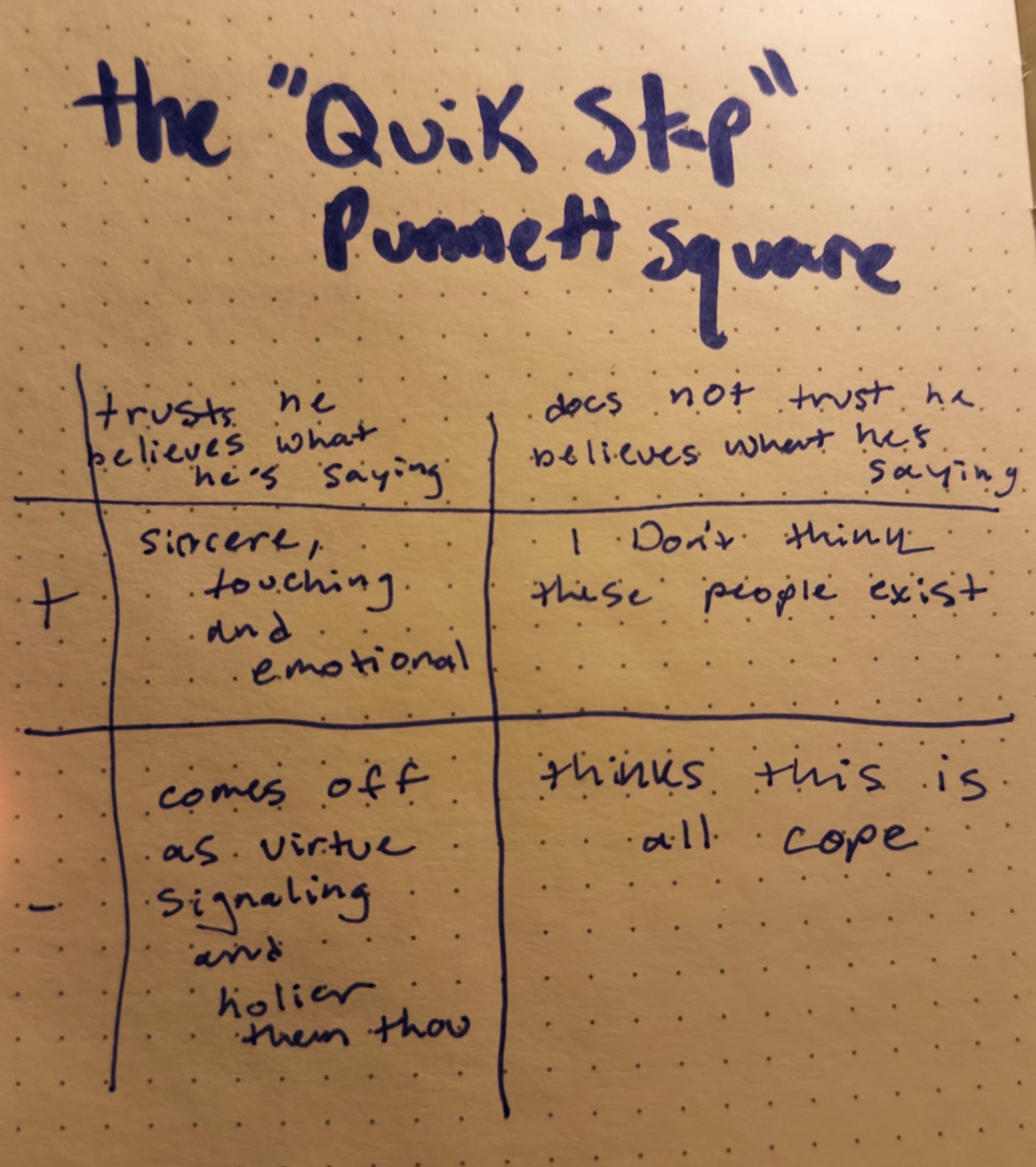
The "Quik Stop" Punnett square is made up of two components: whether you believe J. Cole is being sincere, and your feelings towards him going into hearing the verse. The combination of not trusting J. Cole's sincerity and feeling positively towards him is a genetic mutation that scientists have not found living proof of yet. The other three are viable species.
Trusts J. Cole believes what he's saying, feels positively towards him: This is the most straightforward. These are the J. Cole fans that were able to really get a touching story out of this song and feel acknowledged by it. Many fans in Genius comments and J. Cole's Subreddit said the track brought them to tears. I would be a bad person to knock them for that. Music is supposed to invoke emotion, and I'm glad that these people got that out of this song, especially those that are similarly longtime fans of Cole's.
Trusts J. Cole believes what he's saying, but ultimately feels negative/skeptical towards him: Those in this camp may feel as though this verse is one big virtue signal. He's implying he looks down at his peers that brag about money and sex in their music. To these people, they see this as an outright rebuke of that part of hip-hop culture with Cole positioning himself as "holier than thou."
Does not trust J. Cole believes what he's saying, feels negatively towards him: With this line of thinking, it's possible to view this verse as pure cope. Cole is coming off the biggest loss of his career, and in turn he's deciding to emphasize that he only cares about "making a difference" as diametrically opposed to sex and money. Those fully skeptical of J. Cole may feel as though he is mad at himself for fumbling his quest to be one of the greats over something as petty as rap beef he didn't want to be apart of in the first place. Focusing on something intangible like "making a difference" may help him sleep better at night, but who's to say whether that's what he truly wants.
Regardless of perspective, though, it's indicative of Cole's character that he really only points the finger at himself for his gaffe as opposed to Drake or Kendrick, but it also informs why he backed out of participating in the beef – he just wasn't willing to get dirty like that.
Where is it going?
"Quik Stop" has already fallen off the Hot 100. Spare some miracle, it likely will not find its way back. 10-15 years from now when somebody makes a documentary or feature film about the Drake v Kendrick beef, this song may be a benchmark in J. Cole's epilogue. Perhaps it'll nestle itself as a favorite among Cole's core fanbase – only time will tell. 21/24 of the tracks on The Fall Off debuted on the Hot 100 last week. This week, only eight remain, and each of those eight have dropped an average of 30 spots on the chart.
J. Cole is set to go on what is billed as his "final" major tour throughout the back half of 2026 to promote the record. It's his first headlining tour since 2021, which could potentially provide more insight into Cole's mindset through all of this as he takes the stage in front of ~20,000 people each night. Otherwise, J. Cole's future is fairly uncertain for an artist of his stature. The legacy of The Fall Off and J. Cole himself will ultimately be dictated by what he does (or doesn't do) next.

What do you think?
Show comments / Leave a comment