

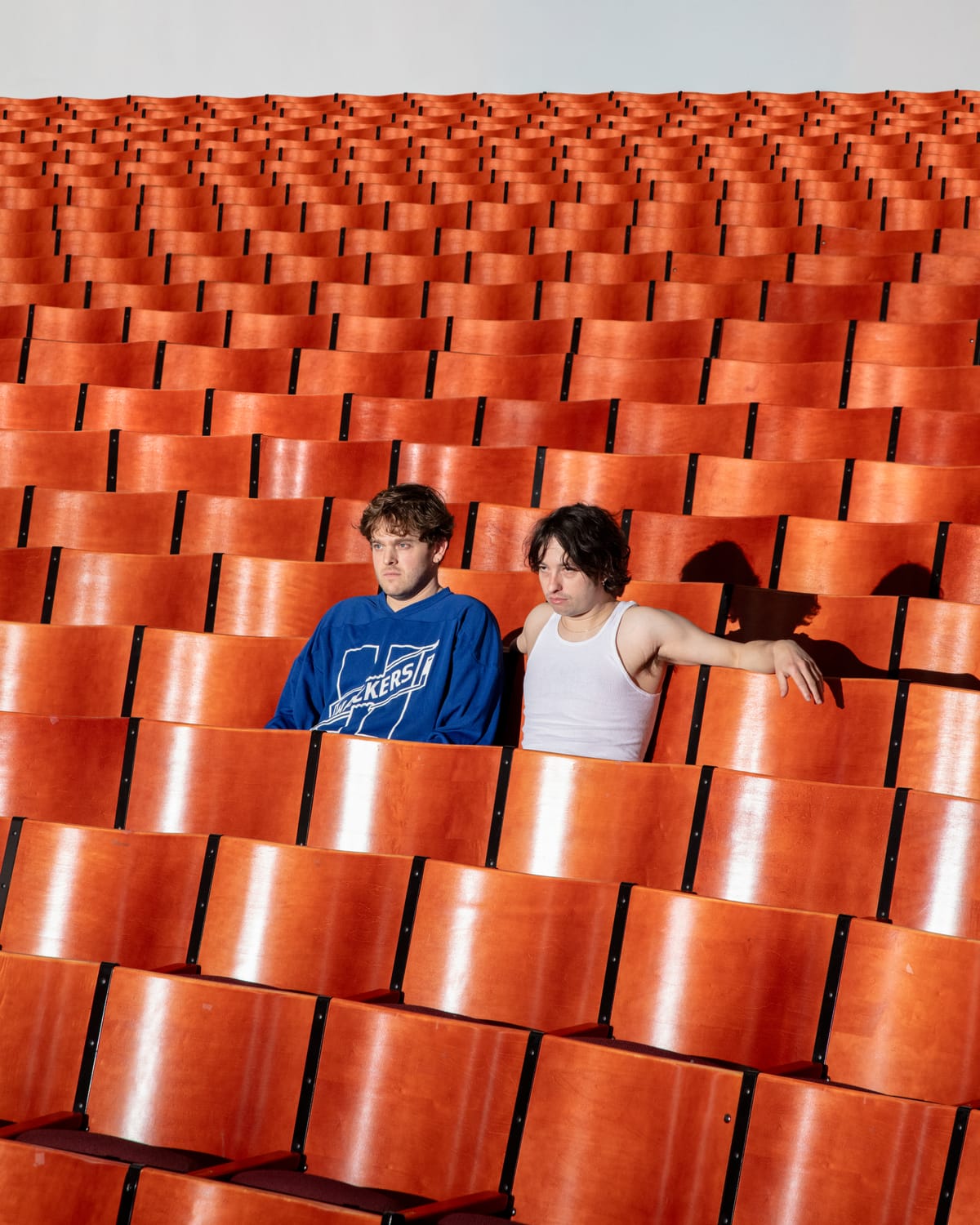
If you’re unfamiliar with Ray Bull, you might reasonably assume it’s just one person. Perhaps even the name of a 1990s amateur wrestler. However, that isn’t the case here.
Ray Bull is, in fact, a pop duo — Tucker Elkins and Aaron Graham, to be exact. But reducing them to “pop duo” also feels incomplete. Their connection runs deeper than music: with roots in visual art, storytelling, and social media virality.
They started making content together in 2020, eventually finding traction with a series called “Did You Know,” where they spun surreal, semi-believable narratives about celebrities. As it turns out, TikTokers are fairly willing to believe most information delivered from a face speaking into their phone lens from ten inches away — and by exploiting this general gullibility, Ray Bull were able to turn a series of small white lies about celebrities into viral moments.
@raybullraybull #dannydevito #mandelaeffect ♬ original sound - Ray Bull
In a less gaslight-y series, titled “Songs That Are The Same,” they layered two unrelated tracks to exhibit how many songs share similar chords, melodies, and rhythms. It didn’t take long for these approaches to catch on, and before long, Ray Bull had built a massive audience, pulling in hundreds of thousands of followers across both TikTok and Instagram.
However, their sights have always been set far beyond viral campaigns. Elkins and Graham are artists first, and they want to be recognized and respected as such, even if their initial notoriety came through social media. In fact, the two began making and releasing music together before any of these internet antics.
There’s a common perception around “TikTok artists,” that they’re either simply capitalizing on viral success and funneling that momentum into projects they don’t truly care about, or that they were plucked by corporate machinery and shaped into lifeless pop products. And, while there are many such cases (the D’Amelio sisters or early Jake Paul-era YouTube being obvious reference points), there’s also been a growing number of artists who bring genuine intention to the work that follows their online breakout. Ray Bull falls into that latter category.
Their upcoming LP, Please Stop Laughing, tentatively explores this idea, twisting it into a sound that pulls from the polish of ’80s synth arrangements, the candor of ’70s Laurel Canyon singer-songwriters, and the earworm hooks of contemporary pop. I sat down with the duo to discuss this relationship between artistry and virality, their new album, and Danny Devito's actual height.
This interview has been edited for length and clarity.
Drew @ TND: Before we get into the album, I’m hoping you can give me a complete timeline of your music career together alongside your social media virality. You released an album in 2021, Baby Mode, and that seems to be around the time you also started on social media together, right?
Aaron: Yeah, it kind of all happened at the same time, just at different levels of engagement. We started making music together in 2020, and then we were working on Baby Mode. But we didn’t really have an audience because we came from an art background first. So we were jumping into music thinking, “How do we get people to pay attention?” We put out that album and basically nobody listened because we didn’t have an audience yet.
Then we got on TikTok when it was really starting to take off, and we were making videos that had nothing to do with music. They started going viral — these surreal, weird videos where we were basically lying about celebrities. Then we got shadow banned, took a break, and later a friend went viral and we thought, “We should try again.”
We started experimenting with anything and everything. One of the first things was mashups, and those actually took off. That was better because it was more music-related, so we started building a real music audience there. Then we had a moment where our song “The New Thing Dies” got traction, and that really pushed us to the next level.
So yeah, it’s been there the whole time — music and social media evolving together.
So was that intentional? Like, let’s build a social media presence first, whether it’s lying about Danny DeVito’s height or whatever, and then slowly bring in music so it’s more digestible when you start releasing original tracks?
Tucker: It was kind of a Trojan horse approach, we always said. We asked ourselves, “What goes viral?” And at the time, we thought, it was just crazy stuff involving celebrities.
We weren’t necessarily trying to promote music; we were just trying to get attention. And yeah, we got shadow-banned at one point because one of the reporting categories on TikTok is “misinformation,” and that’s literally exactly what we were doing. But it was obvious satire. Anyone watching for more than five seconds would know it was a lie.
It worked, though! It seems obvious, but I've realized more and more that sometimes I give the general population, too much credit, because, actually, most people refuse to look into anything they see online further, right?
Aaron: Right, exactly.
So, you get some traction on social media, and now you’re releasing more original music. Do you think coming up through TikTok and Instagram affects your reputation? Or do you lean into it?
Aaron: We’re still figuring that out. It’s definitely a love-hate relationship. It’s given us a huge part of our audience. When we’re on tour, people tell us they found us through some random video and now they’re lifelong fans of the music, which is amazing.
But it’s a strange world. Sometimes we look at other artists and think, “It would be nice to just release music without having to do all this.” But for us, this is part of how we work. We come from a visual art background, so it fits in some ways.
Still, there are moments where you think, “What if we didn’t have to do this?”
There’s also this label that gets attached — like “a TikTok artist” — even though there are so many different kinds of artists using the platform.
Tucker: Yeah, there’s a difference between a “Tiktok artist” and an artist who has to use it to promote their music. Now it seems like everyone has to be on there in some way. There’s also this weird idea that being on TikTok somehow makes you less legitimate. But at the same time, it’s sink-or-swim. You have to create attention somehow.
Well, even established artists are doing it now. I’ve seen some legendary artists doing TikTok challenges or things like that, and it felt like, “Do they really need to do this?”
Tucker: A lot of great artists aren’t necessarily great at branding, which is now part of the job. It’s a strange pressure.
So, five years since your first album — you’ve released EPs, grown on social media, but also have been living together the whole time. Do you think your creative chemistry has evolved and strengthened in the last five years?
Aaron: Well, we lived together for five years, and I just moved out. That created this constant songwriting environment. It wasn’t like “let’s sit down and write”—we were always writing. We were constantly hearing what the other was working on.
There were basically no boundaries. Whatever I was working on was Tucker's and whatever Tucker was working on was mine. That time produced hundreds of demos, and this album came from going through all of that and picking what felt right.
So you don’t live together anymore?
Aaron: No, but I’m actually heading over there after this to work on stuff. We still see each other every day.
Were there any fights during the process — creative or roommate-related?
Tucker: Surprisingly, not really. It’s kind of like a creative partnership, a friendship, and a business all in one. You’d think there’d be more friction, but we’re pretty complementary. Maybe small things, like a dish here or there, but nothing major.
Aaron: It’s actually pretty remarkable. We went from being together 24/7 in a small New York apartment to touring together in even closer quarters, and it’s worked out well.
Are you both from New York originally?
Aaron: I’m from the suburbs in Northern Westchester.
Tucker: I’m from LA.
I noticed New York comes up a lot on the album. It opens with the line “I’m back in New York, did you notice?” and the closer, “Fuck Out,” also has direct references to the city. A lot of New York music has a distinct energy and feeling. Do you think living there influenced the sound or writing?
Tucker: A lot of it is more about our peers and the people around us. There’s a kind of rawness, or maybe feeling like we have to leave things less polished.
Aaron: For me it’s more about pace — not tempo, but lifestyle. We wanted the album to feel eclectic, and that feels very New York. Things move fast, everyone’s doing their own thing.
I hear that too. There’s an energy and tension in New York music regardless of genre. And on this album I also hear other NY influences, like some Strokes-like melodies, but also Laurel Canyon-style harmonies, and more experimental production that reminds me of Dijon or Bon Iver. Was there a deliberate sound direction, or did it develop naturally?
Tucker: I would say there’s not really a particular sound we’re chasing. It’s more that we hyper-focus on each song individually and try to figure out what it’s asking for. A lot of these were written at completely different times. Like “Fuck Out” is probably four years old, and then something like “Baby Gene” is much newer, maybe written just a few months ago. So they’re all coming from different moments. We just ask what each one needs. We obviously have our own tendencies and things we gravitate toward, and that seeps into everything, but this approach lets us be a bit like chameleons.
It’s probably more cohesive than it feels to us sometimes. In the studio we’ll think, “This feels so different from the last one,” but that’s also because we’re not a traditional band just playing everything live. We’re writing and producing, so there’s more flexibility. Some songs feel like they could be performed by a full band, others feel like, “How are we even going to do this live?” So each one ends up having its own sonic identity.
Aaron: Yeah, and we have so many songs lying around. We could have easily leaned into one lane — picked 12 folk-leaning songs and people would think we’re a folk band. Or gone more in a Strokes direction with the New York stuff, or leaned into Beatles-inspired tracks.
But instead, it feels like we have all these different genres in the same pool. The goal became: how do we represent all of them? Whether that’s folk and old country influences, Bon Iver or Wilco, or New York indie rock—those influences are spread across everything.
Tucker: I still have a playlist on my computer called “rock” or something. It’s just songs that feel like they came from different moments but share a certain flavor. But thinking about it too much fucks with you a bit. And I’m sure other musicians feel this too, but it can affect your self-perception — like, what are we doing? Are we a rock band? Then you start asking questions you probably shouldn’t be asking, like how you want to position yourself or what genre you belong to.
This album became a way to push back against that. We were trying to get at something that feels like a larger cohesion made of different parts. It might feel more cohesive to other people than to us, but from inside it can feel a bit trippy. Especially when you’ve been writing a lot but not releasing everything, you end up with a huge stockpile. Then you’re sorting through it thinking, “What is this? Who are we?” It becomes a bit of an identity question.
Were there songs that were difficult to finish or shape into the final versions?
Tucker: Yeah, all of them had their challenges, but “Fuck Out” was probably the toughest. It was written years ago and we always liked it, but it felt unfinished. We kept avoiding it, and when we finally came back to it, it became a big process. We ended up throwing a lot at it.
Aaron: Some of the hardest ones actually didn’t make the album.
Tucker: Yeah, that’s a good point. The difficult songs just don’t make it. And if you spend too long on something, it can be hard to come back without overthinking it. But sometimes, if you leave a song alone long enough, it feels fresh again when you return to it.
I wanted to get into the lyrical content a bit, because a lot of the time there feels like a kind of disillusioned, almost spiteful energy sitting underneath some of these really joyful, bright instrumentals. Was that intentional juxtaposition?
Aaron: I think it might just be us. Our way of existing and communicating is often through humor. Tucker and I are constantly thinking, what’s the joke here? How can we talk about this through humor? But at the same time, we have really deep feelings and a lot going on internally. And I think that’s where New York comes in too—because it’s really hard to live here, to make it, and try to be an artist. It’s not a particularly artist-friendly city in terms of support structures.
So it feels like a record of trying to live in this city, be artists, try to be funny and happy, but also deal with all the bullshit that comes with life.
I get that a lot through the record. There is usually a bright side, but sometimes, it seems you guys are genuinely discontented.
Tucker: Yeah, that’s another part of it. The title Please Stop Laughing feels really representative of what’s going on. We do tend to look for the joke, but sometimes you push it too far and suddenly it’s like — wait, no. There’s something in that idea of having to ask someone to please stop laughing that feels very familiar to us. It even connects back to the social media side of things, where we’re making funny videos and leaning into humor, but at the same time wanting to be taken seriously as artists. It’s this constant oscillation between those two things. It’s part of what defines us, but also something we’re always negotiating internally.
My next question was about the title, actually. My interpretation was pretty much exactly that: there’s the public-facing, social media version of you that’s funny, goofy, internet-based, but also this is serious work you’ve poured yourselves into. So it’s like, “please stop laughing” at us, but also it applies more broadly, like sometimes you do have to eventually take things seriously in life.
Aaron: Also, on the other side of it, that’s just an awful thing to tell somebody. If you’re laughing and someone says, “stop laughing,” it’s like — oh fuck… it’s not the best feeling. And then maybe you think, “this wasn’t supposed to be funny at all."
Please Stop Laughing is out May 8 via AWAL, and Ray Bull kick off their tour on May 12 in Cambridge, MA. See the full list of dates below.
05/12 Cambridge, MA @ The Sinclair
05/14 Toronto, ON @ The Mod Club
05/15 Detroit, MI @ El Club
05/16 Chicago, IL @ Lincoln Hall
05/18 Saint Paul, MN @ Amsterdam Bar & Hall
05/21 Denver, CO @ Bluebird Theater
05/23 Salt Lake City, UT @ Soundwell
05/25 Seattle, WA @ Neumos
05/26 Vancouver, BC @ Fox Cabaret
05/27 Portland, OR @ Holocene
05/29 San Francisco, CA @ The Independent
05/30 Los Angeles, CA @ El Rey Theatre
05/31 San Diego, CA @ SOMA Sidestage
06/02 Phoenix, AZ @ The Rebel Lounge
06/05 Houston, TX @ White Oak Music Hall (Downstairs)
06/06 Dallas, TX @ Club Dada
06/07 Austin, TX @ Antone's Nightclub
06/09 Atlanta, GA @ The Masquerade (Purgatory)
06/11 Washington, DC @ The Atlantis
06/12 Philadelphia, PA @ The Foundry at The Fillmore
06/13 New York, NY @ Bowery Ballroom
The Needle Drop may earn an affiliate commission via purchases on ticket links through this article.

What do you think?
Show comments / Leave a comment