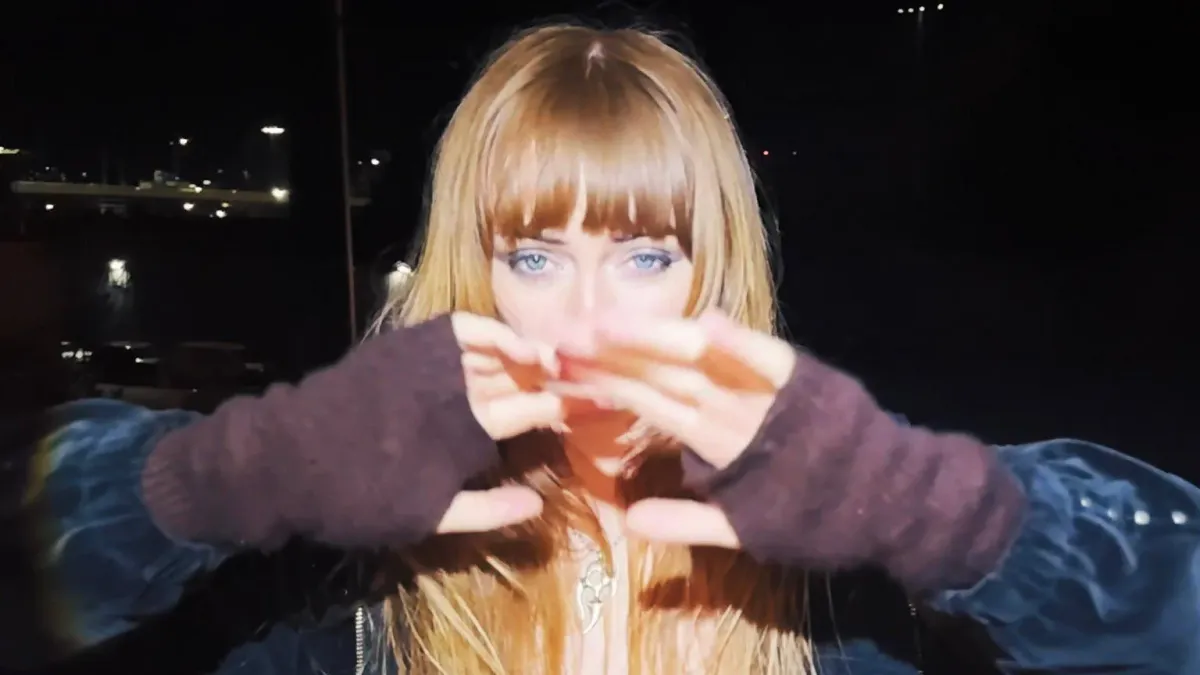
Pop history is littered with iconic origin story songs, from the Monkees’ theme and the Mamas and the Papas’ “Creeque Alley” to Art Brut’s “Formed a Band” and MGMT’s “Time to Pretend.” But “Sing Good,” by 26-year-old Australian electronic pop producer Ninajirachi (born Nina Jo Wilson), is one of the most charming, and emotionally affecting.
In the song, she recalls getting only a 40% on a music class assignment and Googling what a chorus even is. These setbacks didn’t hinder an artistic dream that was becoming increasingly real for her “cuz when the melody is meant for me / I’m gonna find it.” Of her former classmates, she muses, “I might never see them again / But I hope they're well and that they like the new songs that I've written.” It hits with a matter-of-fact innocence that’s not played for schmaltz, one that now a whole generation that’s grown up with Auto-Tune just being another fact of pop music can relate to: “Cuz I can't really sing good / But I'm still gonna try it / I might even like the way it feels.” The world is their Snapchat filter.
“Sing Good” hits even harder because it’s a winning little private intermission between one industrial-strength EDM banger after another on Ninajirachi’s full-length debut album I Love My Computer, one of the most easy-to-love surprises of 2025. She shouts out one of her first DAWs (digital audio workstation), FL Studio, on “iPod Touch,” and straight-up propositions her laptop on “Fuck My Computer.” And the album’s first line is “I’ve never been to London.”
So the whole thing plays like someone who doesn’t get out much before mastering all the best traits of their favorite music on home equipment and finally getting to see the world as a happy ending. It’s both relatable and inspiring, but that wouldn’t have been the case if every song wasn’t total ear candy. Highly recommended to anyone lamenting what has become of Grimes.
And now Ninajirachi has performed for two weekends straight at Coachella, debuting a new Porter Robinson collab reportedly titled “WannaCry” and following it up with beloved hyperpop icon Underscores joining her to remix another Robinson track, “Perfect Pinterest Garden.”
Nina spoke to me via phone shortly before her biggest gigs to date to ask about how she willed her success into reality, and why her music impacts even people (me) who don’t go out hitting the clubs or EDM festivals.
This interview has been edited for length and clarity.
Daniel Aaron @TND: Hi Nina! I Love My Computer really impressed me, and I’m not a clubgoer or raver. I’ve been told I’m missing out on a lot of context in dance music when I don’t really go out dancing. Is it a very different frame of mind to be in as an artist sequencing her own album versus how you build a live set from your music?
Ninajirachi: Umm… no, I think it's actually really similar! I think being a DJ helped me sequence my album so much. Also, to what you said about being a home listener, that is cool! The context of hearing dance music in a big room definitely is amazing, but I first fell in love with EDM when I was a 12-year-old on the bus home from school. I was not going to the club. [Laughs.] And then when I first went to a show and heard the bass on the big speakers, it obviously rocked my world. But at the same time, if you’re a home listener, that’s also what it’s made for as well. But I really do think that DJ shows where I’m playing my own music and also other people’s music set me up in a way that I could sequence my album’s songs with a lot of intention and produce the transitions and stuff. When you’re a DJ, your job is to keep the audience engaged and dancing and take them through the peaks and valleys of the energy. Stuff like that. So I’ve put a lot of thought into sequencing with the knowledge that I gained from DJing a bunch, I think.
Yeah, and the shape of the album has this feeling to me where it starts out kind of intimate, and then takes on more festival vibes as it goes.
For sure. When I had the demos, before they were all finished even, I would sequence them in Ableton, just the mp3s, and listen to the transitions. A lot of the time I’d go back and edit the songs based on what was coming next or after. Like, obviously, you can hear a bit of “Delete” coming in at the end of “CSIRAC,” and that's because when I put them next to each other instead of just on their own, it was like, ‘oh, that's a bit of a jump-in vibe going from that song to this one. So how can I make that more of a smooth landing?’ And also a song like “Sing Good” is the drumless soft moment of the album, and that couldn’t just go anywhere. Like, if that was just song number two, that would have been so random. [Laughs.] So, yeah, I just went back and forth until it felt right, basically.
I feel like this era, after the dawn of hyperpop, caters to those of us with shorter attention spans in a way dance music historically hasn’t always done. I don’t usually relate to a song that makes you wait ten minutes for “the good part” to drop.
100%, that's why I love pop music. That was my favorite growing up before I discovered any EDM because it was just so stimulating. You're never bored. It’s like next part, next part, next part. I wasn’t on YouTube discovering ten-minute-long techno songs with two sounds in them. No shade. I know that music has its place, but no shade at all. I was discovering music that, stimulated me in the same way pop music does, where it's like, ‘okay. It's a new sound here. Oh, there's chords now. Oh, it's a drop.’ Do you know I mean? Like pop-structured electronic music. I was so enamored with Sophie and PC Music and Cashmere Cat and even Avicii and Calvin Harris because the way their music is structured, I'm listening the whole way through. I’m never bored.
Lyrically, there’s all this biographical information in a song like “Sing Good.” And the album starts off talking about where you haven’t been. Were you consciously trying to will the next chapter into existence, where you wanted to go, how you wanted to succeed?
That's a good question. I think I unconsciously willed the next chapter of my… I did magic by accident. Like an accidental manifestation. Some of it was conscious, and some of it was like, ‘oh, now I have been to London.’ Which is very cool. There's still a lot of places I haven't been, but it's funny that “London Song” is about seeing places that you haven’t seen either, like, through the computer screen or from computer music taking me there. And now it's more true than ever.
And now that you’ve gone some places, do you feel more compelled to write about the things that you haven't done still, or more about the stuff you have now gotten to experience?
It's probably a mix of both, because that's also what my album was. It's probably always gonna be a mix of both, I think.
Things have happened very fast for you in the last year. What has been the biggest surprise?
Well, today, it got announced — I mean, I knew about it before today — but the Harry Styles Meltdown Festival lineup came out. And it’s just funny, like, when I was making my album, I never would have thought Harry Styles is gonna stream I Love My Computer. That was crazy. There's some people for sure that have heard my album that I never… I’ve never had my music reach beyond a small group of people before this album. When I was making my album, I never thought I would be supporting Tame Impala on an arena tour. I never thought Tame Impala is gonna hear this album and want to have me on his shows. Do you know what I mean? That was so far out of my mental idea of album release success, but it's awesome. It's fucking sick.
It is. Did Harry reach out to you personally?
No, it was very through the people, through the teams. [Laughs.] but I’m stoked. Super excited to play in London again.
“FL Studio free download in my search history” in “iPod Touch” was the first moment that touched my heart.
Oh, thank you!
Growing up, I started using FruityLoops when I was 15. Were you aware your personal experience would be such a shared one that resonates with people?
No. Especially because I grew up in a smaller town. I don’t wanna say it was a tiny country town, because it was only two hours away from Sydney, but it was. Especially when I was younger and I wasn't, like, traveling to the city. It did feel kind of isolated. I didn’t have any friends who were into electronic music and I didn’t even know anyone even remotely related to music production or anything like that. So it felt like this secret original experience that I was having. Then getting older, I’m like, ‘oh, we actually all experienced that.’
I didn't think “iPod Touch” would particularly be as popular as it was. I always loved the song, but it was the trickiest song to finish, on the production and structure. So there was a time where I was really fed up, and I was like, maybe this one's just not [going] on there. Obviously, I’m very glad I stuck it out. Even the video, we were like, ‘let's shoot a quick video at the beach near my house,’ and I think we were editing it up until, like, the night before release. Nothing about it indicated people would like it so much, but it's awesome. I’m glad they all like that one because it is personal to me.
It’s an amazing song. Why do you think FL Studio is so many people’s gateway into making electronic music?
I'm sure a lot of people have an equally special or sentimental relationship with Ableton or, I mean, I also have a soft spot for GarageBand because that was truly my first DAW. And now I use Ableton and love it so much as well. But FL Studio, personally I started with it because, after reaching the limitations of GarageBand, I just looked up what software my favorite artists used. Also when you first download and open FL Studio, the interface is very easy to understand. You can see the step sequencer, and you’re like, ‘okay, kick, snare, clap.’ It's so beginner-friendly in that sense for beatmaking, so maybe that's why. Whereas I love Ableton so much, I use it every day. But when you first open it as a beginner, it does look a little bit like some Windows 95 situation. [Laughs.]
Do you remember first time you had a breakthrough using a DAW to realize the beats in your head?
That's a good question. The first full-length thing I made was a bootleg Lana Del Rey remix, which is so 2011. Everyone was doing that.
Oh, yeah.
But the first, you know, three-and-a-half-minute original song I made was in 2014. That felt like I’d climbed the hill. Before that, I’d just kind of been bootlegging things to learn how.
I was also struck by your computer knowing you best as a positive thing. This is a time when AI has run amok and many people love their computer because it lets them, like, harass people anonymously. Your record is a gentle reminder that sane and good people view it as an artistic tool and security blanket, too.
For sure. Is the question whether I still feel that way?
I guess I’m expecting a lot of music with anti-technology statements to come, because it’s been hijacked by so many bad forces, and I was wondering if you were consciously pushing back on that with a positive sentiment.
Maybe. I don’t think I was really trying to make some grand statement. It was a pretty myopic process; I was just making music about myself. So when I had a few demos that felt album-y, once I looked at them, I thought ‘what is my music really about?’ Like, what is the essence of it, the square root of my identity and practice, rah rah rah. And what am I always talking about when people ask me about my music and stuff?
So I was thinking about how it’s all computer music. I sing all my songs, but I probably wouldn’t do that without the assistance of a computer because I’m not a naturally strong singer. I really wasn’t thinking about the world and evil tech and stuff. I was just thinking about how I love getting to be a musician and if I had been born a hundred years ago, maybe I wouldn't be a musician. Maybe I would have done something else. I was writing songs when I was a kid just for fun, but the first time I was like, ‘I really wanna know about music’ was when I got into electronic music. That was what shook my world. I was just thinking about how grateful I am to be alive at a time where I get to learn about my favorite thing and make a life out of it. I honestly wasn’t trying to make a statement. But if it inspires some positivity, then that's awesome. I'm very happy to be doing that.
I take it when you were making the record, you didn't expect to be asked things like that?
Yeah, I wasn’t making the music with consideration to how I would talk about it or what people would ask me about it. It was just like, ‘oh, this sounds good to me.’ I figured people would ask me about “Fuck My Computer” because it's silly or provocative or whatever. But I didn’t really feel like anything I was saying was that deep. But if it is, that's cool as well.
And I know the album brings up conversations about trance music but when I listen to it, I hear Grimes in 2015, Madonna in 1998, obviously Sophie and PC Music on “CSIRAC.”
It’s so cool that that's the world that you hear it in because those are some of my favorite artists. The way that I came into liking electronic and dance music was not from going to a show or a rave or anything like that. It was really just listening in headphones and thinking, ‘wow, this is such emotional, euphoric, and stimulating music.’ I would listen to trance and Madonna and Grimes and Sophie; it’s all kind of one big pot to me. And also, they’re all electronic-related.
Are there any non-electronic songwriters who have had a profound influence on you? I know you talked about the song transitions earlier and I’m especially fond of some of the key changes at the end of a couple tracks.
Yeah, one of my favorite bands in the world is Alt-J. I think they always have pretty interesting song structures. There's pretty often a nice surprise where there will be a tempo change or a totally different bridge. A lot of the music sounds really different from song to song. I’ve always felt like it sounds like producer music. Their first album blew my mind when I first heard it as a 12-year-old. I'm really into them. I’m trying to think. I’m blanket-terming but, honestly, pretty much all my favorite artists are producers. So their music is informed by the production and it’s a very cohesive vision in that sense and all very considered.
Do you feel like that happened by coincidence?
Yeah, I guess so. Well, sorry, I know I just said that, but it's also not necessarily true. Some of my favorite formative music when I was really young was pop where the artist probably didn’t have much of a hand in the creation of it at all, like, writing or production. But they're still an awesome artist because they have the vision and, like, the curation and stuff. So it just depends. But, yeah, a lot of my favorite artists, at least at the moment, are people who produce or lock in with one producer. That consistent sound, you know what I mean?
And from there, I wanted to ask you about producing 2charm’s Star Scum City, which they've described as “gooner-pop.” Was that a serious idea that was discussed while working on it?
Oh my god, absolutely not. That’s their vision. I was not there for that. [Laughs.] I don't know how much I’m allowed to say because 2charm was invented after we made a bunch of music together, and we didn't know where any of it was gonna land. Which is the same for all the songs on my album and basically everything I work on ever. I never really do sessions where it's like, ‘am I gonna go and work on this person's album?’ I just make music, and then we figure it out. I don't like the pressure of the cage on my mind. So we had just made a bunch of music, and they had made some with other producers, and they were like, oh, we’re gonna make this project 2charm. So, no, all of the rollout and the vision is theirs. We didn't even about 2charm when we made the songs.
Now that you’re experiencing worldwide success, has it gotten easier or harder to write new music? I could kind of see it going either way.
Am I? That's sick. [Laughs.] I’m just doing so many shows. I haven’t had a second to stop and, like, think about everything. I’ve had a really hard time making new music. Not because I'm uninspired — I would love to just go away for a month and make another ten albums. Before this, I’d only ever done singles and EPs and a mixtape where the cycle is shorter and also the releases were less popular. So I was doing less touring. It was like, ‘okay, that one's out, yep, time to make the next one.’ I can't fathom the concept of my next album being, like, two or three years from now. Like, that's too much. I need to keep it moving.
But, yeah, just very busy with travel at the moment. It’s really disruptive. It’s a bit disheartening to get on a roll with an idea, and then it's like, we gotta get in the Uber or go to the show. So it’s harder to get those periods of being able to lock in really meaningfully on the road, but I'm doing what I can. I'm really inspired, so I'm doing what I can.
What do you think?
Show comments / Leave a comment