
Listening to Mandy, Indiana's second album URGH for the first time on the train, my Bluetooth headphone device started glitching the fuck out. This occurrence triggered a ludicrous hypothesis: if there was a record made that could unequivocally kill technology, would anyone dare to release it?
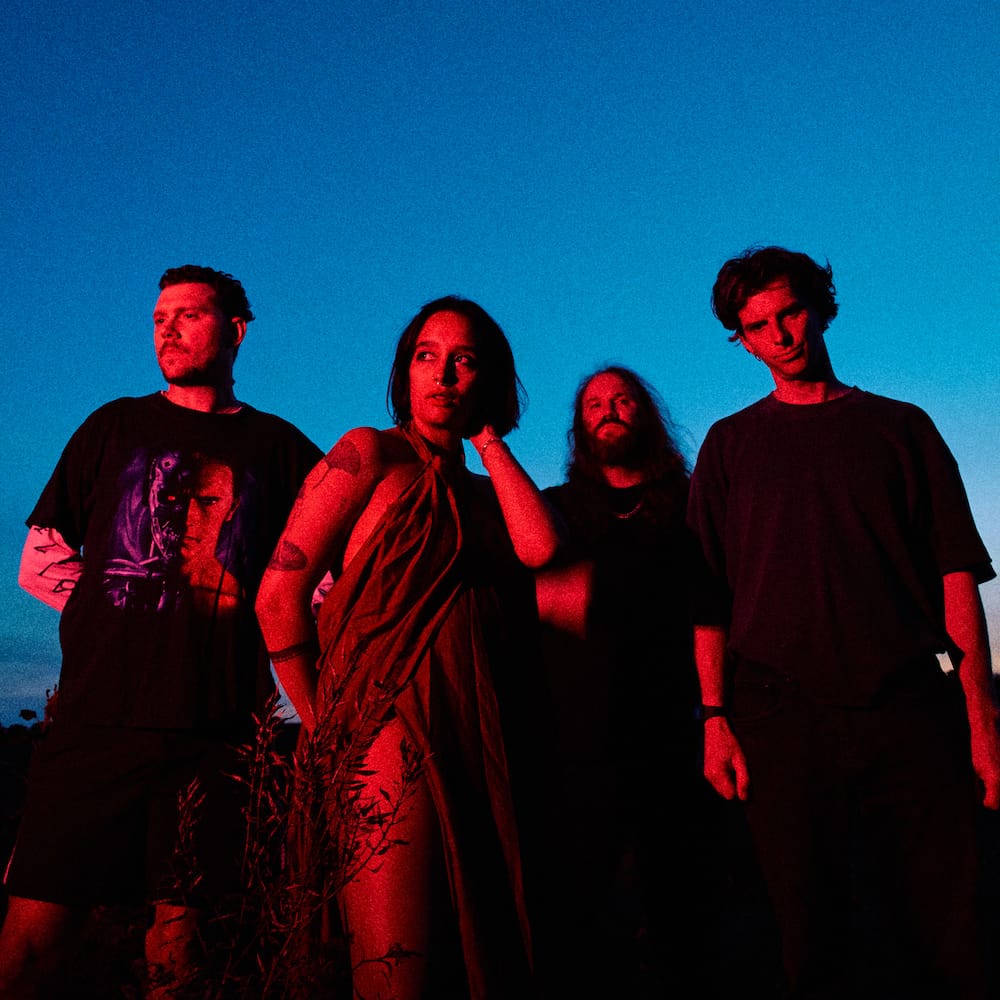
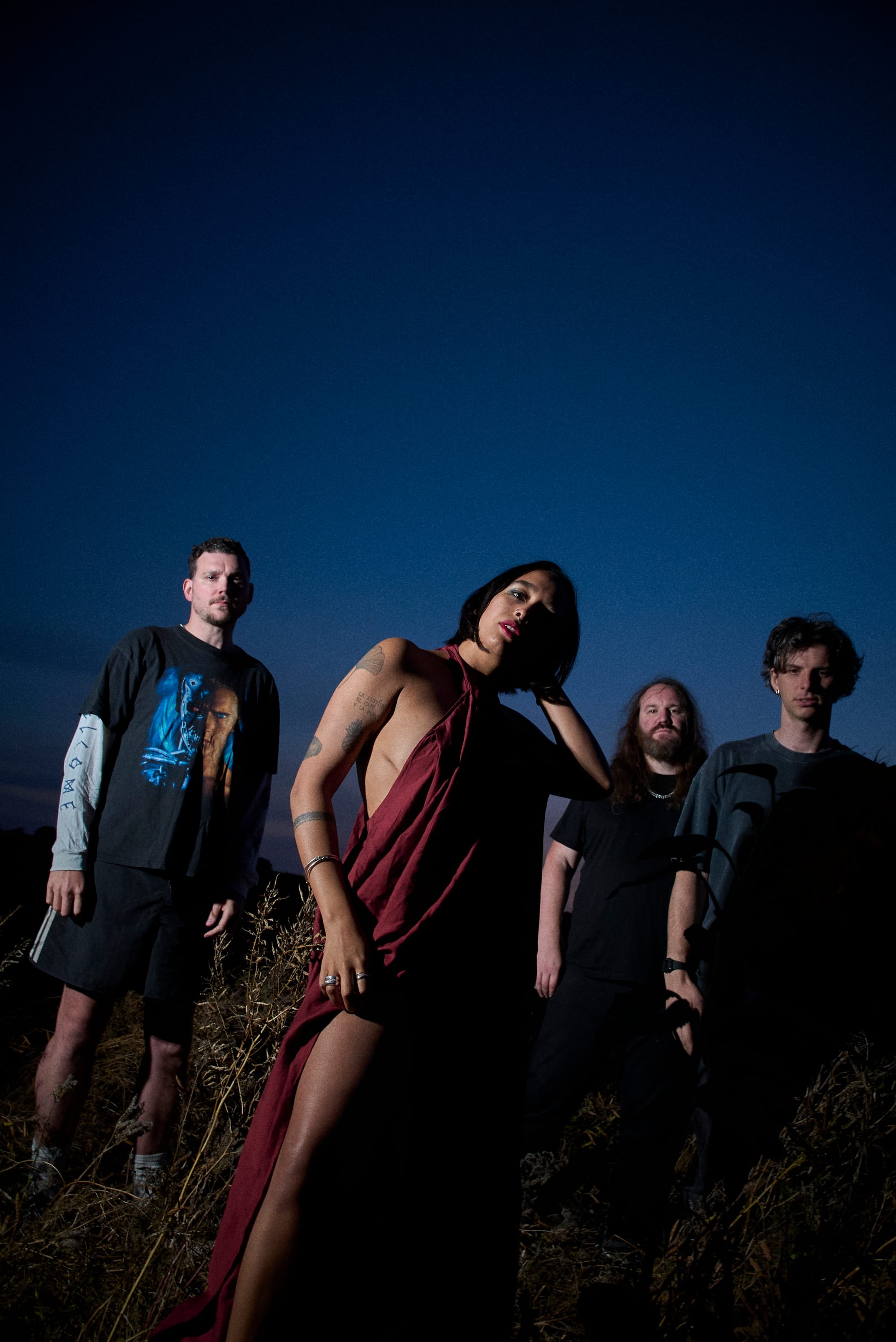
Mandy, Indiana – the quartet of vocalist Valentine Caulfield, guitarist/composer Scott Fair, synth/percussion player Simon Catling, and drummer Alex Macdougall – isn't concerned about being a rock band in the traditional sense. Their ravenous splinter-bomb avant-noise pop actually makes me want to compulsively run back this wonderful quote by Brian Eno: "The excitement of grainy film, of bleached-out black and white, is the excitement of witnessing events too momentous for the medium assigned to record them.”
Debut album i've seen a way refreshingly established Mandy, Indiana as a band of the Throbbing Gristle mold, eager to experiment with recordings made from anywhere but a professional studio. Parts of the record were captured in shopping malls, crypts, and – why the fuck not – they even tracked drums in a cave in West Brighton, making the chaos inherent of the environment part of the band's pièce de résistance.
This kind of organized noise, the pushing of music beyond their carriers, often-times is put in a dystopian context, with influential artists like Kraftwerk and movements like industrial rendering the pop music idiom within these stark mechanical geometrics. But with life now dictated by algorithms, systems, metrics, and machines, with every variable converted into quantifiable data, Mandy, Indiana seem quite content in a constant state malfunction – an artistic choice that feels radical.
Indeed, the elusive brilliance of a Mandy, Indiana performance is something to behold. The band was set to present their new material at Nijmegen's Zeitgeist festival billed next to the likes of Lambrini Girls, CLT DRP and Grote Geelstaart. But fate intervened: KLM lost the band's gear. So Mandy, Indiana are here, and their instruments are not.
Nevertheless, I meet Macdougall, Catling, Caulfield and Fair in relatively jolly spirits after the dust settles from particularly raucous The Null Club set. Fully cognizant of the risk management of playing in a touring band, Catling is able to crack a smile about the whole fiasco: "It was bound to happen at some point."
Interviewing a band in the flesh is quite novelty these days, even more so one that isn't feeding off of that dopamine-fueled post-show adrenaline. The collective energy between the four members on this sofa is somewhere between 'elated' and 'non-plussed.' The process around making URGH was a lot more fragmented and long-distance – part of it due to geographic reasons (Caulfield has moved to Berlin), part of it due to other duties and responsibilities everyone in Mandy, Indiana has to maintain outside of working in the band.
"The band being reduced to a Whatsapp-group was a bit of a naigational challenge," Catling deadpans. Serendipitously, Mandy, Indiana court dysfunction rather than be compromised by it. One of Fair's foundational childhood memories was seeing footage of the Universal Studios Jaws ride. "The trauma actually came from a video my grandparents had of the ride," he recalls. "So I used to watch that as a kid in their house. I had this fear of falling in the water. Because some parts of that ride are like half the shark. They didn’t make the back half, you don’t see that in the water. So I had this fear as a kid that I would fall off the side of the boat on the ride, and like to see the shark – in a weird way, half of an animatronic shark. It was actually my sister who said out loud: ‘Imagine if you fell off of that boat.’ And then my imagination ran away with that."
There's an infectious disharmony within Mandy, Indiana, particularly between its two founding members, Caulfield and Fair. When films like Crimes of the Future and Titane were brought up as possible touchstones for Mandy, Indiana's creative process, Caulfield immediately vents a roguish disgust for Léa Seydoux and Kristen Stewart's performances in the former picture, while Fair leisurely confesses, "I’d probably be into that!"
Later on in our interview, their opinions clash again, when I described "try saying" as a "corrupted Timbaland-production," prompting Caulfield to jest "I hate it even more now!", whereas Fair appears happily blindsided by this descriptor. Caulfield swiftly backpedals on her take on "try saying", but her little verbal prick does allude to URGH living up to its title. "I think it’s our best work and I’m very proud of what we’ve done. Doesn’t change the fact that it was a hard fucking process," she later elaborates.
Furthermore, one can sense visible ambivalence in Mandy, Indiana in allowing outside reference points to mark their art. A common narrative in bands is to always name their influences, to formulate some kind of contrived cause-and-effect narrative of why the music sounds the way it does. Caulfield's musical background doesn't abide by such narrative logic. The short story reads as someone who has studied classical music and sung opera from the age of five, only to flip on a dime and rebel into punk rock and alternative music in her late teens.
But there has to be some kind of turning point to just make music completely differently – this concrete formative moment. But Caulfield persistently opts for the "boring" answer: no, there really has not.
"And also, now having treated my voice the way I have, even if I wanted to go back to classical music, I couldn’t do it," Caulfield confesses. She says she still loves classical music and singing, even after having forfeited her ability to sing and perform it after the mileage that comes with snarling and screaming in punk bands. But Caulfield is quick to deem it less as a regression from her natural voice, and more as organic change that's in no way inferior.
Aside from their often hilariously clashing takes on popular culture, Fair's trajectory into more – shall we say – atonal musical avenues rings remarkably similar to Caulfield's. Initially brushing with more professional studio environments, he quickly realized he didn't want to chase proficiency and technique, gravitating more towards physics and moods.
"I was curious to push things to a more extreme area and what the limitations are with that," Fair says. "And it’s really fun doing that. It’s great when you realize you can always go deeper with something. You think you understand it and someone splits the atom or whatever, somebody opens it up. And you’re like 'Woah fuck, I didn’t know you could do that.' And you go further down that wormhole."
In any type of music making, courting such a quest feels altruistic, until the cracks of that resolve start to occur. As its title so bluntly echoes, on URGH, Mandy, Indiana weigh their personal toils starkly beneath their artistic pursuits. It expresses all the stresses and the strains; the physical and psychological mileage accumulated over time. All four band members, now "solidly" past their thirties, are candid about transposing this gradual atrophy to their music.
"At Coachella I jumped off this stage not realizing how high it was, then I split my toenail down the middle," Caulfield shares. "It was horrible. First I thought I had broken a toe. And then I looked at it, and my nail was split down the middle. It was disgusting. It grew and then it fell off and now I have a normal toenail. And then I almost went blind in one eye this year." Caulfield has had a total of three surgeries on her left eye to minimize the damage.
Fair promptly reminds Caulfield: “What about that one time at bluedot festival, where you fell over a monitor?” Caulfield responds: "Oh yeah! I genuinely fell backwards in a way that could have been dramatic. But then I just flipped it into an almost perfect back roll. "
Macdougall also had to cope with several taxing physical ailments during the making of URGH. "My work outside the band required me to carry heavy equipment every now and then," he explains. "I got a hernia which isn’t very rock and roll, but maybe it is rock and roll. I had surgery for that September 2024, and then it got infected – I’m still getting pain from that so that’s annoying. Then I had surgery in January 2025 as well because I had a lump on my thyroid. So I had my fair share of surgery this year as well."
Instead of opting for rest in between surgeries, both Macdougall and Caulfield opted to push through. Caulfield admits that it wasn't always fun. "I had to record a week before my first surgery, when I was so unwell. I was basically waking up, working, and going back to bed," Caulfield groans. "Turns out losing your sight is actually very tiring. So that was absolutely no fun. But it wasn’t the first time some personal shit came in the way of doing things with the band, and the team around us is very conscious of the fact that I would have felt bad if I had delayed the making of the album. It made more sense for me to get it out of the way and then go and have surgery. But as a result it was a really tough process."
"For me too," Macdougall adds. "When I was recording the drums I was like ‘Why is this so hard?’ It’s really physical drumming. By the last day, I was just a brain in a jar. For me it felt like drumming in survival mode rather than enjoying it. Not to glamorize that in any way." Fair says a lot of URGH was constructed in a sample based way: chopping up and rearranging parts, then reinterpreting them anew with live takes.
"I feel my best ideas on the drums come by complete mistake," Macdougall says. "So I was going into the room and playing with a recorder running, just to capture something that happened almost by mistake. I sent the most interesting ideas to Scott, and he’d build something around those ideas."
"A really good example of that on the album would be 'try saying'" Fair elaborates. "That track was constructed with sampled drums, and then the chopped up sample parts played live again by Alex. In the end it was an imagination of all of that: there’s parts of what he originally played, stuff he did in the studio and stuff that was like sequenced from either or both. That’s one track on the album that kind of has that remixed feel. That was one of the last ones where we got the mix right. It was so difficult to dial that in." Macdougall says, "It forced my limbs to move in ways I never would think to do myself."
Caulfield notes that with i've seen a way, the music has much more of an overarching narrative, whereas on URGH, the band was geared more to making each track is more its own insular thing. "On our first album we thought it was kind of a journey," she says. "And we feel this one is less of a journey and maybe more of an album, if that makes any sense. The storytelling is definitely different, it’s also telling stories, but on the first album there was more of this cinematic aspect than this one. Which makes it sound negative, but I think this one is so much better."
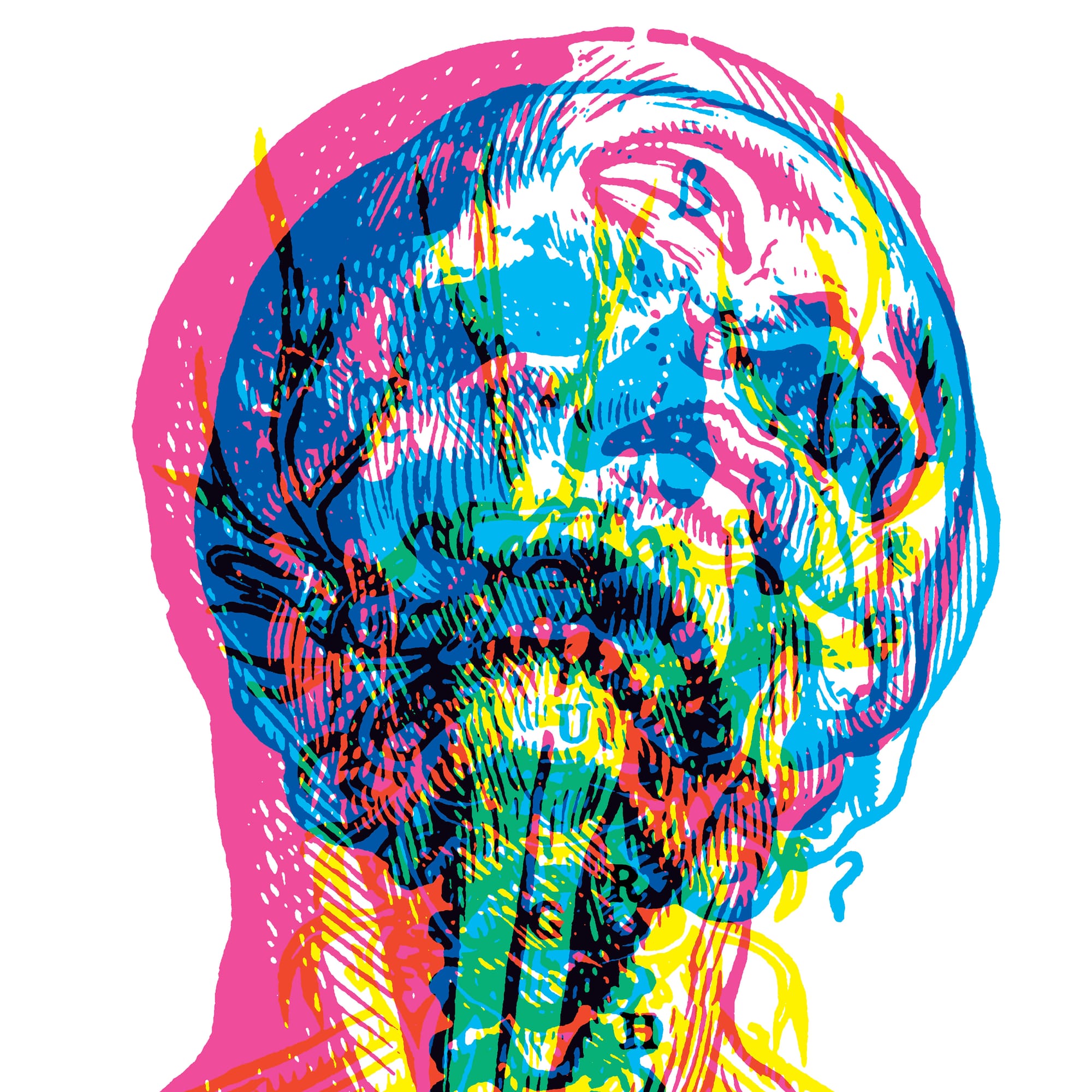
She calls the songs on URGH "more polished," adding, "but there isn’t that kind of storytelling aspect that takes you from the beginning like with [i've seen a way opening track] "Love Theme" where you go down into this underwater room and leads through the thing. This one doesn’t have so much of a narrative arc maybe."
"For me the influence of cinema is that I generally get more inspired to write a song after seeing a film more than after going to see a show or listening to an album," Fair adds. "It’s more personally that that’s where I draw inspiration from. It’s the combination of visuals and audio where I'm like 'I want to make something that feels like that.' But as Val said, the first one feels more structural and narrative-led, there’s even sort of recurring musical themes throughout the tracks. URGH is more track-based; everything’s a little more self-contained."
Each song on URGH is a crucible for deep-seated, front-line experiences. Lead single "Magazine" is a cadaverous "primal scream" revenge fantasy where Caulfield hunts down her own rapist (she courageously came forward on Instagram in 2023 about this traumatic experience), while album closer "I'll Ask Her" – one of the few songs where Caulfield trades her native French for English-spoken lyrics – acts as an austere PSA against rape culture.
Some tracks sprout into unlikely moments of beauty from their withered, miasmic roots. "Dodecahedron" stampedes with mechanized menace, but seeks illumination with a headstrong call-to-arms (Caulfield spits the rather timely line "Leurs tours d’ivoire ne les protègeront pas lorsque nous détruirons leurs sociétés immondes", which translates to 'Their ivory towers won’t protect them when we destroy their disgusting societies'), before dovetailing into a pixellated trance.
URGH goes against the grain of a traditional sophomore album, which usually revolves around refining and further cultivating the winning elements of the debut LP. If anything, all four members agree on actually making the work more obtuse and ambiguous. "When you look back at the repertoires of loads of bands, sometimes they put out a record that is headier and more considered," Fair says. "And then they want to do something different. That’s how I felt with this record. I just don’t want to make that record again. It’s not like ‘What is Mandy, Indiana, and how do we want it to be defined?’ More like ‘What feels right?’, and stumbles in the dark a bit towards whatever that is."
"It’s always an encapsulation of how we’re feeling at every given point," Caulfield adds. "I think a lot of the lyrics are very personal because I was going through some shit, and they capture how I was feeling at that point. A lot of the lyrics are more political because that was also how I was feeling at that point. I don’t think there is much consideration in ‘What is my output in the world, what do I want to bring?’, but more ‘who are we at any given moment’."
"I saw an interesting interview with David Lynch where he was asked: in your film The Elephant Man, did you set out to make a film and change things politically?" Macdougall comments. "And he was like ‘I absolutely do not think about changing the world.’ It’s just pure expression. And I think when something’s done with that pure artistic mode of thinking, you might actually change the world."
"There’s this really famous parable of the rabbi who says ‘When I was young I wanted to change the world, and that was too hard. So I decided to change my community and that was too hard. So I decided to change my family, and that was too hard. And I decided I was going to change myself. And as I grew old I realized that by changing myself, I changed my family, my community, and by changing my community, I changed the world. I don’t think the four of us are gonna take on the fucking world, but maybe we’ll touch someone. We can’t set out to ratify all the wrongs because we’re not going to."
Macdougall confesses the cycles and machinery of the industry can feel equally nourishing and self-destructive much like the Ouroborous, the snake eating its own tail. "It feels to me like things like social media where it’s very stimulating, but not necessarily all the time in a good way. For me it’s this parallel feeling of how I experience things like social media these days. A whole jumble of things being chucked at you, and it doesn’t always feel great. But it’s also quite addictive."
You're not going to single-handedly reverse the polarities as a noisy, outspoken band. But you can be a little glitch in the system – one that hopefully contributes to resetting itself – opening a window for reinvention.
Halfway through "Life Hex", the skeletal drum machines seem to malfunction – forcing listeners to double check whether the music is on verge of devouring itself, or whether it perseveres through the strife. "I remember recording the vocals for 'Life Hex' and Daniel (Fox) and I were going absolutely fucking batshit crazy on the incessant change in time signature," Caulfield says.
"We talk about stuff like that when we see bands on the cusp of falling apart," Fair adds. "Even on records where the music sounds like its teetering on the edge of collapse, but it doesn’t quite get there: it plays with your expectations of what a 'professional' record is."
Caulfield agrees: "I think there’s definitely a joy in letting [in] a level of trial and error that you’ll never detect with something like AI. Especially with other types of music that do feel more polished, which I really don’t care much about. Lambrini Girls are playing later today and I love them so much. I think what they do is genuine pure chaos. And it’s just raw and authentic. and there’s a beauty to that that you’re never going to get from a machine."
The breaking points Mandy, Indiana actively seeks out on URGH do invite the inherently French mentality of working to live, and not the other way around. Whatever half is hidden below the surface can be a departure from the rigid structures forced on us. Or, as Fair adequately puts it: "I’m more likely to engage with something because of its ambiguity. To awaken something in me that I didn’t even know about myself."
Every fracture, every outburst, every silence is a potential ground zero for renewal and healing. On Caulfield's arm I notice a piece of writing tattooed - written in cursive – which is "mistakenly attributed to Frida Kahlo." Caulfield translates: "It means 'hope, coffee, and poetry.' But it’s from a poem that’s really cute – it says, 'You deserve a love that wants to see you disheveled in the morning. And you deserve a love that brings you hope, coffee, and poetry."
Mandy, Indiana's second album URGH is out Friday, 2/6 via Sacred Bones. Buy the record here.


What do you think?
Show comments / Leave a comment