

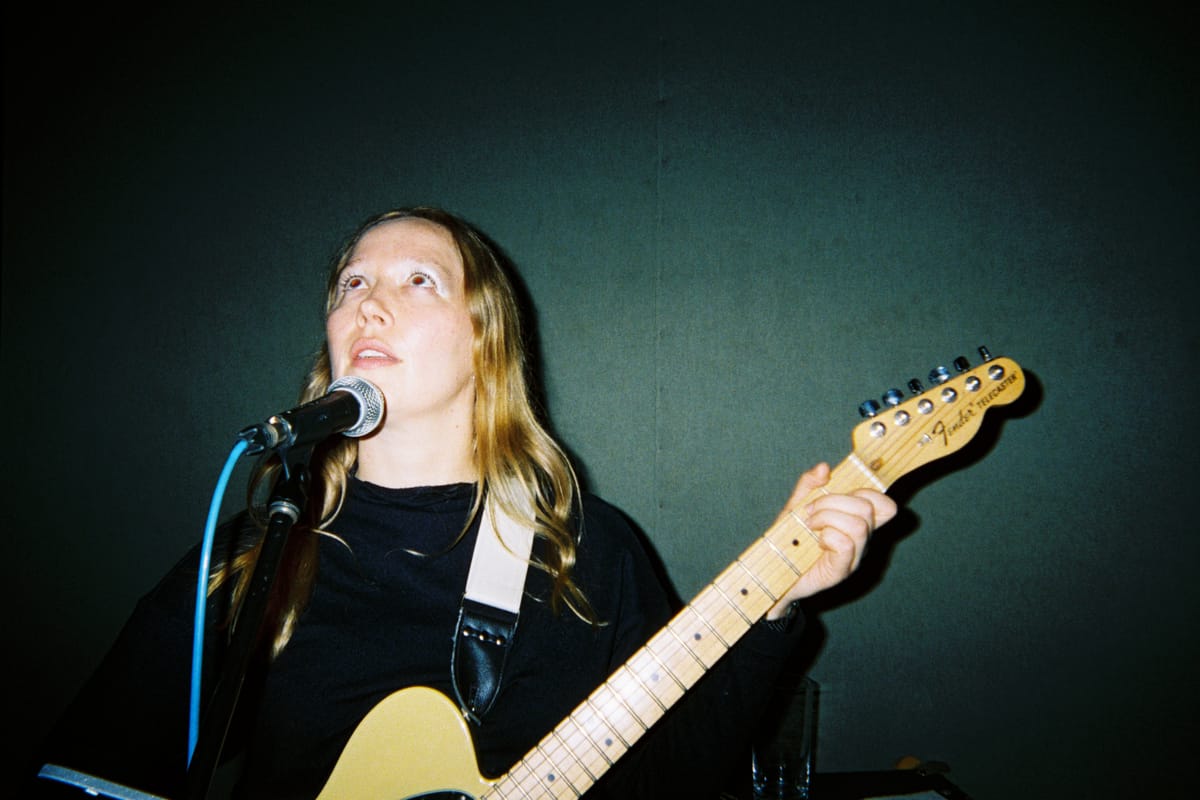
When Australian singer-songwriter Julia Jacklin told me that our interview was one of the only things during a press-focused trip to the east coast of the US that wasn't filmed, I felt weighed down by resign. I met her on a rainy July afternoon in Philadelphia in one of WXPN's broadcast booths. Clad in knee-high boots and fishnets, Jacklin had just wrapped a taping for the station's nationally syndicated program World Café. The day prior, she was in New York City both for said press-ops and to play a pop-up show at Union Pool."It's been four years since I last released an album and everything has changed," Jacklin declared onstage. She meant that in more ways than one.
Her fourth record, The Gem, is a mark of change across the board. It's her first record with an entirely new team, her first on storied indie label 4AD, and the first she's made without the weight of a time crunch.
The liberation of broken patterns explored in The Gem's honest and pragmatic lyricism is mirrored by the process of its very creation. The record is named after the bar in Melbourne that Jacklin became a regular at after becoming a local in 2017. Above the bar lies the Rat Shack, a recording studio owned by Jacklin's longtime friend Robert Muinos that was home to The Gem's year-long slow burn production. On her previous records, she'd shack up in a North American city after tour and knock out all the tracking in a couple weeks.
"[The Rat Shack] didn't have the feeling of a recording studio in particular," Jacklin explained. "It was very easy to kind of get out of your artistic head because you're in a pub and you can hear people working downstairs. Sometimes we'd have to ask the kitchen staff very, very, very gently if they could just turn down the music. There's a tattoo studio next door, there's a hairdresser down there, so there's always stuff going on, there's people walking around. I felt like I enjoyed that, I enjoyed being around people, I enjoyed the limitations of not being able to record drums too late because we were in a suburb."
Sometimes the livelihood of The Rat Shack's surroundings found their way onto the record, like a slammed door at the end of the devastating "You Turned On The Tap." Another track, according to Jacklin, "...you can hear the band playing downstairs at the end as it fades out."
"Recording music can feel like you're trying to replicate something that is usually shared and with other people in a really sterile environment and you're too focused on the sound being perfect. It's so weird because you're like, 'well, this isn't how music usually feels,'" she explained. In the past, she'd felt pressured to continue leveling up and diversifying her recording personnel, but Muinos' transparency as an engineer and his open-mindedness to Jacklin's continuous tinkering resulted in The Gem feeling and sounding more lived-in than any of her previous work.
In another form of change, Jacklin's trip to NYC harbored a rude awakening about how media and the music industry has changed since we'd heard from her last. "Now everything is filmed," she tells me, trying to decipher her own feelings on the matter.
As the rollout for Jacklin's fourth record, The Gem, continued to unfurl, her apprehensions and mild exhaustion towards new media stared daggers back at me from my phone screen. During her NYC trip alone, she filmed in the Criterion closet, shared her "perfect ten" album for Pitchfork, played "On That / Off That" for Rolling Stone (a clear rip of Pitchfork's long-running "Over/Under" video series), cooked a dinner of fish and salad with influencer chef Noah Tanen, and answered some rapid-fire questions for indiehourzz, a meme page turned short form interview and editorial hub. Elsewhere, she shuffled her library for Australian radio juggernaut Triple J and served as the guinea pig for for a new short form series from Polyester Zine where she answered questions while crafting up a collage.
I don't blame her for coming away from all of that with the reflection that everything "just feels more internet-y now... [it] adds an element to [press] that I think is pretty strange. It feels so separate from the music, too," she shares. While Jacklin admits she isn't particularly experienced or comfortable on camera, she succumbs to the reality of its role in the promotional mill. "You have to adapt as you get older in this industry," she says. "If you want to do press and promo, this is what it is now."
The reels-ification of the press cycle is something I have found myself struggling with on the other side of the coin. What is an interview like this worth to the artist, their fans, their publicist? How can I still engage with the artist and their art in a way that is meaningful and representative in a way that can't be captured by rapid-fire vies for people's attention? To promote an album these days is to promote the human being behind it as the music itself plays second fiddle. As a 22-year-old, I barely know a time before this reality. If anything, the dissolution of the traditional music press is what enables me to be able to speak with an artist of Jacklin's calibre in the first place, but Jacklin says it best herself: "Every generation is dealing with completely different things. Like, I'm not sure if I could even give advice to younger people now, because the world that I came into this work from is now very different."
All I know is how her music makes me feel.
There is a measured and gentle demeanor Jacklin holds that translates effortlessly into her music. The first time I remember her music stopping me in my tracks was how casually she could deliver a gut wrenching recollection: "He took my hand and said 'I see a bright future, I'm just not sure that you're in it,'" she sings in the second verse of "Turn Me Down," a highlight of her breakout sophomore record Crushing.
Jacklin continues that allure on The Gem as she navigates heartbreak and what it means to truly take the reigns of her own life. "But you have to be a god sometimes / Force the moment to spring / Unlike the seasons / It won’t just happen," she sings on the spacious and self-assured "God Sometimes." The following track, "If I Had The Hand Of God," finds Jacklin on the more uncertain side of that coin: "If I had the hand of god / would the god whose hand I have / be the kind to know when to let go / before it gets this bad?" she ponders in the song's final chorus, foreshadowing the heartbreak to follow.
"I'm actually not talking about the God I was talking about in PRE-PLEASURE," she clarifies. "[On PRE-PLEASURE] I was actually talking about God and talking about Catholicism," (see: "Lydia Wears A Cross"). "Whereas God on this album, it's more just like a concept. I'm using God as a metaphor for control... We live in a world where God is just, whether you're religious or not, God is a presence in some way. So I think it's just very common for, for artists and songwriters and writers to reach to religious motifs in their work. There's a history of that in art, but also it's kind of unavoidable to be a human being and not absorb it in some way," she opines.
"If I Had The Hand Of God" in particular was written stateside while Jacklin was in Nashville between legs of tour. Because of the pure cost of airfare between the US and Australia, spending the break at home wasn't much of an option. "If I've had anywhere under a month break between tours, I just wouldn't really go home. So then you're kind of spending your break time somewhere random," Jacklin explained.
The song itself came from the disorientation brought about by touring and the liminality of those breaks. "I guess I think about it sometimes like wanting to zoom out of my life so I can have a better view of what is going on. And then I can be better at knowing what to prioritize. I think that being a touring musician is such a chaotic existence. And it's like, there's no routine, so I always feel a bit out of control." She says her best advice comes from bandmate and longtime collaborator Mimi Gilbert: bring a rice cooker. "Eating on the road is one of the hardest things to do. Everybody's stomachs are so fucked," Jacklin says. "The stomach's connected to the head so everyone's gut is crying out on the road unless you really lock in."
The final boss of The Gem's themes of taking control is found on emotional centerpiece "Angel Vision," a track where the gut punches are slow but all the more impactful. I was stunned sitting at my local coffee shop while previewing the record as Jacklin cries out "The vines that grew were blocking my view / I let you teach me things I already knew."
She expounded on the song's meaning:
"That song is about being mistreated in a relationship – and that can mean any kind of relationship – where you realize that you were like diminishing yourself in order to be accepted or to be loved or just because it felt like you had to... like you couldn't actually be yourself. And you couldn't show your strength and your intellect and that over time, you know, you'd get so used to doing that, that it's like, you forget that that's actually not what you're like. Sometimes it takes getting out of something and it takes a while to realize like, 'whoa, like I was really crushing myself down into what I felt like was an acceptable size.'"
A song like "Angel Vision" is a prime example of the way Jacklin so aptly communicates life's hardest truths, accepting their presence with grace and palpable humility. It's her greatest strength, and one she hones further with every album.
The Gem is out now via 4AD.

What do you think?
Show comments / Leave a comment