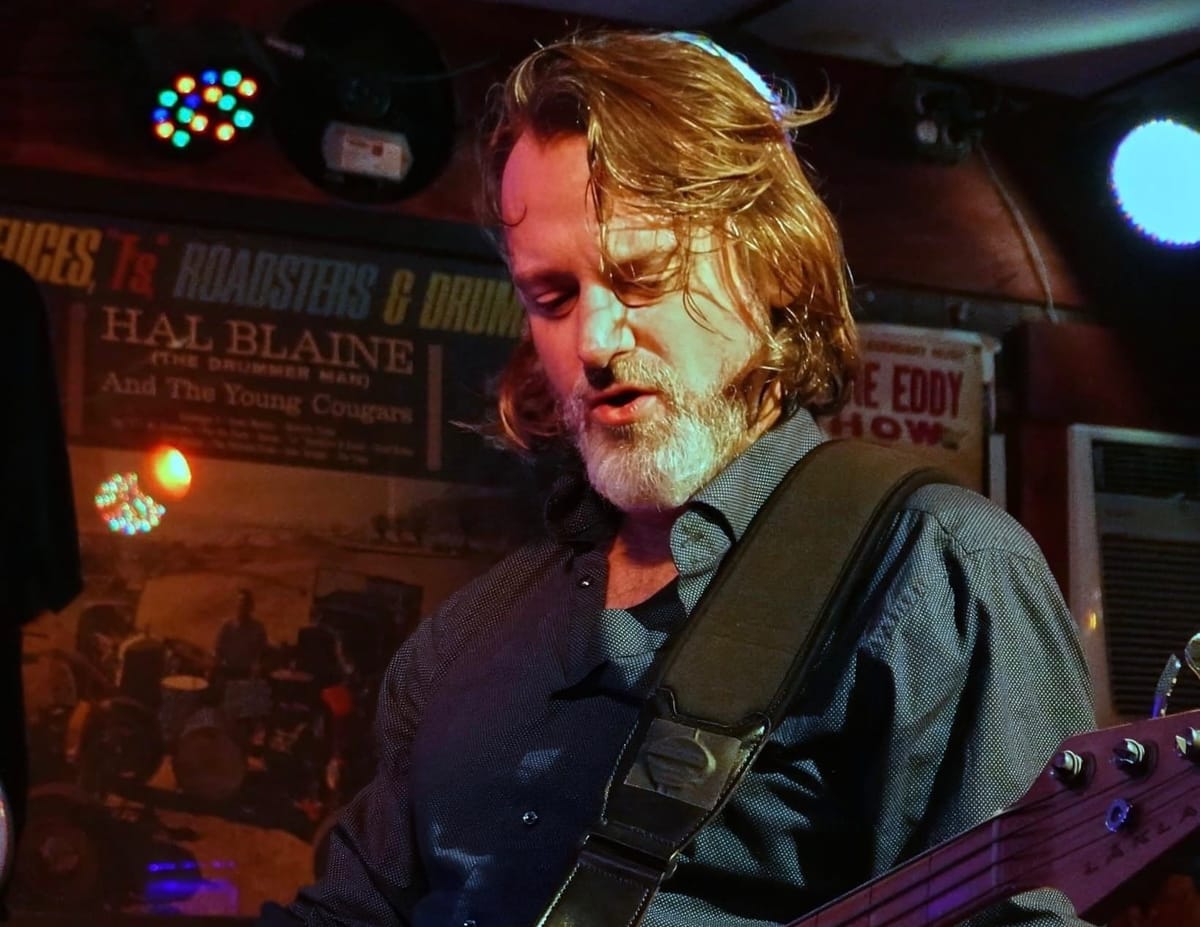
Pete Griffin has had one hell of a bass-playing career. Early on, he established himself through a one-two punch, touring with pop stars Hanson and Frank Zappa's son, Dweezil (in Zappa Plays Zappa). He's a Grammy winner, plays "in" virtual metal band Dethklok, and is the guy to call when you need a bass player to round out your rock or metal supergroup. TND's Tyler Roland sat down with Griffin to discuss his wide-ranging history.
This interview has been edited for length and clarity.
Tyler @ TND: Your body of work is so multifaceted and hard to pin down, that I think it could be difficult to sum you up in a tagline. Is there one sentence to envelop your career as a musician?
Pete Griffin: That’s a great question. Kind of puts me on the spot. The tag that I hear from other people is "that guy can play anything." When I'm on a jazz gig, I'm the metal guy that's on the jazz gig, when I'm on a pop gig, I'm the jazz guy that's on the pop gig, when I'm on the pop gig, I'm the metal guy who's in the... you know. So I'm always sort of an outsider, but that gets me some credit in each of those things, because even the most-versed jazz player can't really play a pop song that well. So the fact that I can put on a lot of different hats, and hopefully convincingly wear them... none of that is a tagline, but it's sort of the goal.
You're known for doing the Zappa Play Zappa stuff [with Frank's son, Dweezil]. I think of people who've played with Frank Zappa as being like the alumni of a notorious professor. Do you see yourself as a part of that school, so to speak?
I can't say I worked with Frank. From all the stories I've heard, just being in the room with the guy was a very formative experience. He was such a strong character. I mean, most geniuses are. There were probably times where he was hard to deal with, but the way he would get his ideas across, that directness, you kind of need that as someone who's telling a bunch of musicians what to do.
I read the "curriculum" that he wrote. With the early days of the Dweezil band, we were able to get separated tracks. So I had the bass stem for songs that I thought I knew inside and out. But, by suddenly getting into it and hearing what was actually being played by the bass, that's an education right there. [The bass] didn't just double the guitar part, like, [it was] doing this harmony of the keyboard part. Had I not put the magnifying glass to that, I would have never found out. The one time I met Dave Grohl for 30 seconds, not even, someone introduced me to him as "oh, he plays Frank Zappa's music with Dweezil," and Dave Grohl goes "you must be really good." I'm not gonna say no to that.
Would you say that's the most intimidating project you've ever taken on?
Yeah, especially because I was young. I was 26 when I got the gig. I had toured with Hanson, [which was] really my first tour. I've been very lucky that a lot of the tours I've done have built-in fanbases. We didn't have to build anything, you know. From the very first major gig I did with Hanson, all of their fans are singing along. From the first gigs we did with Dweezil, all of [Frank's] fans are singing along. When I got called for the gig, that I was gonna have to do another ramping up of my abilities. You approach something like that, and then you go from "hell no, I'll never be able to do that" to "holy shit, look at me, I'll do it." If you look at Frank's oeuvre of music, each of his musicians, even though they're playing the part that he dictated, have their fingerprints on that stuff – they have different tones, different approaches, different instruments. I started getting it later on: "oh, I don't just have to sound like the recording. I just have to get the notes across."
I got introduced to you through your work with Legend of the Seagullmen, with Danny Carey and the late, great Brent Hinds. I've heard that there's bits and pieces of new material recorded, and I want to know if you have any dirt on a follow-up to the 2018 debut.
We need to get on it. We've had so many... life things happen to us since 2018. I got married, we lost Brent just last year, Jimmy [Hayward, film director and guitarist], who's sort of our leader in a lot of ways... had cancer, and had a whole issue with that. He's now moved, he has kids now. But it's not that it's completely disappeared, because any time I see any of those guys, we [say] "yeah, we gotta go back to that." We have a good handful of tunes that we demoed out. Losing Brent is a big one, because he was sort of the magic dust. Even if he wasn't there to write some of it... I have voice memos on my phone of writing sessions that we had with him... we'd have him come in and improvise over what we had already recorded, and it was always that thing that each of those songs needed. So to be completely lacking that is really painful. [It's] difficult to move forward, but it doesn't mean it won't and it doesn't mean it shouldn't.
How did you get involved in the Seagullmen plan?
I had known Brent for a while at that point. Through him, I met Jimmy. I knew Danny from playing around town with him. It was just the same circle of friends. I was talking to Jimmy one day, and he starts telling me about this band he's got, and he already has Danny and Brent, and at that point I was like "cool, I'm sold. I don't need to hear anything." And then he starts telling me the bizarre lore of the Seagullmen, and how they even had visuals mocked up already. They already had such a cool plan for the whole thing.
It's cinematic.
That's exactly what the Seagullmen wound up being. In that case, it seemed like I was the last piece to fall into place. They had been working on stuff for a while, most of the bass lines had been written. Jimmy had played amazing versions on the demo where, a lot of times, I was like, "you really want me to replace this?" It all just came together pretty organically.
I was telling my buddy that I was talking to you, and he thinks it's wild that I'm interviewing the bass player for Dethklok. I understand that Bryan Beller was the initial bass player for that project, so how did you get involved, and how did [Metalocalypse creator Brendon] Small tap your line to join that?
Bryan and I still sort of both occupy the gig. There will probably be a day where I'm otherwise busy and there's a Dethklok gig or two, and he'll come back and do it, you know. I met Brendon through a Queen tribute show that we did in, I want to say, 2009 – [featuring] a lot of people I still work with to this day. Through that, I worked with Brendon. I was such a huge fan of Metalocalypse, so I couldn't believe I got to work with him.
What's the strangest aspect about playing in a virtual band live?
Nobody knows who I am. I can literally walk off stage right after playing that gig and walk through the crowd and nobody knows, and I'm fine with it. We're basically in the dark, and then there's a big, bright screen behind us, so the first few rows can see us decently. [To] the rest, we just look like silhouettes. Honestly, it looks super cool. I'm not mad about that part at all. The flip side of it is, because we don't have lights shining directly on our face, and, therefore, in our eyes, we can see way more of the crowd than of any other gig I've ever done.
Do you sometimes not have enough visual reference for your fretboard?
We start most of the songs in complete darkness, which is scary at times. Bryan actually recommended that I put a little piece of tape on the back of my neck, so I knew when I was at a certain fret, and I did that for a little bit. Now, it's much more common to have these glow-in-the-dark fret markers, and those are life-saving. There is three, four seconds between songs with that band sometimes. Like, the note dies out, Gene [Hoglan, drummer] counts it off, and then we start it that quick, so if I'm in the wrong spot or not prepared, you know, it can go sideways pretty quickly.
When you're doing those gigs, do you rely more on what's happening on the screen as a reference, or on Gene playing?
Just Gene, and the count-off. We learned early on, and Brendon was the first to say it: if you're watching the screen during the show, you're gonna screw up. It's such a sensory overload. It's really easy to get caught up in it, and then, like I said, miss one of these intense transitions. As soon as you're not paying attention, something can go pretty horribly wrong. We'll have one run-through, where Brendon will be like "everybody, watch it this time." Everybody, the sound guys, all of us, as we play through it, watch it this one time. The other 30 times we do it on this tour, no watching.
Given your role in a murderer's row of supergroups over your career – Generation Axe, Giraffe Tongue Orchestra, the aforementioned Seagullmen – are there any stories you have with one of the featured musicians, or any combination thereof, that really made you go "what is my life right now?"
Yeah, there's lots of those. Generation Axe was really interesting because that was five [guitar players]. We were all in the same bus, so that was an incredible social experiment, to put it one way. Something like that had never really been done before, other than, like, maybe the G3 tours, but this was plus two... everybody managed to get along and figure out "no, I'm not the only name on the marquee, so I gotta just do my sound check, and get off stage after my set." Watching them work that out, I was like, "wow, I'm watching Steve Vai and Yngwie talk about when Steve is gonna come back out to join Yngwie on 'Dark Star', and then 'what are we gonna do at the end?'" There were some of those, especially at the ends of those shows, where we'd have everybody back on stage and just, like, this wall of guitar sound. I'm not such a huge fan of shredder guitar playing, but, somehow, that gig managed to keep it fresh and interesting.
A great "pinch me" moment was with Zakk Wylde, we would do a lot of Ozzy tunes and Sabbath, mostly Sabbath. He'd just jam on it and take a super long solo and I'd get to jam in E for a little while, and I can do that, especially before Steve comes out and I have to play some of his incredibly hard stuff, or Yngwie's incredibly hard stuff. At one point we were doing "War Pigs"... the part where everyone goes "oh lord, yeah!" – being able to do that with a crowd and then do my Geezer Butler impersonation, that was pretty amazing, like, "this is cool."
Since you teach bass, do the students you teach ever flip out when you reveal your resume?
Most of them, by the time they've found me, will know most of what I've done – "oh, my God, I saw you with Dethklok." What's always kind of fun is, in the course of the lesson, me bringing up stories from my experiences, I'll drop that I played with Dr. John and they'll be like, "whoa, wait a minute." It wasn't that long – maybe six or eight months that I played with him.
I truly love teaching. I know a lot of musicians and they're like, "oh, God, I guess I gotta teach." I really enjoy it because it does keep me in touch with a lot of stuff that I've done. Oh, that conversation that was just a Tuesday on tour, [but] to the person I'm talking to now, that's very important. Some of the little tidbits I've gotten are much stronger in my mind, [from] me having to recall them and retell them.
One of my favorite ones, that I bring up a lot, was with Dr. John. We would have a little half-huddle half-prayer before the gig. He would start off with "great spirit," in his super awesome voice... he was just such a character – cuh-ractor, as he would say it. But he would go "help us play something we didn't know we could tonight. Help us surprise ourselves tonight." Not "help us have a perfect show." In live performance in general, it's not about being perfect. It's about recovery, and what happens in the meantime, and [what's] a little different tonight than from what was last night. Even in a show like Dethklok, where it is literally the same thing over and over again, you find those little moments where you can tap into what Dr. John was talking about. There's something in there that takes over and you go "I didn't expect that to happen." Like, holy crap, on a gig that I've done a million times... that's really inspiring.
What upcoming projects are you most excited to be working on that are on the horizon? Any future releases that you're pumped about?
One with [Emmy-winning composer] Bear McCreary that I can't really talk about. I'm just starting that, I have to go home and start sending some some test tracks. It's a prolonged recording experience. I can take my time with it, make sure that he likes it... and I really dig the music.