
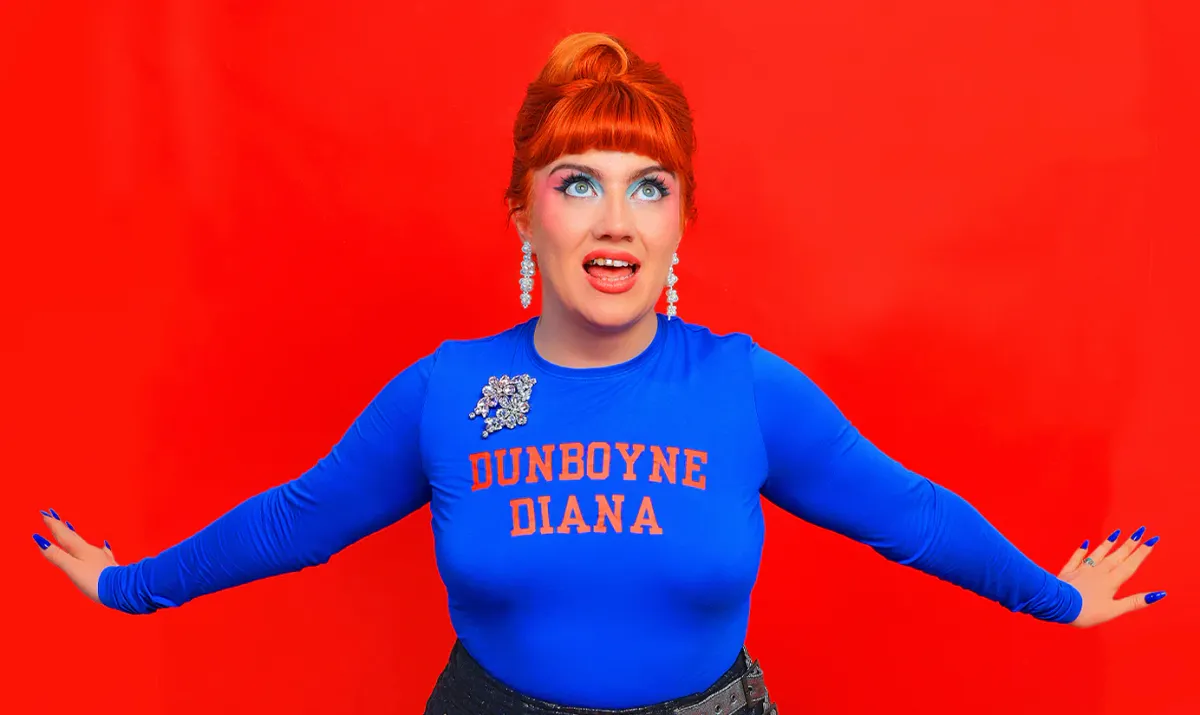
Ciara Mary-Alice Thompson is one of those couple-times-a-generation talents you’ll want to catch live while tickets are still $40 USD. They might already cost a lot more in Europe. The 30-year-old Irish singer-songwriter fits into no easy box — she harnesses Adele’s pipes, Lily Allen’s sass, Chappell Roan’s irreverence and theatrical flair. Yet none of the above orbit around country music like CMAT does, and these days her whip-crack wit might even lap the latter two.
Her set on Tuesday at Philly’s Union Transfer is the one to beat in 2026, surprise-starting from inside the crowd and making real quick connections with its members. “What is it you like about that song?” she asked Este, a signholder with a request, and later she modeled a homemade CMAT headband by one fan, Judy, ordered her a margarita from the stage, and proceeded to serve it to her a few songs later.
Thompson struck moderately choreographed poses with her expert bandmates, shook ass generously, and harmonized flawlessly with her keyboardist on said request, 2023’s “Where Are Your Kids Tonight,” before the whole band joined in, and this was not a song planned or performed for the tour at any other point.
The twixt-song banter (“wow, that’s the nicest I’ve ever been to anyone,” “nobody ever makes a sign for this song!”) could hold its own at drag bingo, and even her band introductions (drummer Hannah Morgan’s was “I just got off the phone with the Lesbian Association, they elected a new leader”) are instantly quotable.
See her. Meet her. Interview her. Do whatever you can.
The Mercury Prize-nominated singer broke through much bigger with last year’s third LP Euro-Country, and she will be well out of our league next time out. Just perhaps not in Nashville. I spoke to her via phone about that industry, as well as Irish artists' support for Palestine, and her pounding “The Jamie Oliver Petrol Station,” a dead-on masterpiece about coming to terms with one’s irrational hatred of celebrities.
This interview has been edited for length and clarity.
Daniel @ TND: I’ve been a fan since If My Wife New I’d Be Dead, and your second album came really quickly after. I’d read that you’ve sat on some of your songs for a long time. Do any of the Euro-Country songs date back pretty far?
CMAT: Oooh, yes. So I think “Ready” is a song that is, like, four years old or something. But funny, funny story about that one: I wrote that in a writing session for someone else. And then they didn't take it and it was kinda knocking around, and I didn't really wanna put it on the album. And basically everyone in my life was, like, “put it on the fucking album,” and I was like, “okay.”
Have you done a lot of writing for other people? Or attempted writing for other people?
Yeah, I have. I’ve done a lot of writing sessions for other people and it just doesn't land, but it's like a numbers game. Do you know what I mean? You just go in and you do sessions and you write and you write and write. I'm doing a lot less of that these days; I’m kinda less interested in it, to be honest. Only because my own songwriting has become so difficult to pull off, and it’s getting weirder and harder all the time. [Laughs.] So I just don’t really have any energy for anyone else. And also my work is becoming more successful, so I don't really need to.
Even from your first album, it's really hard to imagine just anyone singing those songs. There’s a lot of personality-specific things going on.
Yeah. I think that's why the writing for other people doesn't work. Because I'm like, ‘what's wrong with a line about Royal Mail?’ Or whatever the reference is. It's too specific. But I really think that songwriting lives in specificity. Like, all of the greatest songs of all time are really specific to that person, that place, that area. Like, I don't know, off the top of my head, “Chelsea Hotel #2.” That’s a classic standard song, and it’s so specific to Leonard Cohen getting head off of Janis Joplin and then her dying soon after and him being like, “oh, that's weird.” [Laughs.] Like, that's such a specific set of circumstances. And it's a classic because even though it's not “relatable,” quote-unquote, the specificity can get to actual emotions.
Right.
Not just like, “I feel sad” or “I feel happy” or “I feel weird.” It's like, “I feel confused about what the implications of this action are to my life for the next ten years.” That's how people actually behave and act.
Yeah, I cannot imagine Max Martin or someone just shopping that song around.
And I love Max Martin as well. It's just a very different proposition. I love the music of Max Martin, you're joking, I think he's the tits. But it's not what I do, you know.
You and Kneecap are two very outspoken artists about freeing Palestine. Is that a coincidence? Or is the culture very pro-Palestine in Ireland?
It's not a coincidence; it's Irish people. You know, Ireland still is under occupation. Ireland is still under British occupation, and I’m not from the North, but I have family that are and it's this kind of black cloud that you grow up with. You know, that there are people in the country that don’t live under the same laws as you for reasons that you can't understand anymore. And people who are subject to being under the guide of the crown. And it's like, 'but you’re in Ireland.' I don't want to get on a float here and be like, ‘I think people who are unionists are wrong.’ That's the way that they're brought up. But I’m a republican, I was brought up very republican. Not American Republican! [Laughs.] Irish republican.
And so when you have that cultural context, the Palestinian issue is very identifiable, and we understand exactly what's going on there. And we’re very educated about it. We were doing Palestinian fundraisers in, like, 2016, you know? This isn't a new issue for us. This is something we’ve all grown up with, and we’ve all been concerned about for years and years and years. It's just come to a horrible, horrible head. So of course, we will talk about it all the time. Of course, we’re gonna keep harping on about it. I don't see it as being controversial, and I'm not advocating for anything other than peace and other than the ending of the fucking bombardment of an entire civilization. I don't see why that's controversial.
Oh, I completely agree. Here it’s a mess as you’d imagine. Speaking of America, I’d read in Vogue that you said “Nashville hates my fucking guts” and I wasn’t sure if you were being tongue-in-cheek. Has your team actually tried marketing you to our insanely conservative country industry and gotten feedback?
Umm, yeah. I mean, look. It's an interesting one because there is some commercial country that I think is really, really brilliant. You know? I think Ella Langley and that song [“Choosin’ Texas”] is just incredible. I really love it when the biggest song in the world happens to actually be a brilliant thing. That song’s been number one for weeks and weeks and weeks for a fucking reason. It's so brilliant. But the commercial country music scene couldn't be more diametrically opposed to me and what I do and what I believe in. They’re kind of divas.
Totally.
Have you noticed this? Like, the straight men that are country music stars. They don’t interact with their fans. They don’t talk to anyone. They're kinda given a kind of platform by their record label to make themselves feel and believe that they're better than the standard population in a way that doesn't align with Irish country music values at all. Obviously, there’s an issue in terms of, like, the CMAT band is very queer and very leftist. But I would have liked to believe that regardless of that, people would understand that we all have such an unbelievably massive and earnest deep love and respect for country and western music. That's why we're here, and the baseline and the touchdown of everything that I do and make is Hank Williams and Skeeter Davis and Tammy and Loretta. I'm really deep on it.
I mean, Nashville even resisted Beyoncé. And it's funny because pop is, like, so much more welcoming of country now than Nashville is of pop. Sabrina Carpenter can just slip into country for a song or two. It doesn’t have to be the only musical team you’re on. The first thing you hear on Cowboy Carter is a sitar.
I think Beyoncé might have a much better understanding of what country music actually is than Morgan Wallen, to be honest. [Laughs.] If you’ve read any book ever about country music, you understand that it’s melting pot music. And it's a product of a million different cultures and very specific villages from all over the world coming together and sharing what they know. So, of course, the sitar belongs on a country music record. For me, that makes perfect sense.
Definitely.
And this is the thing. I think we are very deep on country music and the study of this and how it came to be, and I don't believe that a lot of the commercial country music artists are. I don’t. I’ve seen too much. I don’t. [Laughs.] Like, I've seen too much on the ground over here, and I’ve been in contact with too many of them, I'm not here to make friends. I'm here to make really good music. Like, that's my job. And I'm here to be welcoming to people that… because there’s a there’s a lot of fucking gay people that love country music.
I think it’s difficult when it's identifiable that it doesn't love you back. There's a lot of honky tonks you can’t go into if you’ve got a big fat tooth gem on your teeth and you’re ginger and you’re wearing a keffiyah or whatever. It’s not a pleasant feeling to not be welcomed into a space that is supposed to just be about the appreciation of music. It should have nothing to do with where you come from. It shouldn’t be separated by religion or creed or sexuality or any of that.
And it was definitely very satisfying to see when “Old Town Road” and Shaboozey ended up having the longest running number-one songs of all time, to stick it to that conservatism. Because so many people apparently do really love country who probably felt alienated by the orthodoxy of its culture.
Yeah. And we’ve done a festival, and we’re about to do a lot of shows with Brandi Carlisle. And that is just an amnesty for gay people that like bluegrass. They have nowhere else to go. So they go and they see the Highwomen or they go and see Brandi and those are some of the best fucking audiences we’ll ever play to, by the way. Her fan base is just the tits. They're so great. They’re so studied on music, and they really, really appreciate it. It's not just gay people there. It's people that just don’t want to be somewhere that gay people aren't allowed.
“Take a Sexy Picture of Me” is, honestly, a pretty emotional experience. It’s really rare to have lyrics that scorching and music that beautiful as, like, a double attack on the senses. How did you feel after writing it?
I felt really good. Because I knew that I’d written a song that was so poppy and so accessible that they would be forced to play it on the radio even though it is me saying that everyone who’s ever called me fat and ugly is essentially a pedophile. I thought that was really funny, and it felt really satisfying when it actually worked as well. After I wrote it, I was like,’ I bet this is gonna do really well,’ and then it did. I felt like a mastermind, like an evil genius. [Laughs.]
I love that. And like I said, I’m a fan of your earlier music, too, but Euro-Country really blew me away with the way you engage your feelings on that album. I don’t know if I’ve heard someone examine their own prejudices like "The Jamie Oliver Petrol Station" does.
Oh, well, thank you.
That song cuts really deep after what happened with Chappell Roan being blamed for whatever happened with that security guard and the soccer player’s kid.
That is a sliding scale of the same thing, really. People’s dislike for her in particular is wild. I swear she just gets on stage and sings songs, and people fucking hate her guts. It’s standard, isn't it? And I’m glad I did it in the way that I did it with Jamie Oliver. I think there’s a more painful song probably coming from me at some point about how people just hate women. Right? Like, there’s irrational hatred and prejudices of famous people because you see them too much, overexposed and they start to annoy you and kind of nag at your brain and that gets turned up to turbo speed fire fuel when that person happens to be a girl. That’s a doozy.
It's awful. You can see it happening over and over when a woman has that kind of sudden rise to fame like Chappell. I’m a big fan of Billy Nomates, and the way she was treated when she played Glastonbury I think it was…
It was Glastonbury, and it was fucking shit. It was terrible. The Billy Nomates thing was such a fucking… men trying to pull the ladder up situation. Because what happened there is she was playing the park stage, which is reserved for indie, alt-rock bands, and kind of inaccessible music. That’s kind of the park stage’s thing. And it’s predominantly covered by BBC Radio 6 Music. And what she was doing was indie/alternative rock music on a stage by herself singing to a track. And the reason for that is because her fucking band name is Billy Nomates. It’s in the fucking name.
By the way, that video? She sounds great. And she looks great. And it's a great fucking song, and it's a great performance. Basically, she's just doing something that flew in the face of what they expected so much that they decided that she wasn't allowed exist in her own artistry in the way that she thought was appropriate. And I think that’s what was so sickening about it: if it was four boys that were white wearing oversized t-shirts and playing instruments badly with songs that were a bit shit — which, by the way, is predominantly what happens — it wouldn’t even have piqued their interest. It would have flown completely over the radar, like, no one cares.
It’s funny because Sleaford Mods are friends with Billy Nomates. I’ve seen them live and it’s a fun show. But it is the one guy jumping up and down at a computer. It's not different. And you never see that kind of criticism or, I don’t know, terrorism against them.
Exactly. Exactly.
What do you think?
Show comments / Leave a comment