

In the 1930s, renowned Russian composer Sergei Prokofiev, who was also a passionate chess player, was asked if we had run out of original melodies. His response was adamant: no. To support his view, he compared music to chess, noting there were 60 million variants just leading up to the white player’s fourth move. Melodic possibilities may not be infinite, but they sure are vast.
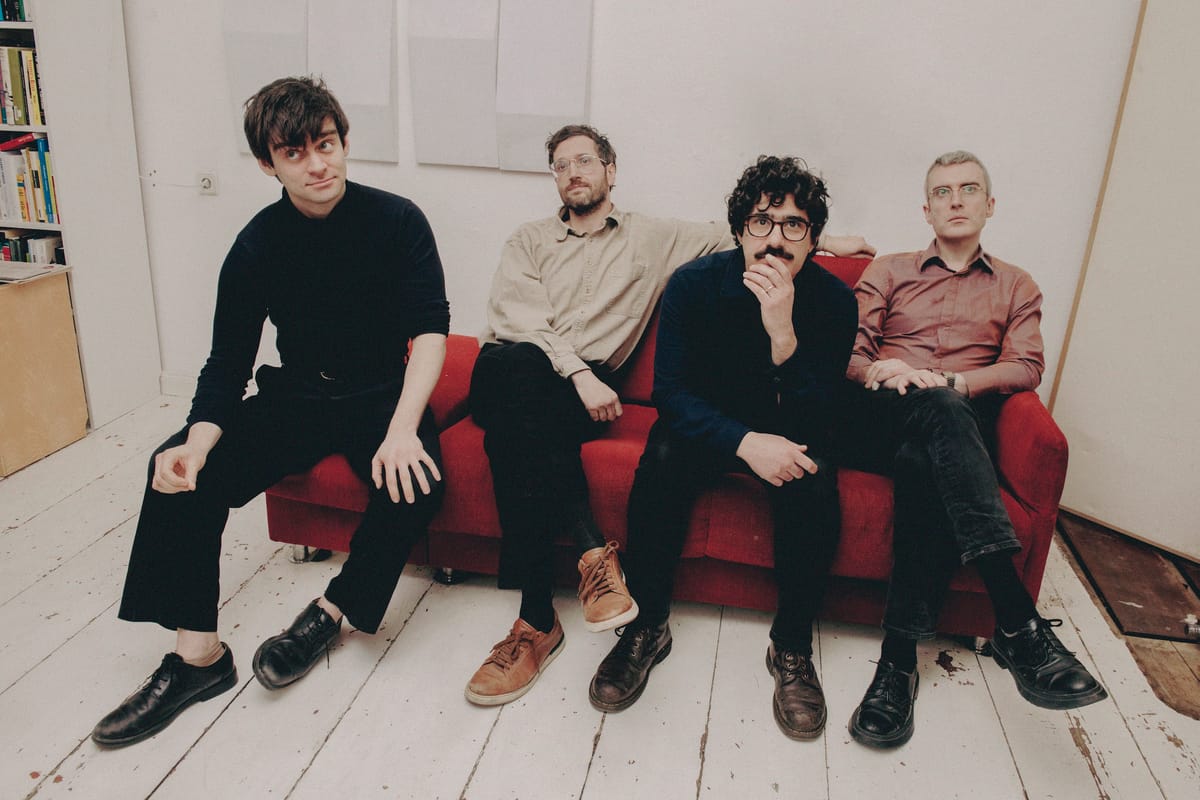
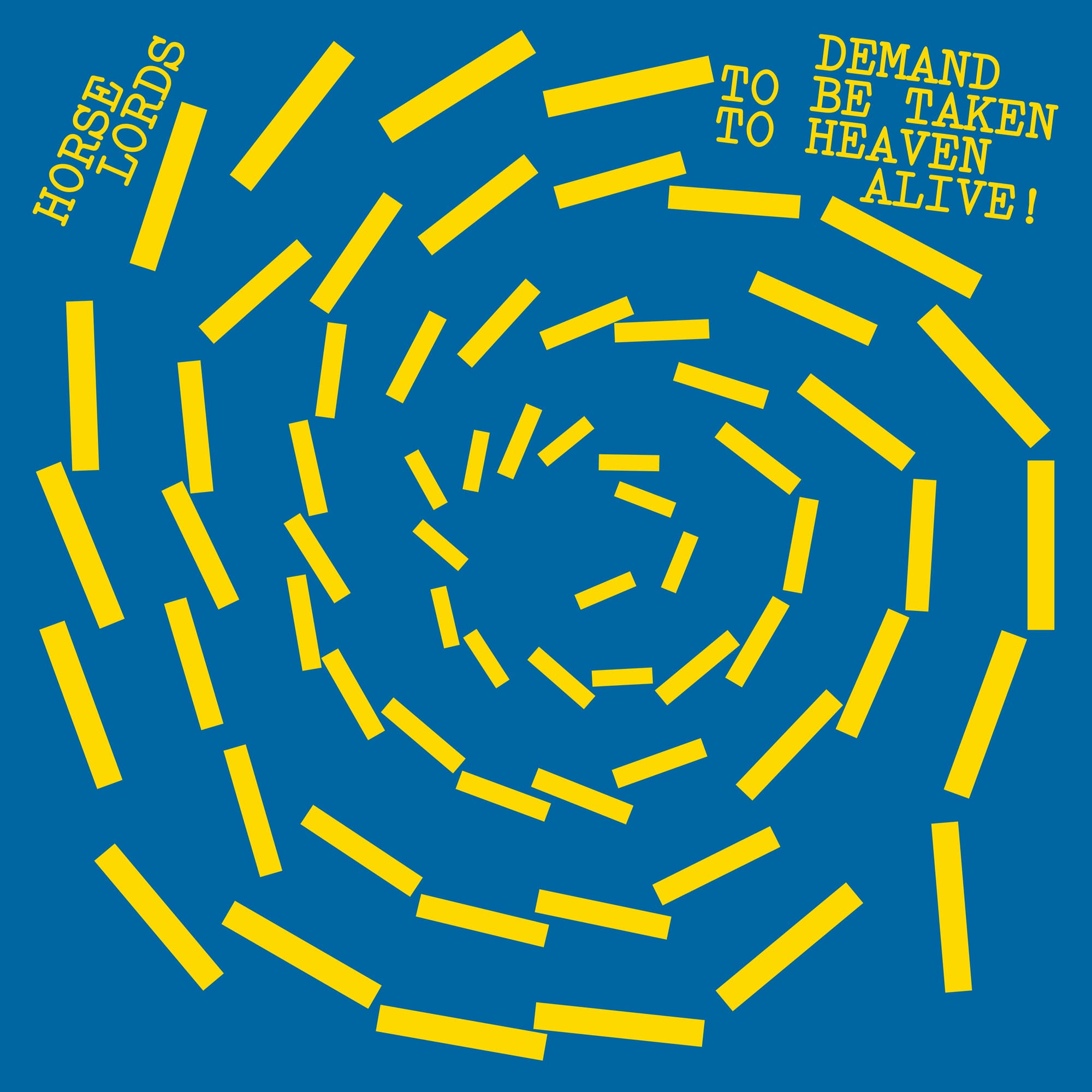
When I listen to Baltimore band Horse Lords, I get a clear grasp about what Prokofiev was trying to say. As texturally rich and well-performed as their experimental rock songs are, their most compelling trait is the compositional novelty that Andrew Bernstein, Max Eilbacher, Owen Gardner, and Sam Haberman have been able to bring together for the last 15 years – something they do with even more success on Demand to Be Taken to Heaven Alive!, their sixth album, out today on RVNG Intl.
D2BT2HA! expands on Horse Lords' affection for creating new melodies by building from a few musical themes and exploring them to the point of exhaustion. "We always try to squeeze the most out of the least amount of content. We take one idea and see how far we can stretch it – like making two pieces out of one idea just by playing it backwards," Bernstein tells me, shedding light on a process rooted in traditional compositional training.
Demand to Be Taken to Heaven Alive! is also the first Horse Lords album to be composed and recorded entirely remotely, since three of the band's members have been living in Germany since 2021. This distance has amounted to a number of new ideas and elements in the quartet's music: more electronic programming, ambient passages, and, for the first time ever in a Horse Lords albums, vocals. There's plenty to unpack.
Read the full interview with Andrew Bernstein below.
Amanda Cavalcanti: This is the first time you guys have recorded an album long-distance. How was the experience?
Andrew Bernstein: Yeah, this is the first album where it was totally done long-distance. Last year we put out a collaborative record with Arnold Dreyblatt, but that was kind of a different thing and Sam, our drummer, didn't play on that record – we had a special guest drummer, Andrea Belfi.
The last full Horse Lords album we made was Comradely Objects, released in 2022, and that was about a year after we had moved to Germany, but we recorded it together in Baltimore right before three of us moved to Germany in 2021. We did the final mixing and editing remotely for that record, but this one, from start to finish, we were never all in the same room.
Was it challenging in any new way?
It was challenging in a lot of new ways. It definitely was different, and I wouldn't necessarily want to do it again this way. But it was still kind of fun. It still felt like making music with my friends, and it had to be a lot more active and intentional.
Before, we would get together, have ideas, work through them, and maybe just play – we didn't have to talk as much about what we were doing when we could play together and listen together. And with this album, we'd talk about ideas we wanted to explore before we even started making sound, and then we started making sketches with MIDI or home recordings and sharing them with each other, and then people would add to or respond to other people's sketches. Slowly, over the course of close to a year, the music took shape. There were these sprints where there would be a lot of development.
We'd never done it this way before, so we didn't know how we were going to do it, or if it would work. But I personally had fun. When I would get a demo from my bandmates to listen to, it was like Christmas morning – I was so excited to listen to what people were coming up with and work on something in response to that, or think about how it could fit with other things we had already generated.
So it was always a collective process? It was never like, "Oh, I wrote this song, now we're going to play it"?
The band has always been a collective process, though maybe this record was, in some ways, more individualized because there was less of that live back-and-forth. There was still a back-and-forth, with each of us adding our own mark to it, but there was less live back-and-forth just because we couldn't be in the same room.
And how did the idea of having vocals emerge? It was the first time you had vocals on an album, right?
Yeah, it's the first time we've had singers singing words. We've done some stuff with spoken word in the past, and some stuff with singers just singing tones like another instrument, but this is the first time where there are singers singing an actual song.
Owen, the guitar player in the band, has been involved in Sacred Harp shape-note singing for a long time. It's an American musical tradition that became widespread and popular in the 19th century, though maybe it dates back to the 18th century. There was a song he wanted to explore – the one sung at the beginning that recurs throughout the album. Sometimes the tradition is referred to as shape-note singing or Sacred Harp singing, with "The Sacred Harp" being the songbook that groups sing from.
We used only one verse from it. A lot of the original text is devotional and talks about God in explicit terms, but the text from the verse we chose resonated with ideas we wanted to explore. So we took the melody, and the first track on the record is essentially that verse being sung. The melodic material from the piece then comes back in different forms throughout the record, both with the singers and the instruments. We arranged and transformed it in different ways, which was really generative for composing.
So the idea was to use this song, have singers, and have it function almost like a Greek chorus commenting on the music happening in between tracks.
Listening to it, it feels like this album might use the most electronic elements you've ever included, or do you disagree?
No, it probably is. There have always been electronic elements in the mix to varying degrees, but it is certainly more integrated on this album. I feel like that’s been a steady progression over the years, going from electronics being just things that happen in between the band pieces to being integrated into the music itself, playing at the same time we are.
There are the more abstract electronics, but there are also straight MIDI parts that were programmed in. That's the first time we've done that, which is maybe an artifact of the recording process since we were not all together. We figured we might as well just program those parts, and I don't have any qualms about that. We also used some electronic instruments that we just programmed in.
With all the recent discourse around AI-generated music, a lot has been said about "human music" and what makes music human as opposed to AI-generated. Sometimes people fall into the trap of thinking if something is acoustic it's human, and if it's electronic it's not. What is it for you and the band that makes music human?
For me, and I think for the band, the experience of making music is why I do it. I don't have a lot of experience with AI music, listening to it or making it, but when you prompt a piece of music, you're not actually doing it. Music is an action; it's a thing that you do, not just a thing that you listen to. Prompting a song totally short-circuits that whole process–music as a verb.
Whether you can tell the difference between artificially generated AI music or not doesn't really concern me. I'm sure there are economic questions with pretty evil implications, but that's just capitalism. I don't think a lot of people are listening to AI music seriously anyway; it's just fun to make a silly song as a gag, like having a famous person sing nonsensical words. The act of making music and the community that forms around it are what's important to me, and AI music lacks both of those things.
Speaking of politics and economics, did politics have anything to do with your decision to move out of the US, or was it purely a professional move?
It wasn't the only or main reason, but it was certainly in our heads. We moved in 2021, well after Donald Trump was no longer president, so things felt a bit different, though they weren't great anyway. And now he’s president again.
I'm happy not to be living in American cities right now, especially with ICE raids still happening. Earlier this year was crazy, with places like Minneapolis under siege, and all of that is still ongoing. There have certainly been moments where I thought to myself that I'm really happy not to be living in an American city, and that my kids don't have to worry about seeing people get grabbed out of school. So I'm glad I don't have to worry about that in my immediate physical reality, but at the same time, I'm American. That's my home, and when bad things happen there, I don't feel better about it just because I'm not there.
Does any of that find its way into the album, consciously or unconsciously?
We're always thinking about what our music means in the world. Since we've made mostly instrumental music up until now, we think a lot about the song titles and what kind of story you can tell with them. They carry more weight since there are no words to grab onto in the sonic content itself.
The lyrics we used for the songs say, "We have no abiding city, we seek a city yet to come." It's hopeful, but it also acknowledges that we're living in a harsh reality. You have to be imaginative about the future because there's no other way. All we have is a city yet to come – all we have is the future, really.
There is a theme of returning to the same musical moments and vocal themes. How did the idea of coming back to those same musical phrases come about?
We mostly make albums, as opposed to just individual tracks, so we look for ways to tie everything together so it feels like a cohesive document, rather than just a collection of songs. Even beyond the recurring vocal motifs and the repetition of a track like "Eureka," we wanted from the very beginning to take musical material, twist it, and listen to it differently. That's where the idea of "rotation" came from–rotating a musical idea to look at and listen to it from a different perspective.
There's a lot of that on the album; different songs might share the same drum beat, or the same beat minus one count. That gives it a totally different feel, especially when superimposing different instrumental parts on top. We always try to squeeze the most out of the least amount of content. We take one idea and see how far we can stretch it – like making two pieces out of one idea just by playing it backwards. That aligns with traditional compositional training: doing it backwards, slowing it down, speeding it up, or inverting the relationships. It's all in service of giving the album a cohesive sound.
Demand to Be Taken to Heaven Alive! is out now via RVNG Intl. Stream/order it here.

What do you think?
Show comments / Leave a comment