
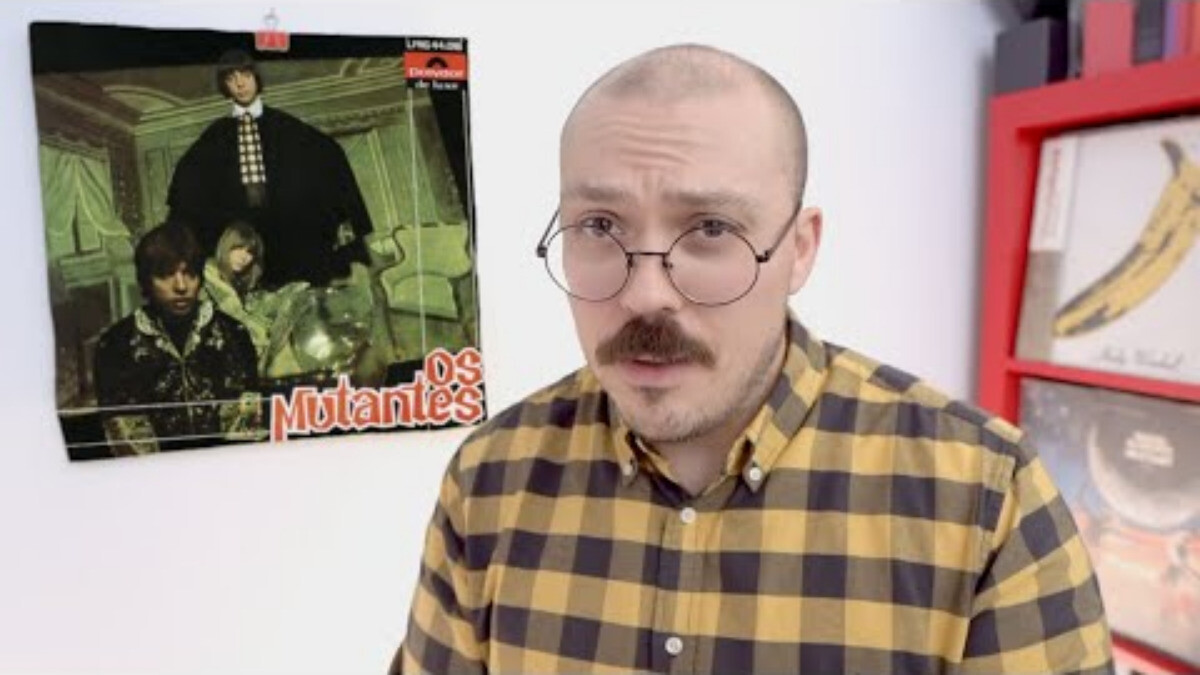
Hi, everyone. Hot-thony Flash-tano here, the internet's busiest music nerd. It's time for a review of this debut self-titled album from Os Mutantes, the classic 1968 record from this pioneering, Brazilian rock outfit.
Game-changers who boldly fused the sounds of Brazilian popular music in the '60s with the psych rock aesthetics that were dominating the USA and UK at the time, resulting in this tropical, psychedelia, Tropicalia movement that held up into the '70s and still inspires new bands today. Mutantes themselves continue to release albums from here for years, expand the group, change members here and there.
But the Tropicalia wave in general, was pretty wild for its time. It all culminated into a scene, a sound, and messaging that angered a lot of conservatives, along with the military government, too. Back in the day, Os Mutantes themselves even played shows where they were booed, had things thrown at them, just for being too wild and experimental and out there.
Now, they originally formed as a trio in São Paulo in 1966 with brothers, Sergio Dias and Arnaldo Baptista, adding singer Rita Lee into the mix as well. They eventually settled on the name Os Brujos, which translates to "the witches". But then they were deemed Os Mutantes by singer-songwriter Ronnie Von, right before going on a TV show the same year they formed.
The band's early days also saw them collaborating operating pretty frequently with singer-songwriter and later politician Gilberto Gil, a successful and highly influential Brazilian artist in his own right, who is most definitely worthy of a classic review down the road. And with Gil, they helped to further define this Tropicalia wave, working on music together and also facing threats from the government of exile.
But by the time Os Mutantes got around to recording this album in '67, along with their own original material, they incorporated covers from François Hardy, The Mamas and the Papas, and material from their Brazilian contemporaries, too. And while the band's delivery of these tracks is no doubt creative and skilled and detailed, the final result also definitely lives up to the name Os Mutantes, as we get all of these mutant spins on the zany psychpop theatrics that you'd catch on Sgt. Peppers and the like, for example, which were already weird for their time, mind you.
But Os Mutantes still still saw a lot of wiggle room to make things noisier, more unhinged and left-field. Especially on the opening track, which opens up with these ceremonial horn sections and suddenly segues into these lackadaisical passages of melty, and sometimes droney, horns and bass, vocal harmonies, too. It all takes on a more trippy and orchestral vibe as it continues, until it suddenly slows down, like the tape machine that's being recorded on breaks, only for the band to return with one more epic finale, that's eventually interrupted by what is played up to be a very chaotic field recording from a restaurant dining room.
Things get even more straightforward and rocking on the following "A Minha Menina", whose brittle and buzzing guitar leads make a very stark contrast from the super warm, sunny vocal harmonies all over the track. The booming bass and drums hit quite a groove, too, and are very fat and large and envelop the rest of the instrumentation. It's very catchy, citrus-flavored psych, and I love the intentional details as much as I enjoy clearly what are a lot of performance blemishes and some less than pristine tape edits, all of which add to the character and chaos of this recording.
The following "The Clock" is a Rita Lee-led song, a very skeletal guitar and vocal number that's eerily beautiful and very atmospheric. That is until the song explodes into this complete psych freak-out with these "oochah, oochah, oochah" chants; some relentless drums too; super pitchy, ear-piercing leads; and all matter of guitars just bleeding into each other violently, which too eventually fade away in favor of the same strange guitars that open the song up.
Then "Adeus Maria Fulô" is a very interesting change of pace in the tracklist, not only because the band is doing a version of a popular Brazilian folk tune on this one, but it's also not as rock-flavored as many other songs in the tracklist here. It's actually a drum-heavy xylophone jam that that sounds like it came from the thick of the Amazon jungle, with some very snappy refrains.
One of the catchiest tracks here, only surpassed a little bit by moments like "Baby", which is like Mutantes' own twisted but still strangely beautiful take on a doo-wop tune. And this track was originally a Gal Costa tune, mind you. Think The Penguins' "Earth Angel", but with overwhelming vocal harmonies and guitar leads that are just absolutely tinny and fried with distortion. I just can't get enough of the band's impassioned calls of "baby, baby" on the track.
But just when you thought the band had completely exhausted their range and their repertoire, we get "Senhor F", which is this pop show tune. I love that the band had the ability to pull something like this off with these super showy saloon pianos, drunken trombones. The mixing and performance creates more commotion than harmony among the instrumentation, and it really plays to the funny and sarcastic attitude the band is clearly going into the song with.
Because despite what is going to be, for many, a language barrier and also maybe a lack of context for the time period and the culture in which Os Mutantes was born, I would still hope the uniqueness of their sound, the absurdity of their energy, still comes through.
Especially on "Bat Macumba", which is this hand-drum heavy psych rock jammer with lots of stuttering, fluttering guitar leads. The song also functions on what is a pretty hilarious lyrical experiment where the group is singing this "Bat Macumba, hey, hey" line over and over. But as it gets repeated, it gets shorter and shorter in syllables until the line is just reduced to the syllable "ba", and then from there it gets longer, once again, until it reaches its full form, resulting in a lyrics sheet that looks like this.
After this, we get a take on a track popularized by François Hardy, "Le Premier Bonheur Du Jour", and Mutantes bring a dreamy, glossy spin to this track that could go toe-to-toe with the bliss of songs like Velvet Underground's Sunday Morning. But the performance and instrumentation here gets progressively more and more sour, until it lands in nightmarish territory at its finish.
The rock influences seat back in on "Trem Fantasma", which is this wild journey of super expressive vocals, woodwinds and drums, guitars too, and the energy of the track makes sense given that it's titled after an amusement park ride that has a horror angle to it. The lyrics describe this guy and his girlfriend getting a ticket to ride, and once they're on there, dealing with all of these very surreal and freaky occurrences. The song also features a lot of weird little instrumental switch-ups and passages that complement the parts of the story that they're sitting underneath.
That Mamas and Papas track that I alluded to earlier shows up next in the tracklist, the band's version of "Once Was a Time I Thought", which is titled here "Tempo No Tempo". It's a short track in the tracklist, the original is short, too. It's really more of a stripped-back vocal piece. But nonetheless, Mutantes do some interesting stuff with it, opting instead for a sound that is backed with these really huge blaring horns. The original version of the song has a very tight and specific flow to its lyrics as well, which Mutantes somehow nail almost perfectly in Portuguese.
Then the closing "Ave Gengis Khan" is a really rowdy jam. Some slick pianos on this one, syncopated scatting. All of which are laced with some interesting tape experiments here and there, either with vocals or what sounds like maybe audio from an opera that's playing in the background or something, around the midpoint. It's a very lively way to take the record out for sure.
But yeah, going back to this album, it's funny how still after all of these years, how many of the ideas, mixes, and instrumental arrangements are still so bold and interesting, especially in an age where I feel like modern streaming and music technology has pushed artists in a direction where they are creating music that is not only more simplified, but also overly-perfected in terms of how it's assembled in the multitrack. Meanwhile, this record over here is almost 60 years old at this point, and most of it sounds like an insane burst of color in comparison to what's in the top 40 today.
While that is disheartening and sad to see, simultaneously, I am encouraged by the fact that Os Mutantes made the music that they did in a time, in a context, socially, where the world around them was absolutely working against their success, and yet they somehow still persevered and made a record that decades later still sounds bold, exciting, and interesting, which is why it is a classic.
Anthony Fantano, Os Mutantes, Forever.

![This Week in TikTok Music: เพลงอร่อยมาก TORWAI [Delicious Rock]](/content/images/size/w600/2026/04/This-Week-s-Releases--4---1-.png)
What do you think?
Show comments / Leave a comment